
Mechanical CADD in 2026: Powering the Future of Intelligent Design and Engineering
Engineering has entered a new era where speed, accuracy, and innovation define success. Industries no longer rely on manual drafting boards or isolated design systems. Instead, they demand intelligent tools that connect ideas with production in real time. Mechanical CADD Future 2026 stands at the center of this transformation. It enables engineers to design complex machines, simulate performance, and refine concepts before production begins. As industries adopt automation, smart manufacturing, and digital twins, Mechanical CADD becomes more relevant than ever. In 2026, organizations that master Mechanical CADD gain a strong competitive edge. They reduce errors, accelerate product cycles, and deliver high-quality results. This blog explores what Mechanical CADD means today, how it evolved, and why it matters profoundly in 2026.
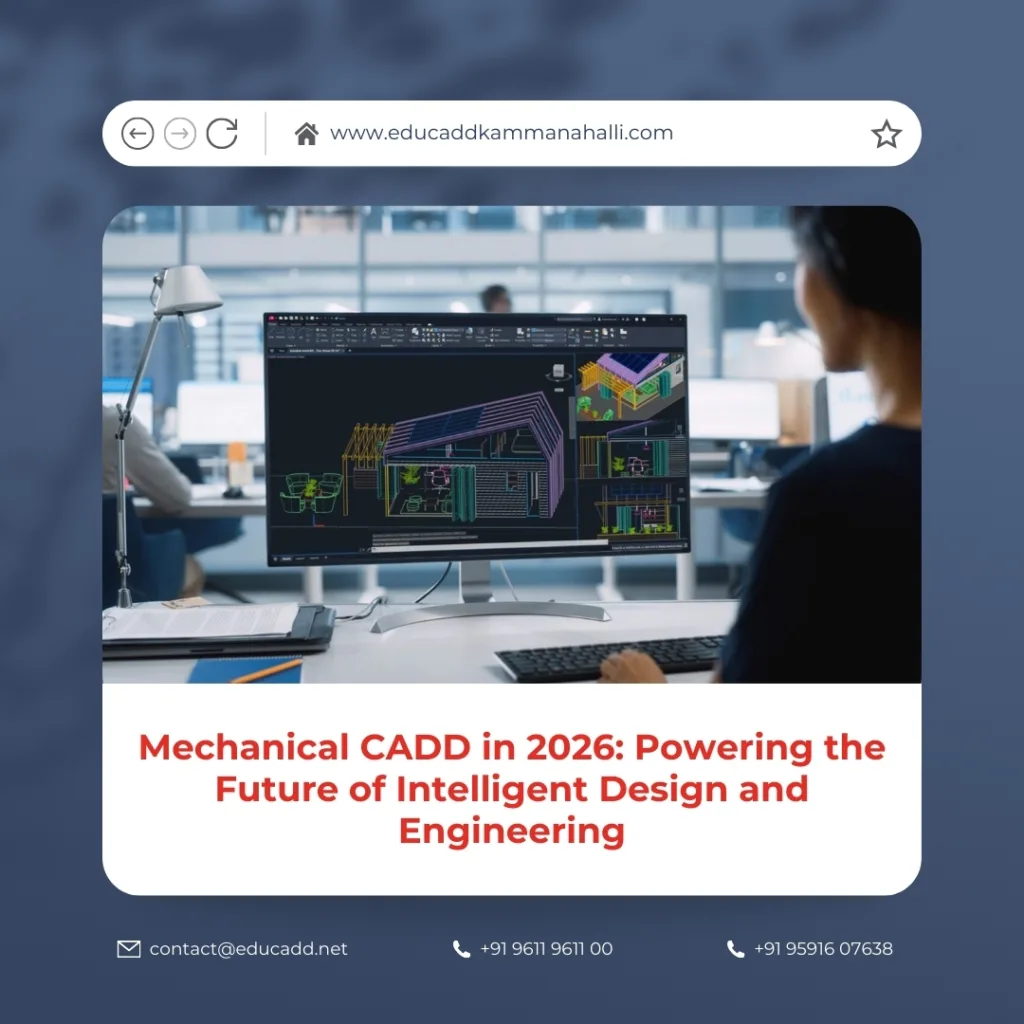
Mechanical CADD Future 2026
1. Understanding Mechanical CADD
Mechanical CADD Future 2026 refers to Computer-Aided Design and Drafting tools specifically built for mechanical engineering applications. It allows engineers to create detailed 2D drawings and 3D models of machines, components, and assemblies. These tools replace manual drafting methods and introduce precision, automation, and flexibility. Engineers use Mechanical CADD to define dimensions, materials, tolerances, and mechanical relationships. As a result, design teams visualize products before manufacturing begins.
Moreover, Mechanical CADD integrates geometry, physics, and manufacturing data into one digital environment. Designers can modify dimensions instantly without redrawing entire layouts. This efficiency saves both time and resources. In 2026, industries demand rapid product development, and Mechanical CADD delivers that capability. It bridges creativity with engineering logic and ensures consistent documentation across teams. Therefore, understanding Mechanical CADD is essential for anyone entering mechanical engineering today.
2. The Evolution of Mechanical CADD
Mechanical CADD has evolved dramatically over the last three decades. Early systems focused on simple 2D drafting functions. Engineers used them mainly to replicate manual drawings in digital form. However, technology advanced quickly. Developers introduced parametric modeling, 3D visualization, and simulation tools.
Today, Mechanical CADD offers integrated design ecosystems. Engineers build intelligent models that update automatically when parameters change. This evolution has reduced design errors and improved collaboration. Furthermore, cloud connectivity now allows teams to access projects from different locations. In 2026, Mechanical CADD continues to evolve through artificial intelligence and automation. These innovations suggest that the future of engineering depends heavily on advanced CADD platforms. The journey from simple drafting to intelligent modeling proves how essential Mechanical CADD has become.
3. Core Features of Modern Mechanical CADD
Modern Mechanical CADD software includes powerful features that enhance design quality. Parametric modeling allows engineers to define relationships between components. When one dimension changes, related elements update automatically. This feature prevents inconsistencies.
Additionally, 3D solid modeling helps teams visualize products realistically. Engineers can rotate, section, and inspect components from any angle. Simulation tools evaluate stress, motion, and thermal performance. These capabilities reduce physical prototypes and testing costs.
Mechanical CADD also supports assembly modeling. Designers test how multiple parts interact within a machine. They detect interference issues early in the design stage. Furthermore, detailed drafting tools generate manufacturing drawings directly from 3D models. These features demonstrate why Mechanical CADD remains indispensable in 2026.
4. Role of Mechanical CADD in Smart Manufacturing
Smart manufacturing relies on digital integration. Factories now use automated systems, robotics, and real-time monitoring. Mechanical CADD plays a critical role in this environment. Engineers create precise digital models that feed directly into manufacturing equipment.
For instance, CNC machines use design data generated from Mechanical CADD files. This direct integration reduces translation errors. Moreover, digital twins replicate physical machines in virtual space. Engineers test performance scenarios without halting production.
In 2026, industries prioritize efficiency and accuracy. Mechanical CADD ensures seamless communication between design and production. It supports data-driven decisions and accelerates innovation cycles. Consequently, companies investing in Mechanical CADD strengthen their smart manufacturing strategies.
5. Integration with Simulation and Analysis
Engineering success depends on validation. Mechanical CADD integrates advanced simulation tools that analyze structural integrity, fluid flow, and motion behavior. Engineers test designs virtually before production begins.
Finite element analysis predicts stress distribution under various loads. Motion studies evaluate mechanical movement and detect possible collisions. Thermal simulations measure heat transfer efficiency. These analyses help engineers refine designs early.
Because of this integration, Mechanical CADD reduces costly design revisions. Teams can experiment freely without physical prototypes. In 2026, simulation-driven design becomes standard practice. Mechanical CADD provides the platform that supports this methodology effectively.
6. Impact on Product Development Speed
Time-to-market determines competitive advantage. Companies that launch products faster capture market share quickly. Mechanical CADD significantly shortens development cycles.
Designers can modify models instantly. Automated documentation reduces manual drafting time. Collaboration tools allow multiple engineers to work simultaneously. These improvements accelerate workflows.
Furthermore, Mechanical CADD Future 2026 supports rapid prototyping through 3D printing compatibility. Engineers export models directly for prototype creation. This seamless process speeds up testing and iteration. In 2026, industries cannot afford slow development. Mechanical CADD ensures agility and responsiveness in product design.
7. Collaboration and Cloud Connectivity
Engineering teams often work across different locations. Mechanical CADD now includes cloud-based collaboration features. Designers share models in real time and track revisions efficiently.
Version control prevents confusion and data loss. Stakeholders review models without installing complex software. This accessibility enhances communication between engineers, clients, and manufacturers.
In 2026, remote work continues to expand. Mechanical CADD supports distributed teams and global partnerships. It creates a centralized design environment where everyone contributes effectively. Therefore, collaboration tools make Mechanical CADD even more valuable in modern engineering.
8. Mechanical CADD and Industry 4.0
Industry 4.0 emphasizes automation, connectivity, and intelligent systems. Mechanical CADD aligns perfectly with these principles. It generates digital models that integrate with IoT devices and analytics platforms.
Engineers use Mechanical CADD data to optimize machine performance. Sensors provide feedback, and designers adjust models accordingly. This continuous improvement cycle increases productivity.
Moreover, data integration enhances predictive maintenance strategies. Engineers simulate wear and tear scenarios. They improve component durability before failures occur. In 2026, Industry 4.0 initiatives rely heavily on accurate digital models. Mechanical CADD provides the foundation for these innovations.
9. Career Opportunities in Mechanical CADD
Mechanical CADD skills open diverse career paths. Industries such as automotive, aerospace, construction, and manufacturing demand skilled professionals. Engineers, design analysts, and CAD technicians all use Mechanical CADD daily.
In 2026, employers prioritize candidates with strong modeling and simulation skills. Knowledge of Mechanical CADD improves employability significantly. Professionals who master advanced features gain higher salary potential.
Furthermore, freelancing and remote opportunities continue to grow. Many companies outsource design projects globally. Mechanical CADD expertise allows professionals to work independently while delivering high-quality designs. Therefore, investing in Mechanical CADD training creates long-term career stability.
10. Mechanical CADD in Sustainable Engineering
Sustainability influences every engineering decision in 2026. Companies aim to reduce waste and improve energy efficiency. Mechanical CADD supports sustainable design practices effectively.
Engineers simulate material usage and optimize component weight. Lightweight designs reduce fuel consumption in transportation systems. Additionally, lifecycle analysis tools evaluate environmental impact.
By using Mechanical CADD, teams minimize material waste during production. Virtual testing prevents unnecessary physical prototypes. These practices conserve resources and lower costs. Sustainable innovation depends on precise planning, and Mechanical CADD enables that precision.
11. Artificial Intelligence in Mechanical CADD
Artificial intelligence transforms design workflows. Modern Mechanical CADD platforms integrate AI-driven suggestions and automation tools. These features recommend optimal design parameters based on historical data.
Engineers receive real-time alerts for potential design conflicts. Automated geometry generation accelerates concept development. AI also assists in topology optimization, improving structural efficiency.
In 2026, AI integration makes Mechanical CADD more intuitive and intelligent. Designers focus on creativity while software handles repetitive tasks. This synergy increases productivity and innovation simultaneously.
12. Challenges and Skill Requirements
Despite its advantages, Mechanical CADD requires technical proficiency. Beginners must understand engineering principles before mastering advanced tools. Complex assemblies demand attention to detail.
Moreover, rapid software updates require continuous learning. Engineers must adapt to new features regularly. Strong analytical thinking enhances simulation accuracy. Communication skills also matter, especially in collaborative projects.
However, these challenges encourage professional growth. With proper training and practice, individuals can master Mechanical CADD effectively. In 2026, adaptability becomes a core competency in engineering careers.
13. Mechanical CADD in Education and Training
Educational institutions now prioritize digital design skills. Mechanical CADD training prepares students for real-world engineering tasks. Practical projects help learners understand modeling techniques deeply.
Hands-on experience builds confidence and technical accuracy. Students learn drafting standards, assembly modeling, and simulation analysis. Many programs also include industry-oriented case studies.
In 2026, technical education aligns closely with industry needs. Mechanical CADD bridges academic knowledge with professional practice. Graduates who understand Mechanical CADD enter the workforce with strong competitive advantages.
14. Why Mechanical CADD Matters More Than Ever in 2026
Mechanical CADD Future 2026 because industries demand precision, speed, and digital integration. It supports smart manufacturing, sustainable engineering, and AI-driven design. Companies rely on it to maintain quality standards and reduce operational risks.
Furthermore, Mechanical CADD strengthens collaboration across global teams. It accelerates innovation while minimizing errors. As digital transformation expands, mechanical engineers depend heavily on advanced CADD systems.
The future of engineering revolves around intelligent modeling and simulation. Mechanical CADD remains at the center of this transformation. Organizations that adopt it strategically position themselves for long-term success.
Conclusion
Mechanical CADD Future 2026 has transformed mechanical engineering from manual drafting to intelligent digital design. It empowers engineers to visualize, analyze, and optimize products before production begins. In 2026, industries operate in fast-paced, technology-driven environments where accuracy and efficiency define growth. Mechanical CADD supports smart manufacturing, sustainability, AI integration, and global collaboration. Moreover, it enhances career opportunities and strengthens competitive advantage. As engineering challenges grow more complex, Mechanical CADD provides the tools needed to solve them confidently. Therefore, mastering Mechanical CADD is no longer optional. It is essential for shaping the future of engineering innovation.

