
Mechanical Design and Drafting Certification Course: Build Industry-Ready Skills for a Successful Engineering Career
The engineering industry continues to evolve with modern technologies, advanced manufacturing methods, and intelligent design solutions. Companies now expect professionals to possess strong technical knowledge along with practical software skills. As industries adopt automation and digital product development, the demand for skilled mechanical designers has increased significantly. This shift has created exciting career opportunities for students, diploma holders, graduates, and working professionals who wish to build a rewarding future in mechanical engineering. A Mechanical Design Drafting Certification Course equips learners with the practical knowledge and technical expertise required to create accurate engineering drawings, 3D models, product assemblies, and manufacturing documentation. Unlike traditional classroom learning, this certification focuses on real-world applications that match industry standards. Students gain hands-on experience with leading CAD software, understand engineering principles, and learn how to solve practical design challenges.
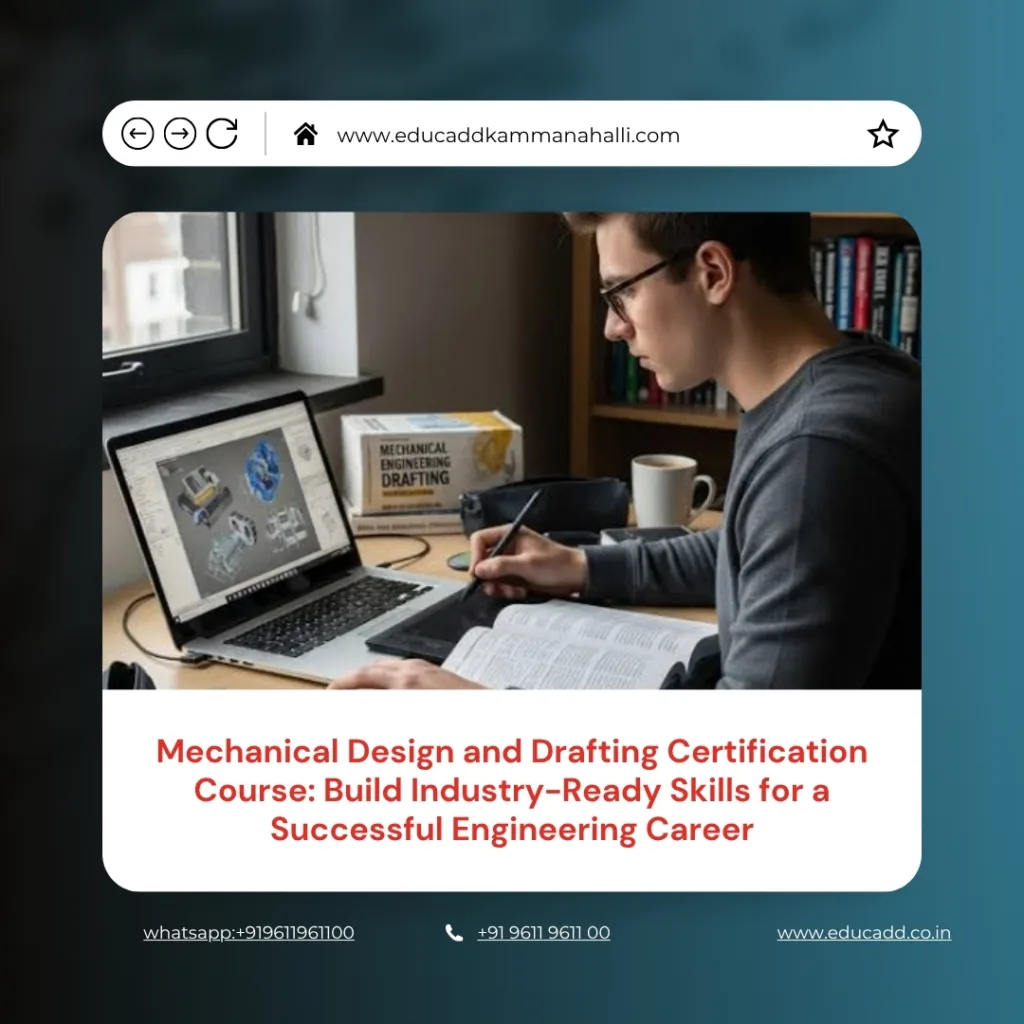
Mechanical Design Drafting Certification
Whether you want to secure your first engineering job, improve your existing skills, or transition into a specialized design role, enrolling in a Mechanical Design Drafting Certification Course can significantly improve your career prospects. The following sections explain why this course has become an essential qualification for aspiring mechanical design professionals.
Master the Fundamentals of Mechanical Design
Every successful engineer begins with a strong understanding of mechanical design principles. Before working on complex industrial projects, learners must understand the basics of engineering drawing, machine components, dimensioning, tolerances, and manufacturing processes.
A Mechanical Design Drafting CertificationMechanical Design Drafting Certification introduces students to these essential concepts in a structured manner. Instead of memorizing theories, learners apply their knowledge through practical exercises and design assignments. They understand how individual components function together within larger mechanical systems.
Moreover, students learn international drafting standards, drawing conventions, projection methods, section views, and assembly drawings. These concepts improve design accuracy while preparing learners for industrial work environments. Since employers value engineers who understand design fundamentals, mastering these skills creates a strong foundation for long-term career growth.
Develop Expertise in Industry-Leading CAD Software
Modern engineering organizations rely heavily on Computer-Aided Design software for product development. Engineers rarely create drawings manually because digital tools offer greater precision, flexibility, and efficiency.
A comprehensive Mechanical Design Drafting Certification trains students in popular software such as AutoCAD, SolidWorks, CATIA, Creo, Siemens NX, and Autodesk Inventor. Each software application serves different industrial requirements, making software proficiency a valuable asset.
Students practice creating 2D drawings, 3D models, sheet metal components, assemblies, exploded views, and manufacturing drawings. Furthermore, they learn to modify designs quickly, generate detailed documentation, and collaborate efficiently with production teams.
As a result, graduates become comfortable working with software commonly used across automotive, aerospace, manufacturing, heavy engineering, and industrial equipment sectors.
Gain Practical Experience Through Real-Time Projects
Technical knowledge alone does not guarantee career success. Employers consistently look for candidates who can apply their learning in practical situations. Therefore, project-based training plays an essential role in skill development.
A quality Mechanical Design Drafting Certification emphasizes hands-on learning through industry-oriented projects. Students design machine parts, mechanical assemblies, production fixtures, industrial equipment, and complete product models.
These practical assignments help learners understand real engineering challenges while improving problem-solving abilities. Additionally, students become familiar with design modifications, client requirements, production limitations, and quality standards.
Working on live projects also strengthens confidence because learners experience the complete design process from concept development to final documentation.
Understand Manufacturing Processes and Product Development
Mechanical designers do much more than prepare engineering drawings. They also contribute to product development by considering manufacturing methods, material selection, production costs, and product functionality.
A Mechanical Design Drafting Certification introduces students to various manufacturing techniques, including casting, forging, machining, welding, fabrication, injection molding, and additive manufacturing.
Understanding these processes allows designers to create practical components that manufacturers can produce efficiently. Consequently, learners develop designs that reduce production costs while maintaining product quality.
This combination of design and manufacturing knowledge makes certified professionals more valuable in today’s competitive engineering industry.
Improve Precision Through Geometric Dimensioning and Tolerancing
Accuracy is one of the most important aspects of mechanical engineering. Even a small error in dimensions can lead to production delays, assembly issues, or complete product failure. Therefore, industries expect designers to prepare drawings that communicate every specification clearly and accurately.
A Mechanical Design Drafting Certification provides detailed training in Geometric Dimensioning and Tolerancing (GD&T). Students learn how to define dimensions, specify tolerances, control form, orientation, profile, and runout according to international engineering standards. These skills help manufacturers produce parts that fit together perfectly.
In addition, learners understand the importance of surface finish symbols, welding symbols, fits and clearances, and engineering notes. Since these details directly influence manufacturing quality, mastering them makes students more reliable and industry-ready. Employers value professionals who can prepare drawings that reduce errors and improve production efficiency.
Strengthen Problem-Solving and Analytical Thinking
Mechanical design is not simply about creating attractive models. Designers must analyze engineering problems and develop practical solutions that meet functional, manufacturing, and economic requirements.
A Mechanical Design Drafting Certification encourages students to think logically while solving real engineering challenges. During project work, learners evaluate multiple design options before selecting the most effective solution. They also consider factors such as material strength, weight reduction, production feasibility, maintenance, and product performance.
Furthermore, students develop analytical thinking by reviewing design failures, identifying improvement opportunities, and optimizing existing components. This approach builds confidence and prepares learners to work independently in professional engineering environments.
As industries continue to innovate, engineers with strong analytical abilities remain in high demand because they contribute to continuous product improvement and operational efficiency.
Create a Professional Portfolio That Impresses Employers
Technical interviews often focus on practical work rather than academic marks. Recruiters prefer candidates who can demonstrate their design capabilities through completed projects and engineering documentation.
A well-designed Mechanical Design Drafting Certification helps students build an impressive professional portfolio throughout the training period. Instead of completing only theoretical assignments, learners develop detailed CAD models, assembly drawings, production drawings, and design reports that showcase their technical abilities.
Moreover, each completed project reflects the student’s understanding of engineering principles and software proficiency. A strong portfolio allows candidates to confidently explain their design process during interviews while proving their practical expertise.
This professional presentation significantly improves job prospects because employers can immediately evaluate the candidate’s capabilities through real engineering work.
Explore Diverse Career Opportunities Across Industries
Mechanical design professionals enjoy opportunities across multiple industrial sectors. Manufacturing companies, automotive firms, aerospace organizations, construction equipment manufacturers, industrial machinery producers, energy companies, and consumer product manufacturers all require skilled mechanical designers.
Completing a Mechanical Design and Drafting Certification Course opens doors to numerous career paths, including Mechanical Design Engineer, CAD Design Engineer, Drafting Engineer, Product Design Engineer, Tool Design Engineer, Industrial Design Technician, Manufacturing Design Engineer, and Production Support Engineer.
Furthermore, professionals with strong CAD expertise can also work in research and development departments, engineering consulting firms, automation companies, and multinational corporations. Since design skills remain essential across industries, certified professionals benefit from greater career flexibility and long-term job security.
As technology advances, companies continue investing in digital engineering solutions, creating consistent demand for skilled mechanical design specialists.
Stay Updated with Modern Engineering Technologies
Engineering technology evolves rapidly. New software tools, intelligent manufacturing systems, simulation technologies, and digital workflows continue transforming product development processes worldwide.
A modern Mechanical Design and Drafting Certification Course introduces learners to current industry practices, helping them remain competitive in today’s engineering landscape. Students become familiar with concepts such as parametric modeling, design automation, digital prototyping, simulation, reverse engineering, and collaborative product development.
Additionally, many training programs include exposure to Product Lifecycle Management (PLM), Computer-Aided Manufacturing (CAM), and Computer-Aided Engineering (CAE), allowing learners to understand the complete product development cycle.
Keeping pace with these advancements ensures that certified professionals remain valuable contributors as industries adopt smarter manufacturing technologies and digital engineering solutions.
Develop Professional Communication and Team Collaboration Skills
Successful mechanical designers rarely work alone. Most engineering projects involve collaboration with production engineers, quality inspectors, project managers, procurement teams, and clients. Therefore, communication skills play a vital role in project success.
A Mechanical Design and Drafting Certification Course helps students improve both technical and professional communication. Learners present design concepts, explain engineering decisions, prepare documentation, and participate in collaborative project discussions.
Furthermore, students learn how to interpret client requirements, respond to design revisions, and coordinate with multidisciplinary teams. These experiences improve workplace readiness while strengthening interpersonal skills.
Employers appreciate professionals who communicate clearly because effective collaboration reduces misunderstandings, speeds up project completion, and improves overall productivity. Strong communication abilities, combined with technical expertise, often lead to faster career growth and leadership opportunities.
Enhance Career Growth Through Industry-Recognized Certification
In today’s competitive engineering job market, employers prefer candidates who possess both technical expertise and recognized certifications. While academic qualifications provide a strong educational foundation, professional certifications demonstrate that an individual has developed practical skills aligned with current industry requirements.
A Mechanical Design and Drafting Certification Course serves as proof of your technical competence and commitment to continuous learning. Recruiters often view certified professionals as job-ready because they have received structured training in engineering design, drafting standards, CAD software, and real-world project execution.
Additionally, certification improves your credibility during interviews and campus recruitment drives. It gives hiring managers greater confidence in your ability to contribute from the first day of employment. Many organizations also consider certified candidates for higher-paying roles because they require less initial training.
As your experience grows, this certification continues to support career advancement into senior positions such as Design Engineer, Senior CAD Engineer, Project Engineer, Product Development Engineer, Design Team Lead, and Engineering Manager. Therefore, investing in professional certification not only improves your first job opportunities but also strengthens your long-term career progression.
Prepare for High-Demand Roles in the Global Engineering Industry
Mechanical engineering has become increasingly global. Companies now collaborate with international clients, suppliers, and manufacturing facilities across different countries. As a result, skilled design professionals who understand global engineering standards have access to a wider range of employment opportunities.
A Mechanical Design and Drafting Certification Course prepares learners to meet these international expectations. Students become familiar with globally accepted drafting standards, engineering documentation practices, quality control procedures, and CAD workflows that are commonly used by multinational companies.
Furthermore, industries such as automotive, aerospace, industrial automation, renewable energy, heavy equipment manufacturing, robotics, medical device production, and precision engineering continuously seek qualified mechanical designers. Since these sectors rely heavily on digital product development, professionals with advanced CAD and drafting skills remain highly valuable.
Another significant advantage is the flexibility of career options. Certified professionals can work in design departments, manufacturing units, research and development centers, engineering consultancy firms, EPC companies, product development organizations, and multinational corporations. Some professionals even choose freelance CAD design or remote engineering projects, expanding their earning potential beyond traditional employment.
As Industry 4.0, smart manufacturing, and digital engineering continue to reshape the industrial landscape, the demand for highly skilled mechanical design professionals is expected to grow steadily. Completing a Mechanical Design and Drafting Certification Course positions learners to take advantage of these emerging opportunities while building a stable and rewarding engineering career.
Conclusion
A successful engineering career requires far more than theoretical knowledge. Modern industries expect professionals to combine technical understanding with practical software expertise, problem-solving ability, precision, and effective communication. A Mechanical Design Drafting Certification Course provides all these essential competencies through structured training, hands-on projects, and exposure to real industrial practices.
Throughout the course, students develop strong foundations in engineering drawing, CAD software, mechanical components, product development, manufacturing processes, and international drafting standards. They also gain valuable experience by working on practical projects that reflect real workplace challenges. This balanced approach enables learners to build confidence while preparing them for professional engineering roles across multiple industries.
As engineering technologies continue to evolve, organizations will increasingly rely on skilled mechanical designers who can transform innovative ideas into practical, high-quality products. By choosing the right training program and continuously improving your expertise, you can build a successful career filled with learning opportunities, professional growth, and long-term success in the dynamic world of mechanical design and drafting.

