
Mastering the Basics: Object-Oriented Programming Explained for Beginners
In today’s digital world, software runs everything from mobile apps to enterprise platforms. Behind most modern applications lies a powerful concept known as Object Oriented Programming Basics. Many beginners feel confused when they first hear this term. However, once you understand the logic behind it, the idea becomes simple and practical.
This blog on Object Oriented Programming Basics will help you build a strong foundation. You will learn what object-oriented programming means, why developers use it, and how it shapes real-world software. Moreover, you will explore its core principles, advantages, and practical applications.
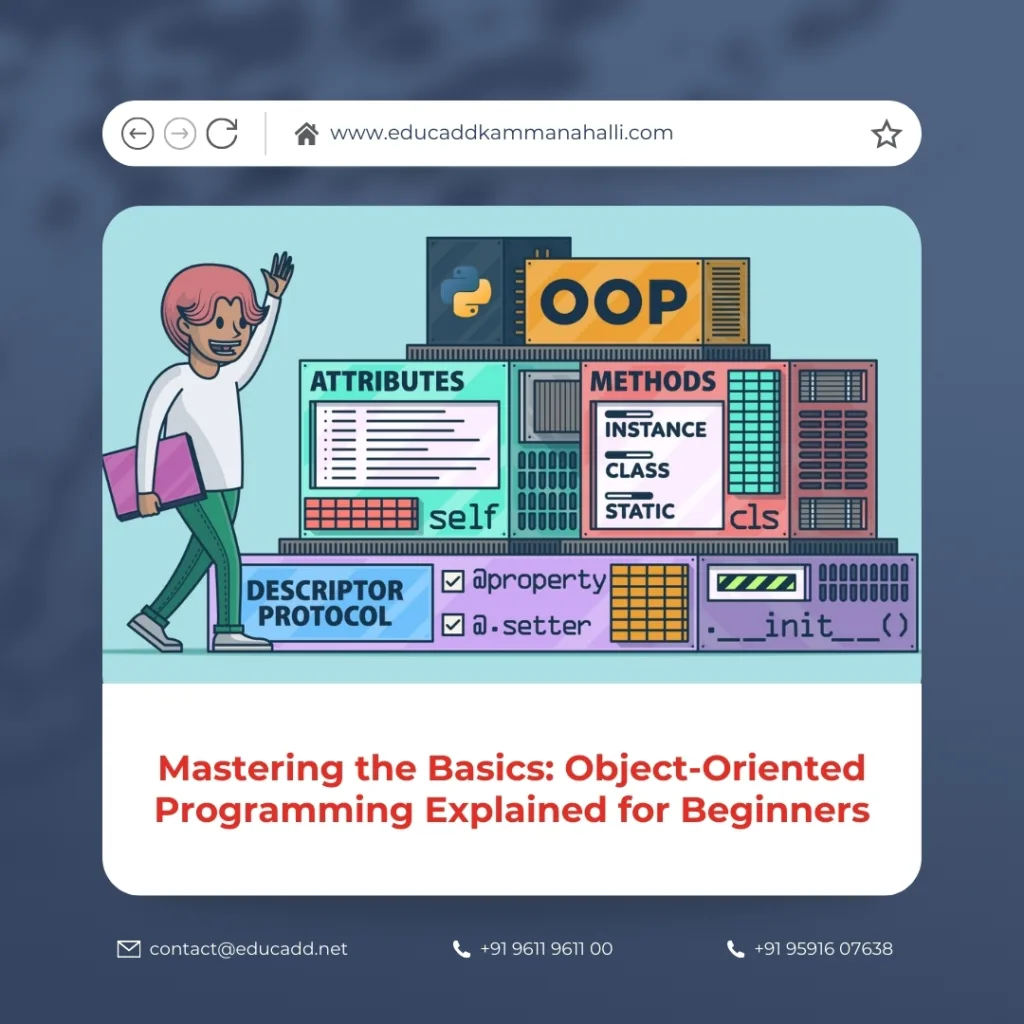
Object Oriented Programming Basics
Instead of focusing on complex technical jargon, this guide explains every concept in a clear and structured manner. By the end, you will confidently understand how object-oriented programming works and why it remains one of the most popular programming approaches in the world.
1. What Is Object-Oriented Programming?
Object Oriented Programming Basics is a programming paradigm that organizes software design around objects rather than functions and logic alone. In simple words, object-oriented programming models real-world entities as “objects” inside a program.
An object combines data and behavior. The data represents the properties of the object, while the behavior represents the actions it can perform. For example, imagine a car. A car has properties like color, model, and speed. It also performs actions such as accelerating, braking, and turning. In object-oriented programming, developers represent such entities as objects.
This approach makes code more structured and easier to understand. Instead of writing scattered functions, programmers group related data and actions together. As a result, object-oriented programming improves clarity and organization.
Furthermore, object-oriented programming allows developers to reuse code efficiently. Instead of rewriting the same logic, they can create reusable components. Therefore, object-oriented programming saves time and reduces errors.
2. Why Object-Oriented Programming Matters Today
Object-oriented programming plays a major role in modern software development. Most widely used programming languages support this paradigm. These include Java, C++, Python, and C#. Companies rely on object-oriented programming to build scalable and maintainable applications.
First, object-oriented programming improves productivity. Developers can reuse existing classes and extend them when needed. This approach speeds up development and reduces redundancy.
Second, object-oriented programming enhances collaboration. When teams work on large projects, organized code becomes essential. Since object-oriented programming groups related functionality together, team members can understand and modify code more easily.
Third, object-oriented programming increases maintainability. If a developer needs to update a feature, they can modify a specific class instead of rewriting the entire program. This modular structure prevents unnecessary complications.
Therefore, object-oriented programming remains relevant and essential in today’s technology landscape.
3. Understanding Classes in Object-Oriented Programming
A class is a blueprint for creating objects. In object-oriented programming, developers define classes to describe the structure and behavior of objects.
For instance, if you want to create multiple student records in a system, you first define a Student class. This class might include properties such as name, age, and grade. It may also include methods like calculateGrade or displayDetails.
Once the class is defined, you can create multiple objects from it. Each object represents a unique student with specific values. This process is known as instantiation.
Classes provide structure to object-oriented programming. Without classes, organizing related data and behavior would become difficult. Therefore, understanding classes is fundamental when learning object-oriented programming.
4. Objects: The Core of Object-Oriented Programming
Objects form the heart of object-oriented programming. They represent real-world entities inside a program.
Each object contains attributes and methods. Attributes store data, while methods define behavior. For example, in a banking system, an Account object might include attributes like accountNumber and balance. It might also include methods like deposit and withdraw.
Objects allow developers to simulate real-life systems. This realistic modeling makes object-oriented programming intuitive and practical. Instead of thinking in abstract logic, programmers think in terms of objects and interactions.
Moreover, objects communicate with each other through method calls. This interaction creates dynamic and flexible systems. Consequently, object-oriented programming simplifies complex software design.
5. The Four Pillars of Object-Oriented Programming
Object-oriented programming stands on four core principles. These principles form the foundation of the paradigm.
Encapsulation
Encapsulation means bundling data and methods together inside a class. It also restricts direct access to certain components. Developers use access modifiers to protect sensitive data.
Encapsulation improves security and prevents accidental changes. It ensures that objects control how their data is accessed or modified.
Abstraction
Abstraction hides complex implementation details and shows only essential features. Users interact with simplified interfaces without worrying about internal logic.
For example, when you use a remote control, you press buttons without understanding the internal circuitry. Similarly, abstraction in object-oriented programming simplifies interaction.
Inheritance
Inheritance allows one class to acquire properties and methods from another class. This promotes code reuse and hierarchical relationships.
For example, a Vehicle class may serve as a parent class. Car and Bike classes can inherit common features from it.
Polymorphism
Polymorphism enables objects to behave differently while sharing the same interface. It allows flexibility in method implementation.
For instance, different shapes can have a method called draw, but each shape draws differently.
Together, these four pillars define object-oriented programming and make it powerful.
6. How Encapsulation Strengthens Code Structure
Encapsulation ensures that data remains protected and organized. In object-oriented programming, developers use private variables and public methods to control access.
This structure prevents direct modification of sensitive data. Instead, users interact through defined methods. As a result, the integrity of the program remains intact.
Encapsulation also improves debugging. When errors occur, developers can trace them within specific classes. Therefore, object-oriented programming promotes reliability and security.
7. The Role of Abstraction in Simplifying Complexity
Abstraction reduces complexity by hiding internal details. In object-oriented programming, abstract classes and interfaces define expected behavior without revealing implementation.
This approach helps developers focus on high-level design. Instead of worrying about inner mechanics, they concentrate on functionality.
Moreover, abstraction improves flexibility. Developers can modify internal logic without affecting external code. Hence, object-oriented programming supports adaptable systems.
8. Inheritance and Code Reusability
Inheritance plays a key role in object-oriented programming. It allows classes to share common features.
By creating a base class, developers avoid repeating code. Child classes inherit attributes and methods, then extend them as needed.
For example, an Employee class might include general information. A Manager class can inherit from Employee and add additional responsibilities.
Inheritance reduces duplication and enhances efficiency. Therefore, object-oriented programming supports scalable design.
9. Polymorphism and Flexible Behavior
Polymorphism allows objects to take multiple forms. In object-oriented programming, it ensures that similar methods perform different actions depending on context.
There are two main types of polymorphism: method overloading and method overriding. Overloading allows multiple methods with the same name but different parameters. Overriding enables a subclass to provide specific implementation.
Polymorphism increases flexibility. Developers can write general code that works with different object types. Consequently, object-oriented programming becomes dynamic and adaptable.
10. Real-World Applications of Object-Oriented Programming
Object-oriented programming powers many real-world systems. Banking software uses objects to manage accounts and transactions. E-commerce platforms rely on objects to handle products and orders.
Game development heavily depends on object-oriented programming. Characters, weapons, and environments are modeled as objects. This structure allows realistic interactions.
Enterprise systems also benefit from object-oriented programming. Large-scale applications require modular and maintainable code. Therefore, object-oriented programming supports business growth and innovation.
11. Popular Languages That Use Object-Oriented Programming
Several programming languages support object-oriented programming.
Java emphasizes strict object-oriented principles. C++ combines procedural and object-oriented features. Python offers flexibility and simplicity. C# provides strong support for enterprise applications.
Each language implements object-oriented programming differently. However, the core concepts remain consistent. Once you understand the principles, you can apply them across languages.
12. Advantages of Object-Oriented Programming
Object-oriented programming offers many advantages.
It improves code organization. It enhances reusability through inheritance. It strengthens security with encapsulation. It simplifies maintenance and debugging.
Additionally, object-oriented programming supports modular design. Developers can build applications step by step. This structured approach reduces errors and increases efficiency.
Because of these benefits, object-oriented programming remains widely adopted in software development.
13. Common Challenges Beginners Face
Although object-oriented programming offers many benefits, beginners often struggle initially.
Understanding abstraction may feel difficult at first. The relationship between classes and objects can also seem confusing. Moreover, concepts like polymorphism require practice.
However, consistent learning and hands-on coding improve understanding. Building small projects helps reinforce concepts. Therefore, patience and practice make object-oriented programming easier to grasp.
14. How to Start Learning Object-Oriented Programming
To begin with object-oriented programming, choose a beginner-friendly language such as Python or Java. Start by learning basic syntax and gradually move to classes and objects.
Practice creating simple models like a student management system or a library system. Apply the four pillars consistently.
Additionally, read documentation and explore sample projects. Over time, your understanding of object-oriented programming will deepen.
Conclusion
Object Oriented Programming Basics Explained for Beginners is more than just a theoretical concept. It represents a structured and practical approach to building software. By organizing code around objects, developers create systems that are scalable, maintainable, and efficient.
Throughout this guide, you explored classes, objects, and the four core principles of object-oriented programming. You also learned how these concepts apply in real-world applications and modern programming languages.
Although the journey may seem challenging at first, consistent practice and structured learning make the process easier. Once you understand the logic behind object-oriented programming, you will see how naturally it mirrors real-world interactions.
In conclusion, object-oriented programming remains a foundational skill for every aspiring developer. Mastering its principles will empower you to build robust applications and advance confidently in your programming career.

