
Primavera P6 Fundamentals for Project Planning Excellence: Mastering Professional Scheduling for Successful Project Delivery
Modern projects demand precision, clarity, and strong control over timelines and resources. Organizations across construction, engineering, infrastructure, oil and gas, manufacturing, and IT rely on structured scheduling tools to manage complexity. Among these tools, Primavera P6 Project Planning stands out as one of the most powerful and reliable project management solutions available today.
Primavera P6 fundamentals form the backbone of professional project planning. When planners understand these fundamentals, they gain the ability to build realistic schedules, allocate resources effectively, monitor progress accurately, and deliver projects on time. Strong scheduling is not only about creating a timeline; it is about building a strategic roadmap that guides teams from initiation to completion.
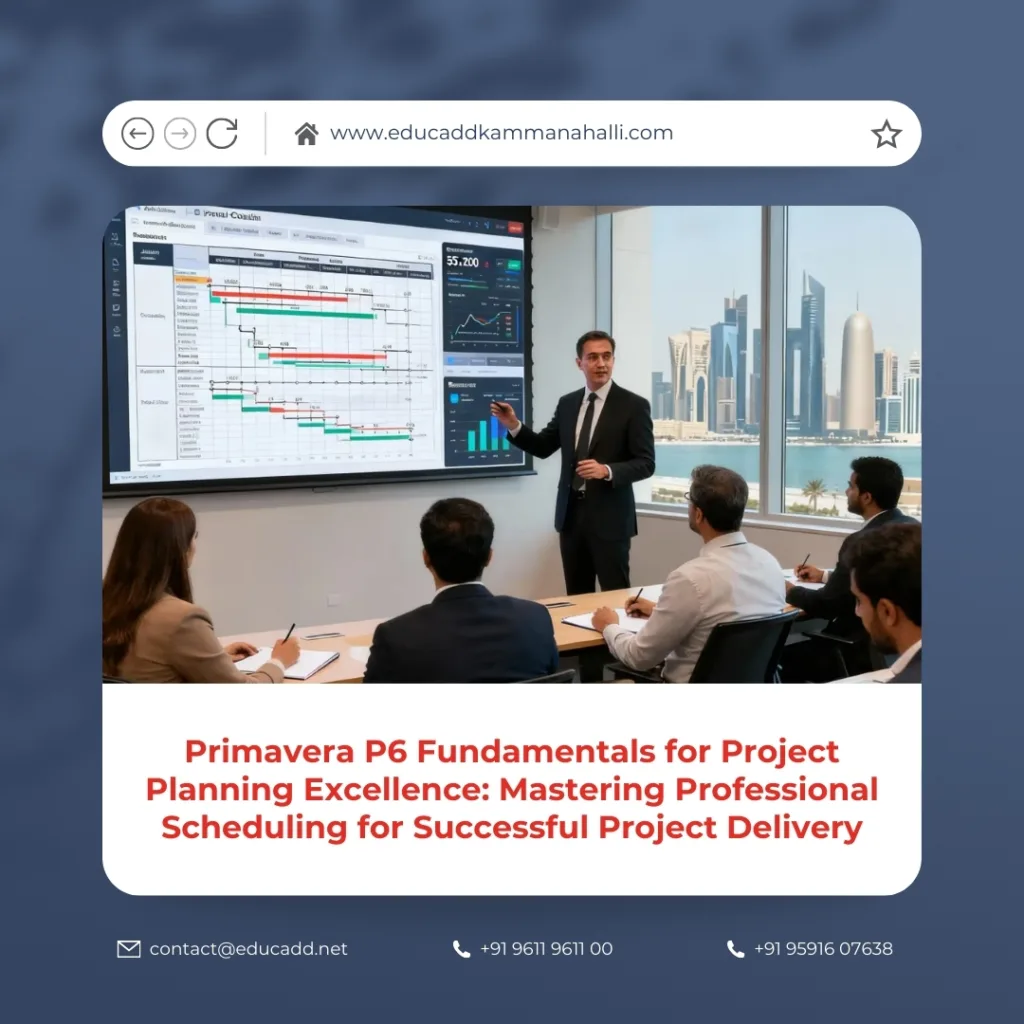
Primavera P6 Project Planning
This comprehensive guide explores Primavera P6 fundamentals for project planning excellence. It explains key concepts, practical techniques, and professional strategies that improve planning accuracy and project control.
1. Understanding Primavera P6 and Its Role in Project Planning
Primavera P6 Project Planning is an enterprise-level project management software designed to manage large and complex projects. It supports multiple projects simultaneously and allows detailed control over cost, schedule, and resources.
Project planning excellence begins with understanding how Primavera P6 structures data. The software organizes projects within an enterprise hierarchy. This structure enables planners to manage portfolios, programs, and individual projects efficiently.
Primavera P6 fundamentals include creating enterprise project structures (EPS), organizational breakdown structures (OBS), and project calendars. These elements define how the system organizes projects and responsibilities. When planners understand these components, they establish clarity across the organization.
Moreover, Primavera P6 helps teams visualize critical paths, forecast delays, and analyze performance. As a result, decision-makers can take corrective action before issues escalate.
2. Setting Up the Enterprise Project Structure (EPS)
The Enterprise Project Structure forms the foundation of Primavera P6 fundamentals. EPS organizes projects within a hierarchical framework. It allows companies to group projects based on departments, regions, or business units.
A well-designed EPS improves visibility and reporting. Managers can track performance at various levels. They can analyze portfolio health and allocate resources accordingly.
When setting up EPS, planners should align it with organizational goals. This alignment ensures consistency across projects. Additionally, a logical EPS simplifies security control and access management.
Without a clear EPS, project data becomes scattered. However, a structured hierarchy enhances control and strategic oversight.
3. Creating Organizational Breakdown Structure (OBS)
The Organizational Breakdown Structure defines responsibility within Primavera P6. While EPS organizes projects, OBS assigns managerial control.
OBS links project managers and stakeholders to specific project nodes. This structure ensures accountability. Each project has a designated responsible manager.
Primavera P6 fundamentals emphasize the importance of clear governance. When OBS aligns with the company’s management structure, communication improves. Reporting becomes streamlined.
Furthermore, OBS enhances data security. It controls user access based on roles. Therefore, only authorized personnel can modify sensitive schedules.
4. Building Work Breakdown Structure (WBS) for Clarity
Work Breakdown Structure is one of the most critical Primavera P6 Project Planning. WBS divides the project into manageable sections. It breaks large projects into smaller, structured components.
A strong WBS improves clarity and accountability. Teams understand their deliverables. Managers can track progress at each level.
When creating WBS in Primavera P6, planners should follow a deliverable-oriented approach. Each WBS element must represent a measurable outcome. This method improves tracking accuracy.
Moreover, WBS enhances reporting capabilities. Stakeholders can review progress by phase, discipline, or area. Therefore, project control becomes more precise.
5. Defining Activities and Relationships
Activities represent the tasks required to complete the project. Primavera P6 fundamentals require planners to define activities accurately. Each activity should have a clear scope and measurable duration.
After defining activities, planners must establish logical relationships. These relationships determine task sequencing. Primavera P6 supports various relationship types, including Finish-to-Start, Start-to-Start, Finish-to-Finish, and Start-to-Finish.
Logical sequencing prevents unrealistic schedules. It ensures that tasks follow practical construction or execution flow.
When planners avoid unnecessary constraints and maintain logic-driven schedules, they create flexible and reliable project timelines.
6. Scheduling Techniques and Critical Path Method (CPM)
Primavera P6 uses the Critical Path Method to calculate project duration. CPM identifies the longest path of activities that determines project completion.
Understanding CPM is central to Primavera P6 fundamentals. Activities on the critical path have zero float. Any delay in these activities delays the entire project.
By analyzing float values, planners identify risk areas. They can prioritize monitoring efforts accordingly.
Additionally, regular schedule updates help maintain accuracy. Recalculating the schedule reveals changes in the critical path. This proactive approach strengthens project control.
7. Resource Management and Allocation
Effective resource management defines project planning excellence. Primavera P6 fundamentals include creating labor, material, and equipment resources.
Planners assign resources to activities. The software calculates resource demand and highlights over-allocation. This feature helps managers balance workloads.
Resource leveling is another important technique. It resolves conflicts and prevents unrealistic workloads. By optimizing resource usage, organizations reduce costs and increase productivity.
Furthermore, tracking resource performance supports data-driven decisions. It reveals productivity trends and helps forecast future requirements.
8. Cost Planning and Budget Control
Primavera P6 integrates cost management with scheduling. Planners assign cost rates to resources and activities. The system calculates total project cost automatically.
Cost loading transforms schedules into financial planning tools. Primavera P6 fundamentals emphasize aligning time and cost for comprehensive control.
When planners track actual costs against planned values, they identify variances early. Earned Value Management (EVM) metrics such as CPI and SPI provide performance insights.
Through continuous monitoring, managers maintain budget discipline and financial transparency.
9. Baselines and Performance Tracking
A baseline represents the approved project plan. Primavera P6 fundamentals require setting a baseline before execution begins.
Baselines provide a reference point for comparison. Planners measure actual progress against planned performance.
Without a baseline, performance evaluation becomes subjective. However, with a defined benchmark, managers identify deviations accurately.
Regular updates ensure realistic tracking. By comparing planned dates with actual dates, teams detect schedule slippage early and implement corrective measures.
10. Updating and Monitoring Project Progress
Project planning excellence depends on consistent updates. Primavera P6 fundamentals include periodic progress entry and schedule recalculation.
During updates, planners record actual start dates, actual finish dates, and remaining durations. The system recalculates the schedule and highlights delays.
This process provides real-time project visibility. Managers can adjust strategies based on current data.
Moreover, frequent monitoring improves stakeholder confidence. Transparent reporting builds trust and strengthens communication.
11. Risk Identification and Schedule Analysis
Risk management strengthens project outcomes. Primavera P6 Project Planning fundamentals encourage proactive identification of schedule risks.
Float analysis reveals potential bottlenecks. Critical path shifts indicate emerging threats.
Advanced planners use schedule simulations and scenario analysis to evaluate alternatives. They test mitigation strategies before implementation.
By integrating risk awareness into planning, organizations minimize uncertainty and improve predictability.
12. Reporting and Dashboards for Decision Making
Clear reporting enhances strategic planning. Primavera P6 provides customizable reports and dashboards.
Primavera P6 fundamentals include designing reports that align with stakeholder expectations. Executives prefer summary dashboards, while planners require detailed activity reports.
Accurate reports improve communication. They enable data-driven discussions and faster decision-making.
Additionally, graphical representations simplify complex data. Stakeholders understand trends quickly, which accelerates approvals and corrective actions.
13. Integration with Other Systems
Modern organizations rely on integrated workflows. Primavera P6 supports integration with ERP systems, cost control tools, and BIM platforms.
Primavera P6 fundamentals extend beyond standalone scheduling. Integration improves data consistency and eliminates duplication.
When systems communicate effectively, teams reduce manual errors. They maintain synchronized information across departments.
As a result, project planning becomes more strategic and aligned with enterprise objectives.
14. Best Practices for Achieving Project Planning Excellence
Mastering Primavera P6 fundamentals requires discipline and continuous improvement. Planners should follow best practices to maximize effectiveness.
First, maintain logic-driven schedules. Avoid excessive constraints.
Second, update schedules regularly. Consistency ensures accuracy.
Third, document assumptions and changes. Clear documentation prevents misunderstandings.
Fourth, train teams thoroughly. Skilled users unlock the full potential of Primavera P6.
Finally, conduct schedule reviews periodically. Peer reviews improve quality and reliability.
By implementing these best practices, organizations elevate project planning standards and deliver consistent results.
Conclusion
Primavera P6 Project Planning form the cornerstone of structured and professional project planning. From defining enterprise structures to managing resources, costs, risks, and performance, every feature contributes to project planning excellence.
Organizations that invest in mastering Primavera P6 gain a competitive advantage. They improve predictability, enhance transparency, and reduce project risks. More importantly, they build confidence among stakeholders through reliable planning and proactive control.
Project success rarely happens by chance. It results from disciplined planning, continuous monitoring, and informed decision-making. By embracing Primavera P6 fundamentals for project planning excellence, professionals transform complex challenges into structured opportunities and deliver projects with precision, confidence, and measurable success.

