
Why Primavera Is the Backbone of Successful Project Management
Modern projects are no longer simple or linear. They involve multiple stakeholders, tight budgets, strict deadlines, and limited resources. Managing such complexity without advanced tools often leads to failure. This is where Primavera Project Management Software becomes essential. Primavera is a professional project management software designed to handle large-scale and high-risk projects with accuracy.
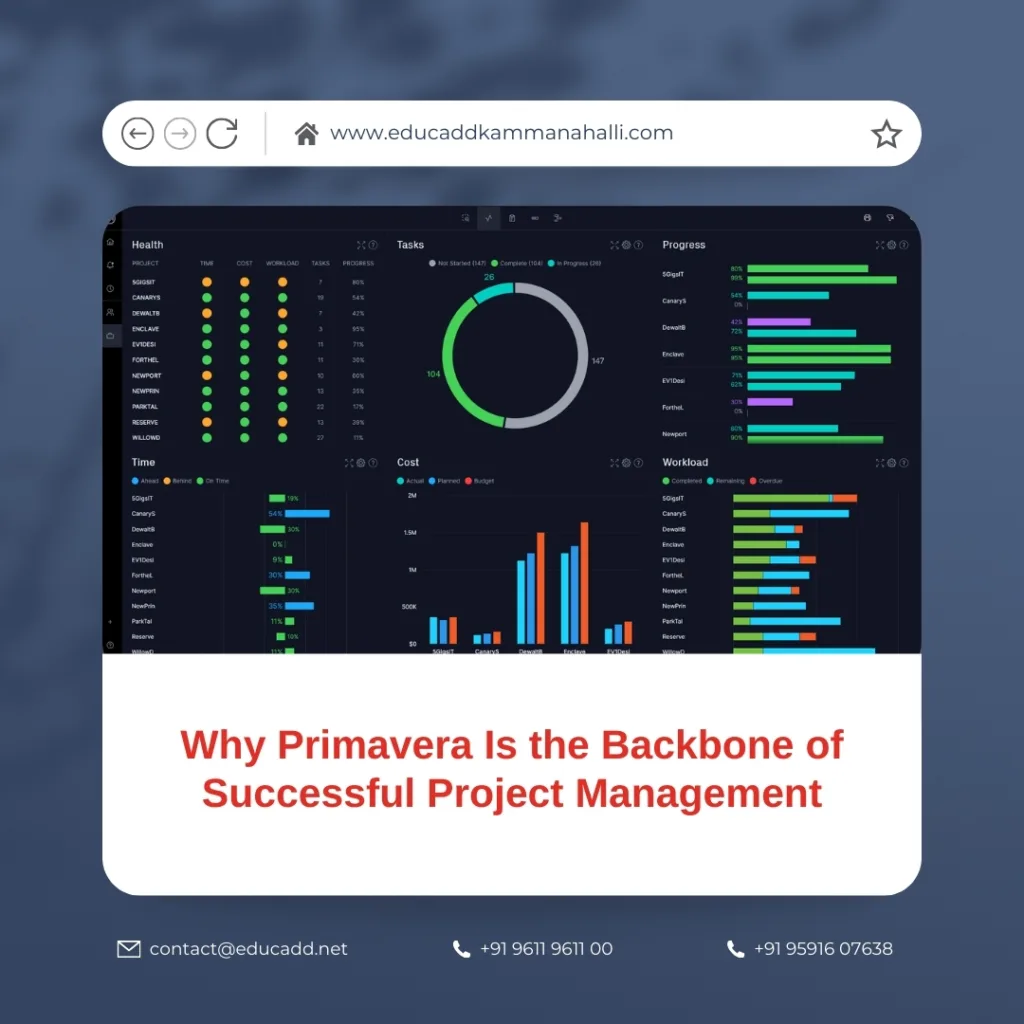
Primavera Project Management Software
Industries such as construction, infrastructure, oil and gas, manufacturing, and IT rely heavily on Primavera. It provides project managers with complete visibility, control, and confidence. Unlike basic scheduling tools, Primavera supports strategic planning, detailed scheduling, cost control, and performance tracking in one integrated system.
This blog explains the Primavera Project Management Software and how it helps organizations deliver projects on time, within budget, and with improved efficiency.
1. Strategic Project Planning and Structure Control
Every successful project starts with strong planning. Primavera in project management offers a powerful framework for building realistic and achievable project plans. It allows project managers to define project objectives clearly and align them with organizational goals.
Primavera supports the creation of a detailed Work Breakdown Structure (WBS). This structure divides large projects into smaller and manageable components. As a result, planning becomes clearer and more organized. Each task has a defined scope, duration, and responsibility.
Additionally, Primavera allows planners to establish project baselines. These baselines act as benchmarks for measuring performance. Without baselines, tracking progress becomes difficult. With Primavera, deviations become visible early, which helps managers take corrective actions quickly.
Another key advantage is long-term planning capability. Primavera supports multi-year projects with thousands of activities. This makes it ideal for infrastructure and construction projects. Project managers can forecast outcomes, identify risks, and plan mitigation strategies in advance.
Therefore, Primavera strengthens planning accuracy and improves project predictability. It transforms planning from guesswork into a structured and data-driven process.
2. Advanced Scheduling and Time Management Excellence
Scheduling is one of the most critical aspects of project success. Primavera in project management is globally recognized for its advanced scheduling capabilities. It handles complex activity relationships with ease and precision.
Primavera allows the creation of logical links between activities. Finish-to-start, start-to-start, and other dependencies can be applied accurately. This ensures that schedules reflect real-world conditions. As a result, timelines become more reliable.
Critical Path Method (CPM) is another major strength of Primavera. It identifies activities that directly impact project completion. By focusing on critical tasks, project managers can reduce delays and protect deadlines. When changes occur, Primavera recalculates schedules instantly.
Moreover, Primavera supports multiple calendars. This feature is essential for projects operating across regions. Different working hours, shifts, and holidays can be managed without confusion. This improves schedule accuracy significantly.
Through real-time updates, teams stay informed. Schedule transparency improves coordination and accountability. Ultimately, Primavera helps projects finish on time, even under challenging conditions.
3. Resource Planning, Allocation, and Optimization
Poor resource management often leads to increased costs and reduced productivity. Primavera in project management solves this issue by offering advanced resource management tools. These tools help organizations use their resources wisely.
Primavera allows managers to assign labor, equipment, and materials to activities. Resource availability and workload can be tracked throughout the project lifecycle. This prevents over-allocation and underutilization.
Another advantage is resource leveling. Primavera identifies conflicts where resources are overbooked. Managers can then adjust schedules or redistribute tasks. This improves efficiency and reduces stress on teams.
Primavera also supports enterprise-level resource management. Organizations managing multiple projects can view resource demand across portfolios. This helps in strategic decision-making and workforce planning.
By improving resource visibility, Primavera enhances productivity. Teams work more efficiently, and project execution becomes smoother and more controlled.
4. Cost Management, Budget Control, and Risk Reduction
Cost overruns remain a major challenge in project management. Primavera in project management plays a vital role in controlling project finances. It integrates cost planning with scheduling for better accuracy.
Primavera allows detailed cost estimation at the activity level. Budgets can be allocated and tracked continuously. Any variance between planned and actual costs becomes visible immediately. This enables faster corrective action.
Risk analysis is another important feature. Primavera helps identify schedule and cost risks early. Project managers can perform what-if analysis to evaluate different scenarios. This supports proactive decision-making.
Earned Value Management (EVM) further strengthens financial control. Primavera calculates performance metrics that show cost efficiency and schedule performance. These insights help stakeholders understand project health clearly.
Through accurate cost control and risk management, Primavera protects project profitability. It reduces uncertainty and improves financial discipline.
5. Monitoring, Reporting, and Stakeholder Communication
Effective monitoring ensures that projects stay aligned with plans. Primavera in project management provides powerful monitoring and reporting tools. These tools offer real-time visibility into project performance.
Dashboards display key metrics such as progress, delays, and cost variance. Project managers can identify issues instantly. This improves responsiveness and control.
Primavera also supports customizable reports. These reports meet the needs of different stakeholders. Executives receive high-level summaries, while teams access detailed task reports. This improves communication and transparency.
Collaboration improves as all stakeholders work with a single source of truth. Data consistency reduces misunderstandings and conflicts. As a result, decision-making becomes faster and more confident.
By strengthening governance and reporting, Primavera enhances trust and accountability across projects.
Conclusion
The Primavera Project Management Software lies in its ability to manage complexity with confidence. It combines planning, scheduling, resource management, cost control, and monitoring into one powerful platform. This integration allows project managers to deliver predictable and successful outcomes.
Primavera transforms project management from reactive problem-solving to proactive control. Organizations that adopt Primavera gain a competitive advantage through improved efficiency, reduced risk, and better decision-making.
In a world where project failure is costly, Primavera stands as a reliable foundation for professional project management success.

