
Construction Project Monitoring with Primavera Dashboards: Turning Project Data into Powerful Decisions
Modern construction projects move at a rapid pace. Multiple teams work together across sites, timelines shift, costs fluctuate, and risks emerge without warning. In such a dynamic environment, relying on spreadsheets and manual reports is no longer practical. Project managers require accurate, real-time insights that help them make confident decisions. This is where Primavera Project Monitoring Dashboards becomes essential.
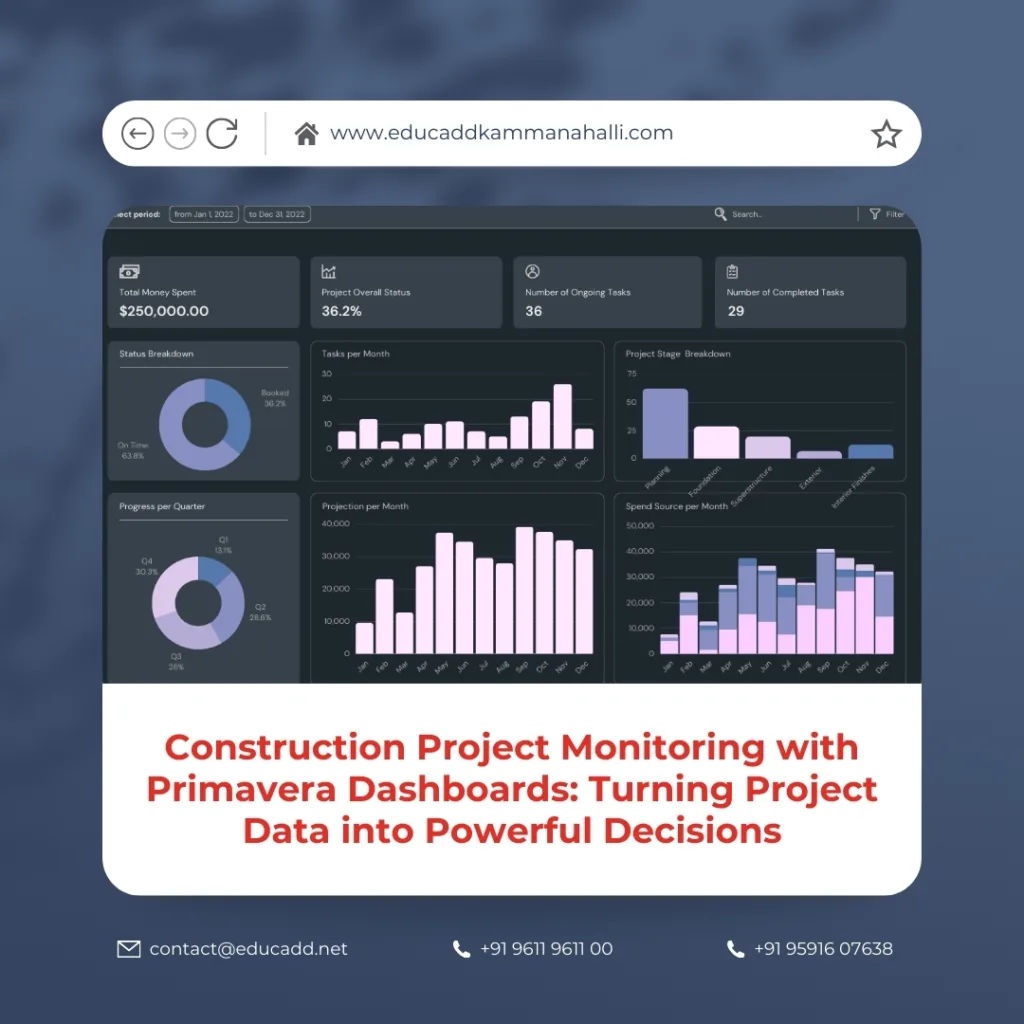
Primavera Project Monitoring Dashboards
Primavera dashboards provide a centralized platform where project data transforms into clear visual insights. They help stakeholders track schedules, budgets, resources, and risks without confusion. Instead of reacting to problems after delays occur, managers can identify early warning signs and take corrective action. As construction projects grow more complex, structured monitoring through Primavera dashboards ensures control, transparency, and measurable performance improvement.
1. Understanding Construction Project Monitoring
Primavera Project Monitoring Dashboards refers to the continuous tracking of progress, cost, scope, quality, and risk throughout a project lifecycle. It ensures that the project remains aligned with defined objectives. Monitoring does not simply mean collecting data. Instead, it involves analyzing trends, identifying deviations, and implementing corrective strategies.
Traditionally, monitoring relied heavily on manual reporting. However, manual processes create delays and increase the risk of errors. Therefore, organizations now depend on digital tools to enhance accuracy and speed. Construction Project Monitoring with Primavera Dashboards replaces fragmented reporting with structured visualization.
Through centralized dashboards, project managers can instantly review schedule performance, cost variance, and resource allocation. As a result, decision-making becomes proactive rather than reactive. Moreover, stakeholders gain better visibility into project health at every stage.
2. The Role of Primavera in Modern Construction
Primavera has become one of the most trusted project management solutions in large-scale construction. It offers powerful scheduling, cost control, and resource management capabilities. However, its real strength appears when dashboards transform raw data into visual insights.
Construction Project Monitoring with Primavera Dashboards enhances clarity. Instead of scanning long activity lists, managers view graphical summaries of critical metrics. For example, dashboards can display schedule performance index, cost performance index, and earned value analysis in one screen.
Furthermore, Primavera integrates seamlessly with enterprise systems. This integration ensures consistent data flow across departments. Consequently, teams avoid data silos and miscommunication. With structured monitoring, organizations improve accountability and project transparency.
3. Why Dashboards Matter in Construction Projects
Construction projects generate massive volumes of data daily. Without structured presentation, data becomes overwhelming. Dashboards solve this challenge by presenting information in a simplified and visual format.
Construction Project Monitoring with Primavera Dashboards enables teams to focus on what truly matters. For instance, color-coded indicators highlight delays or budget overruns. Charts display task progress, while resource histograms reveal workforce distribution.
Because dashboards update in real time, project leaders gain immediate insights. They no longer wait for weekly reports. Additionally, dashboards improve communication during stakeholder meetings. Clear visuals support confident decision-making and reduce misunderstandings.
4. Key Components of Primavera Dashboards
Effective dashboards rely on well-defined components. Each component contributes to comprehensive monitoring.
Schedule Tracking: Dashboards display planned versus actual progress. They highlight critical path activities and identify delays.
Cost Management: Financial metrics such as budget variance and earned value appear in graphical form. Managers can quickly detect cost overruns.
Resource Utilization: Dashboards present labor and equipment allocation. This feature helps prevent resource overload or underutilization.
Risk Indicators: Visual alerts flag potential risks before they escalate.
Construction Project Monitoring with Primavera Dashboards combines these components into one structured interface. Consequently, teams maintain complete project visibility without navigating multiple systems.
5. Real-Time Data for Better Decision Making
Timely decisions define project success. When information arrives late, corrective actions lose effectiveness. Therefore, real-time monitoring plays a crucial role in construction.
Primavera dashboards update instantly as teams record progress. Managers can review live performance data at any time. For example, if a critical activity falls behind schedule, the dashboard reflects the delay immediately.
Primavera Project Monitoring Dashboards ensures that decision-makers act on current data rather than outdated reports. This approach reduces uncertainty and supports strategic planning. Moreover, it strengthens leadership confidence and stakeholder trust.
6. Enhancing Collaboration Across Teams
Construction involves architects, engineers, contractors, suppliers, and clients. Coordination among these stakeholders determines project outcomes. Poor communication often leads to delays and rework.
Dashboards encourage collaboration by presenting unified information. Every stakeholder accesses the same data source. Consequently, teams align their efforts with shared objectives.
Construction Project Monitoring with Primavera Dashboards eliminates fragmented reporting. Instead of exchanging lengthy emails, teams review a centralized dashboard during meetings. Clear visualization reduces confusion and promotes accountability.
7. Improving Schedule Performance
Delays remain one of the most common challenges in construction. Even minor schedule disruptions can create cascading impacts. Therefore, schedule monitoring requires precision.
Primavera dashboards highlight critical path activities and float values. Managers quickly identify tasks that require immediate attention. If progress deviates from the baseline, dashboards display performance indicators.
Through Construction Project Monitoring with Primavera Dashboards, teams detect potential delays early. They adjust resources or resequence activities accordingly. As a result, projects maintain schedule alignment and avoid penalties.
8. Strengthening Cost Control Strategies
Cost overruns significantly affect profitability. Without accurate monitoring, financial risks escalate quickly.
Primavera dashboards integrate earned value management metrics. They compare planned value, actual cost, and earned value in visual charts. This comparison reveals cost performance trends clearly.
Construction Project Monitoring with Primavera Dashboards empowers financial control. Managers identify budget variances instantly and implement corrective measures. Additionally, stakeholders gain transparency regarding project expenditures.
Effective cost monitoring supports informed negotiation with suppliers and subcontractors. It also enhances forecasting accuracy for future projects.
9. Resource Optimization for Maximum Efficiency
Efficient resource allocation determines productivity. Overloaded resources cause burnout and reduce quality. Underutilized resources waste budget.
Primavera dashboards present resource histograms and allocation graphs. Managers analyze workforce distribution across activities. They identify imbalance and reassign resources strategically.
Construction Project Monitoring with Primavera Dashboards ensures optimal workforce utilization. Teams maintain steady productivity without exceeding budget limits. Furthermore, data-driven resource planning reduces last-minute adjustments.
10. Risk Identification and Mitigation
Every construction project faces uncertainties. Weather disruptions, supply chain delays, and design changes create potential risks. Proactive monitoring minimizes their impact.
Primavera dashboards integrate risk registers with performance indicators. Visual alerts notify managers about high-risk activities.
Through Construction Project Monitoring with Primavera Dashboards, project teams evaluate risk probability and impact systematically. They implement mitigation strategies before issues escalate. This proactive approach safeguards timelines and budgets.
11. Customization and Scalability
Each construction project differs in size and complexity. Therefore, dashboards must adapt accordingly.
Primavera allows customization of dashboard layouts and metrics. Managers select indicators relevant to specific project objectives. For example, infrastructure projects may emphasize resource distribution, while commercial projects focus on cost performance.
Construction Project Monitoring with Primavera Dashboards remains scalable for small and large projects. Organizations maintain consistent monitoring frameworks across multiple sites. This scalability ensures standardized reporting and improved governance.
12. Reporting and Stakeholder Transparency
Transparent reporting strengthens client confidence. Stakeholders expect clear insights into progress and financial performance.
Primavera dashboards generate structured reports based on real-time data. Managers share concise visual summaries during review meetings. This clarity enhances trust and reduces disputes.
Construction Project Monitoring with Primavera Dashboards supports effective communication with investors and regulatory authorities. Accurate reporting demonstrates accountability and compliance.
13. Integration with Digital Construction Ecosystems
Modern construction increasingly relies on digital integration. Tools such as BIM, ERP, and document management systems contribute to project success.
Primavera dashboards integrate seamlessly with these systems. Data flows automatically between platforms. Consequently, monitoring becomes comprehensive and reliable.
Construction Project Monitoring with Primavera Dashboards strengthens digital transformation initiatives. It aligns scheduling, cost management, and resource planning within a unified ecosystem.
14. Best Practices for Effective Dashboard Implementation
Successful implementation requires strategic planning. Organizations should define clear performance metrics before designing dashboards.
Training also plays a vital role. Project teams must understand how to interpret indicators correctly. Without proper understanding, dashboards lose effectiveness.
Construction Project Monitoring with Primavera Dashboards delivers maximum value when organizations maintain accurate data entry practices. Regular updates ensure reliability. Additionally, continuous review of dashboard metrics keeps monitoring aligned with evolving project goals.
Conclusion
Construction projects demand precision, transparency, and adaptability. As complexity increases, traditional monitoring methods no longer suffice. Structured digital monitoring ensures projects remain aligned with schedule, cost, and resource objectives.
Primavera Project Monitoring Dashboards transforms raw data into actionable intelligence. It empowers project managers to detect deviations early, optimize resources efficiently, and strengthen stakeholder communication. Furthermore, real-time insights enhance decision-making and reduce risk exposure.
Organizations that adopt Primavera dashboards gain strategic advantages. They improve project control, maintain profitability, and build long-term trust with clients. In an industry where delays and cost overruns can erode reputation, effective monitoring becomes a competitive differentiator.
Ultimately, Construction Project Monitoring with Primavera Dashboards serves as a foundation for successful project execution. It bridges the gap between planning and performance, ensuring that every construction initiative progresses with clarity, confidence, and measurable success.

