
RCC Detailing in Civil CADD Explained: The Complete Practical Guide for Precision, Productivity, and Professional Excellence
RCC Detailing in CivilCAD plays a critical role in the success of structural construction projects. While structural design defines the strength and stability of a building, detailing ensures that the design is translated accurately into practical execution. In today’s digital era, Civil CADD software has transformed how engineers create, modify, and manage structural drawings. As a result, professionals can produce highly accurate reinforcement layouts, bar bending schedules, and structural drawings with improved efficiency.
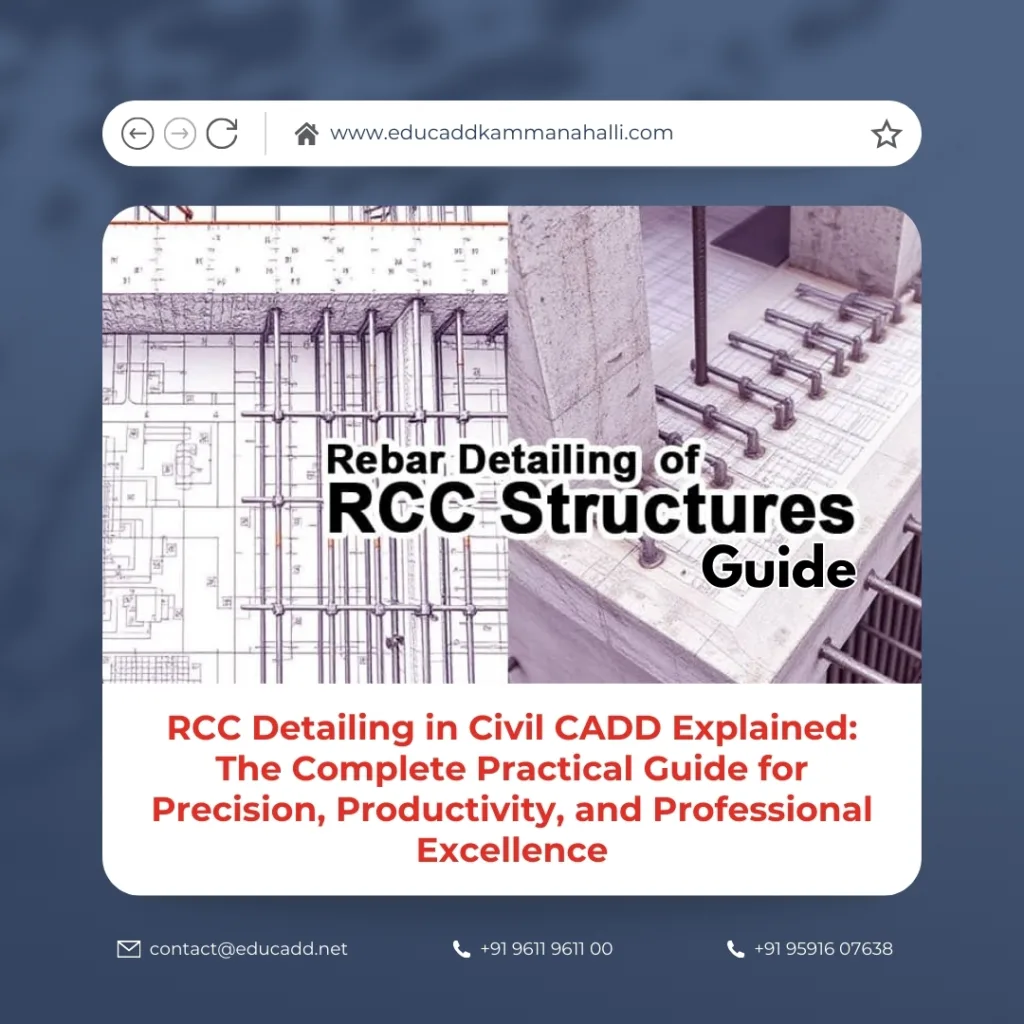
RCC Detailing in CivilCAD
This comprehensive guide explains RCC Detailing in CivilCAD in depth. It covers the fundamentals, workflow, tools, industry standards, practical challenges, and career opportunities. Whether you are a civil engineering student, site engineer, structural drafter, or design professional, this blog will help you understand how RCC detailing works in Civil CADD and why it is essential for modern construction projects.
Understanding the Fundamentals of RCC Detailing
RCC detailing refers to the preparation of detailed drawings that show the placement, size, spacing, and arrangement of reinforcement bars within structural elements such as beams, slabs, columns, and footings. These drawings guide contractors and site engineers during construction.
In structural engineering, the design engineer calculates loads, moments, shear forces, and reinforcement requirements. However, construction teams require clear drawings that indicate exact bar placement and bending shapes. Therefore, RCC detailing bridges the gap between structural calculations and on-site execution.
Civil CADD software allows drafters to prepare these reinforcement drawings with high precision. Instead of manual drafting, engineers use digital tools to create plan views, section views, and reinforcement layouts. Consequently, drawing revisions become faster and more manageable.
Moreover, RCC detailing ensures structural safety. Poor detailing can cause congestion, improper anchorage, or inadequate development length. On the other hand, accurate detailing improves durability and structural performance. For this reason, mastering RCC Detailing in Civil CADD is essential for structural professionals.
Importance of RCC Detailing in Modern Construction
Modern construction projects involve complex architectural forms, high-rise buildings, and infrastructure structures. Therefore, structural drawings must be precise and coordinated. RCC Detailing in CivilCAD ensures that reinforcement drawings align with architectural and structural design.
Firstly, detailed drawings reduce site errors. When reinforcement is clearly indicated, workers can place bars correctly. Secondly, detailing improves cost control. Accurate bar bending schedules help estimate steel quantities, which reduces material wastage. Thirdly, digital detailing accelerates project timelines because modifications can be implemented quickly.
In addition, contractors rely heavily on RCC detailing for execution. Without proper detailing, even a well-designed structure may face construction challenges. Thus, RCC Detailing in Civil CADD plays a direct role in quality control and project success.
Furthermore, digital detailing enhances collaboration. Structural engineers, architects, and contractors can review drawings electronically. As a result, coordination issues are resolved before construction begins.
Core Components of RCC Detailing in Civil CADD
RCC Detailing in Civil CADD includes several structural components. Each element requires specific reinforcement detailing techniques.
Beams require longitudinal bars, stirrups, anchorage lengths, and curtailment details. Slabs require main reinforcement, distribution bars, crank bars, and spacing details. Columns require vertical bars, ties, lap splices, and confinement reinforcement. Footings require bottom reinforcement, top reinforcement (if necessary), and column dowel bars.
Civil CADD software allows users to draft these components with dimensions, bar marks, and notations. Drafters must follow structural drawings carefully. They must also ensure that cover requirements, development lengths, and lap splices comply with relevant codes.
In addition, bar bending schedules form a key part of RCC detailing. These schedules list bar marks, diameters, shapes, quantities, and total weights. Civil CADD tools simplify the preparation of these schedules by using block libraries and automated calculations.
Because every structure contains multiple elements, RCC Detailing in Civil CADD demands attention to detail and systematic workflow.
Step-by-Step Workflow of RCC Detailing in Civil CADD
The workflow of RCC Detailing in Civil CADD begins with reviewing structural design drawings. The drafter studies general arrangement drawings, beam schedules, slab reinforcement details, and foundation layouts.
Next, the drafter sets up the drawing environment. Layers are created for reinforcement, dimensions, text, centerlines, and structural outlines. Proper layer management ensures organized drawings.
After that, the structural outline is drafted. Then reinforcement bars are inserted according to design specifications. Spacing, bar diameters, and anchorage details are added clearly. Section views are prepared to show reinforcement arrangement inside members.
Subsequently, bar marks are assigned. Each bar type receives a unique identification number. The bar bending schedule is generated using these marks.
Finally, the drawing undergoes quality checks. The drafter verifies bar lengths, lap locations, cover dimensions, and notes. Once approved, the drawings are issued for construction.
This structured workflow ensures efficiency and minimizes errors in RCC Detailing in Civil CADD.
Essential Tools and Commands Used in Civil CADD
Civil CADD software offers numerous drafting tools that support RCC detailing. Line, polyline, offset, trim, extend, and hatch commands help create structural outlines and reinforcement layouts.
The copy and array commands simplify repetitive reinforcement placement. For example, slab bars with uniform spacing can be created quickly using array functions. Dimension and text tools help annotate reinforcement details clearly.
Blocks and dynamic blocks improve productivity. Drafters can create standard stirrup shapes, hook details, and bar symbols as reusable blocks. Consequently, drawing time reduces significantly.
Layer management tools ensure that reinforcement, dimensions, and annotations remain organized. Proper layer naming also improves coordination with other project drawings.
By mastering these tools, professionals can perform RCC Detailing in Civil CADD efficiently and accurately.
Standards and Codes Followed in RCC Detailing
RCC detailing must comply with national and international standards. In India, engineers commonly follow IS 456 for plain and reinforced concrete and SP 34 for detailing guidelines. These codes specify minimum cover, development length, lap splice requirements, and reinforcement spacing.
Compliance with codes ensures structural safety and durability. Therefore, drafters must understand basic code provisions. Even though structural engineers finalize calculations, detailers must apply those requirements correctly in drawings.
Moreover, proper notation standards should be followed. Clear labeling, consistent dimensioning, and standardized symbols enhance drawing readability.
When RCC Detailing in CivilCAD aligns with relevant standards, the risk of construction errors reduces significantly.
Common Mistakes in RCC Detailing and How to Avoid Them
Despite digital tools, errors can occur during RCC detailing. One common mistake is improper lap length placement. Another issue involves insufficient concrete cover.
Bar congestion also creates construction difficulties. If too many bars are placed in a small section, proper concrete compaction becomes difficult. Therefore, spacing must be planned carefully.
Incorrect bar bending schedule calculations can lead to steel shortages or excess procurement. To avoid such issues, cross-check calculations and verify dimensions.
Furthermore, unclear annotations confuse site workers. Hence, drawings must remain simple and precise.
By applying systematic checks, professionals can ensure high-quality RCC Detailing in Civil CADD.
Advantages of Using Civil CADD for RCC Detailing
Civil CADD offers numerous advantages for RCC detailing. First, it increases drafting speed. Digital commands enable quick editing and modifications.
Second, it enhances accuracy. Dimension tools reduce manual measurement errors. Third, digital files allow easy storage and sharing.
Additionally, Civil CADD supports coordination with architectural and structural drawings. This integration improves overall project workflow.
Cost efficiency also improves. Reduced rework and precise quantity estimation save both time and money.
Therefore, RCC Detailing in Civil CADD provides a strong competitive advantage in the construction industry.
Role of RCC Detailer in Construction Projects
An RCC detailer plays a crucial role in project execution. The detailer prepares reinforcement drawings based on structural design inputs. They coordinate with engineers and site teams to clarify reinforcement arrangements.
Detailers must possess strong knowledge of reinforcement principles. They should understand bar bending shapes, anchorage details, and reinforcement terminology.
Moreover, they must maintain drawing revisions systematically. Any design change should be updated promptly.
Because construction relies heavily on drawings, RCC detailers carry significant responsibility. Skilled professionals in RCC Detailing in Civil CADD remain in high demand across construction companies.
Coordination Between Design and Detailing Teams
Effective communication between structural engineers and detailers ensures successful project execution. Structural engineers provide reinforcement calculations and general arrangement drawings.
Detailers interpret those inputs and create construction-ready drawings. If discrepancies arise, they must seek clarification immediately.
Regular coordination meetings improve drawing quality. Moreover, digital file sharing accelerates revisions.
Through proper collaboration, RCC Detailing in Civil CADD becomes more efficient and reliable.
Career Opportunities in RCC Detailing
RCC detailing offers promising career opportunities. Construction companies, structural consultancy firms, and infrastructure contractors require skilled detailers.
Professionals who master Civil CADD and reinforcement detailing can work as structural drafters, detailing engineers, or BIM technicians.
With experience, individuals can progress to senior detailing roles or project coordination positions. Additionally, knowledge of advanced software such as BIM tools further enhances career growth.
Therefore, investing time in learning RCC Detailing in Civil CADD opens multiple career pathways.
Best Practices for High-Quality RCC Detailing
High-quality RCC detailing demands discipline and attention to detail. Always follow structural drawings precisely. Maintain consistent layer naming conventions.
Use standard bar bending shapes. Keep annotations clear and readable. Avoid overcrowding drawings with unnecessary information.
Conduct self-checks before submission. Cross-verify bar lengths, spacing, and lap positions.
Continuous learning also improves detailing quality. Stay updated with code revisions and software upgrades.
By applying these best practices, professionals can deliver reliable RCC Detailing in Civil CADD drawings.
Future Trends in RCC Detailing
The construction industry is evolving rapidly. Automation and BIM integration are transforming detailing practices.
While Civil CADD remains widely used, many companies now integrate 3D modeling tools. These tools improve clash detection and visualization.
However, the fundamental principles of reinforcement detailing remain unchanged. Professionals with strong foundational knowledge can adapt easily to new technologies.
Therefore, RCC Detailing in Civil CADD continues to serve as a foundation for advanced structural modeling careers.
Conclusion
RCC Detailing in CivilCAD forms the backbone of structural construction. It translates design calculations into practical reinforcement drawings that guide site execution. With the help of Civil CADD, professionals can create accurate, efficient, and well-coordinated structural drawings.
Throughout this guide, we explored the fundamentals, workflow, tools, standards, challenges, and career prospects of RCC Detailing in Civil CADD. Accurate detailing ensures structural safety, cost efficiency, and project success. Moreover, skilled detailers remain highly valuable in today’s competitive construction industry.
By mastering RCC detailing principles and Civil CADD tools, professionals can enhance productivity, reduce errors, and contribute significantly to successful construction projects.

