
Applications of Reverse Engineering in Industry: Driving Innovation, Accuracy, and Competitive Advantage
In today’s highly competitive industrial landscape, companies must innovate faster, reduce development costs, and improve product quality to remain successful. As technologies evolve rapidly, organizations constantly seek efficient methods to understand existing products, optimize designs, and accelerate manufacturing processes. This is where reverse engineering plays a crucial role. Reverse Engineering Industry Applications involves analyzing an existing product, component, or system to understand its design, functionality, materials, and manufacturing methods. Engineers use advanced tools such as 3D scanners, coordinate measuring machines (CMMs), CAD software, and simulation platforms to recreate digital models from physical objects.
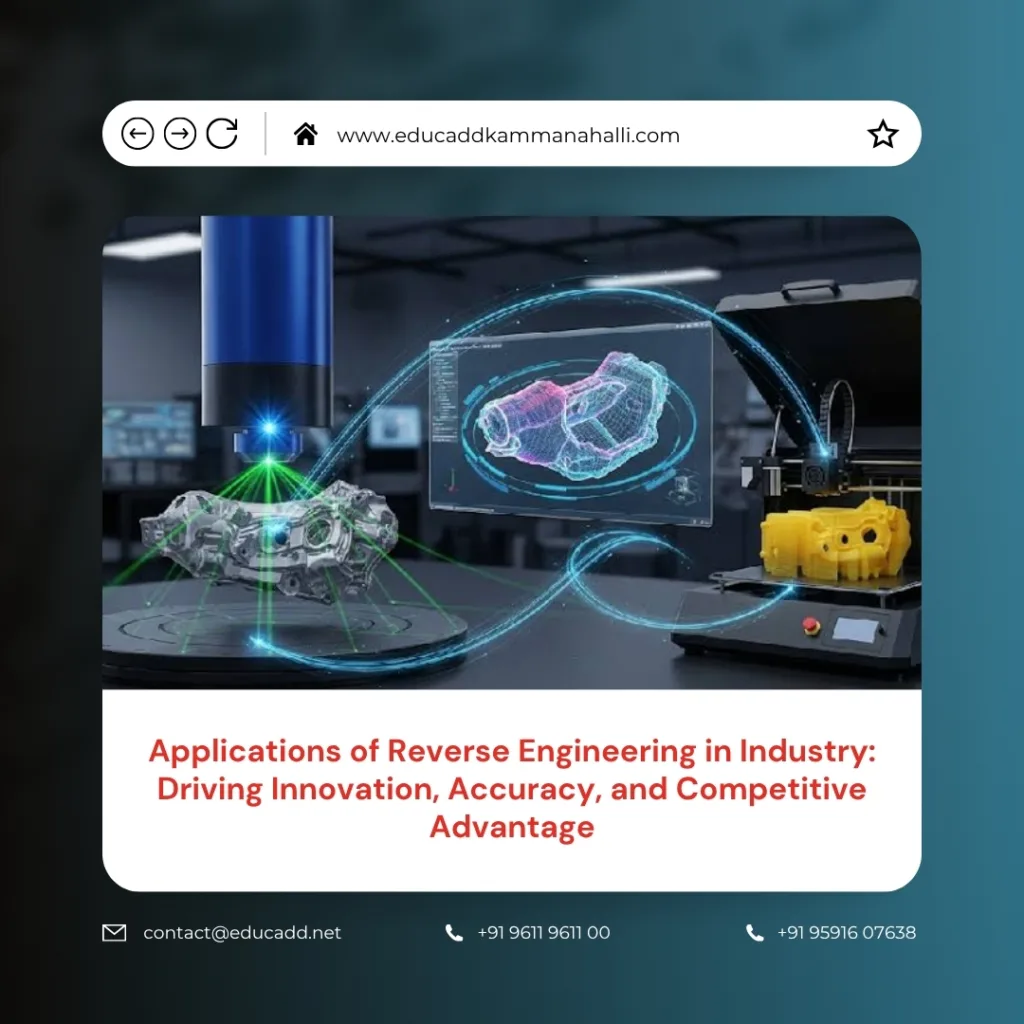
Reverse Engineering Industry Applications
The Reverse Engineering Industry Applications have expanded significantly over the last decade. From automotive and aerospace sectors to healthcare and consumer electronics, reverse engineering helps organizations improve products, maintain legacy equipment, and develop innovative solutions. Moreover, businesses can reduce product development cycles and improve operational efficiency by leveraging reverse engineering techniques. As a result, industries worldwide increasingly adopt reverse engineering to remain competitive and technologically advanced.
Understanding Reverse Engineering Industry Applications
Reverse Engineering Industry Applications is the process of deconstructing a physical product or system to reveal its design specifications and operational principles. Unlike traditional engineering, which begins with a concept and ends with a finished product, reverse engineering starts with an existing product and works backward to create accurate digital representations.
Modern industries rely on sophisticated technologies to perform reverse engineering tasks. Engineers use laser scanners, structured-light scanners, and photogrammetry systems to capture precise measurements of physical objects. Subsequently, they convert the collected data into CAD models that can be analyzed, modified, or reproduced.
The applications of reverse engineering in industry continue to grow because organizations require efficient methods to upgrade products and preserve valuable engineering knowledge. Furthermore, digital transformation initiatives have accelerated the adoption of reverse engineering technologies across multiple sectors.
Product Redesign and Performance Enhancement
One of the most important applications of reverse engineering in industry is product redesign and performance improvement. Manufacturers frequently analyze existing products to identify weaknesses, optimize performance, and enhance reliability.
Through reverse engineering, engineers can evaluate product geometry, material composition, and structural integrity. This detailed analysis allows organizations to develop improved versions that meet evolving customer requirements. Additionally, companies can introduce innovative features without starting the design process from scratch.
Benefits of product redesign through reverse engineering include:
- Enhanced product functionality and user experience
- Reduced development time and engineering costs
As market demands continue to change, reverse engineering provides manufacturers with valuable insights that support continuous product improvement and innovation.
Reverse Engineering Industry Applications in Automotive Manufacturing
The automotive industry extensively utilizes reverse engineering to improve vehicle components, optimize production processes, and support aftermarket manufacturing. Automotive companies often analyze existing parts to create accurate digital models for redesign and performance evaluation.
Engineers use reverse engineering to study engine components, transmission systems, suspension assemblies, and body structures. By examining these elements, manufacturers can identify opportunities for weight reduction, fuel efficiency improvements, and enhanced durability.
Furthermore, reverse engineering helps restore obsolete vehicle parts that are no longer available from original manufacturers. This capability is particularly valuable for vintage vehicle restoration projects and specialized automotive applications. Consequently, the automotive sector remains one of the largest adopters of reverse engineering technologies worldwide.
Aerospace Industry Applications
The aerospace sector demands exceptional precision, reliability, and safety. Therefore, reverse engineering plays a vital role in maintaining aircraft systems and supporting aerospace innovation. Aircraft components often operate under extreme conditions, making regular inspection and redesign essential.
Reverse Engineering Industry Applications allows aerospace engineers to recreate accurate digital models of turbine blades, structural components, and engine parts. These digital models facilitate performance analysis, stress testing, and design optimization.
Moreover, aerospace companies use reverse engineering to reproduce legacy components for older aircraft models. Since replacement parts may no longer be available, reverse engineering ensures continued operation and maintenance of critical systems. As a result, airlines and aerospace manufacturers can extend equipment lifespan while maintaining safety standards.
Manufacturing and Industrial Equipment Maintenance
Industrial facilities depend on complex machinery to maintain production efficiency. However, many manufacturing plants operate equipment that has been in service for decades. Obtaining replacement components for such machinery can be challenging and expensive.
The applications of reverse engineering in industry are particularly valuable in equipment maintenance and repair. Engineers can scan worn or damaged components and generate accurate CAD models for reproduction. These models enable manufacturers to fabricate replacement parts quickly and cost-effectively.
Additionally, reverse engineering helps organizations understand undocumented machinery designs. This knowledge improves maintenance planning, reduces downtime, and increases operational reliability. Consequently, manufacturers can maximize equipment utilization while minimizing production interruptions.
Reverse Engineering for Quality Control and Inspection
Quality assurance remains a critical priority across all industrial sectors. Reverse engineering supports quality control processes by enabling precise measurement and comparison of manufactured components against design specifications.
Using advanced scanning technologies, engineers can capture millions of data points from a product’s surface. They then compare the scanned model with the original CAD design to identify dimensional deviations and manufacturing defects.
Benefits of reverse engineering in quality control include:
- Improved dimensional accuracy and compliance verification
- Faster inspection processes and reduced quality-related costs
By integrating reverse engineering into quality management systems, organizations can maintain consistent product standards and enhance customer satisfaction.
Role in Consumer Electronics Development
Consumer electronics manufacturers face intense competition and rapid technological change. As a result, reverse engineering has become a valuable tool for product analysis and innovation within this sector.
Companies use reverse engineering to study smartphones, laptops, wearable devices, and smart home products. Detailed examination of internal structures, circuit layouts, and mechanical assemblies provides insights into design strategies and manufacturing techniques.
Furthermore, reverse engineering enables manufacturers to identify opportunities for product differentiation and performance enhancement. By understanding competitor products, organizations can develop innovative solutions that address market demands more effectively. Therefore, reverse engineering contributes significantly to technological advancement within the consumer electronics industry.
Medical Device Design and Healthcare Applications
Healthcare organizations and medical device manufacturers increasingly utilize reverse engineering to improve patient care and treatment outcomes. Advanced scanning technologies allow engineers to capture precise anatomical data and create customized medical solutions.
Reverse Engineering Industry Applications supports the development of prosthetics, orthopedic implants, dental restorations, and surgical instruments. By generating accurate digital models of patient anatomy, healthcare professionals can design personalized devices that improve comfort and functionality.
Moreover, reverse engineering facilitates the replication of legacy medical equipment components when original parts become unavailable. This capability ensures continued operation of critical healthcare systems. Consequently, reverse engineering contributes to both medical innovation and healthcare accessibility.
Competitive Analysis and Market Intelligence
Businesses continuously monitor competitors to understand industry trends and technological developments. Reverse engineering provides valuable insights into product design, material selection, and manufacturing processes used by competitors.
Through systematic analysis, organizations can identify innovative features, engineering approaches, and cost-saving techniques incorporated into competing products. This information helps companies make informed strategic decisions regarding product development and market positioning.
Importantly, organizations must comply with intellectual property regulations while conducting reverse engineering activities. When performed ethically and legally, reverse engineering supports innovation and encourages healthy competition across industries.
Supporting Digital Transformation Initiatives
Digital transformation has become a strategic priority for organizations worldwide. Reverse engineering supports these initiatives by converting physical assets into digital formats suitable for analysis, simulation, and optimization.
Digital models generated through reverse engineering enable organizations to implement digital twin technologies, predictive maintenance systems, and advanced manufacturing workflows. Engineers can simulate product behavior, evaluate design alternatives, and optimize performance without physical prototypes.
Additionally, reverse engineering facilitates integration with Industry 4.0 technologies, including artificial intelligence, cloud computing, and industrial automation. Therefore, organizations can achieve higher productivity and operational efficiency through digital transformation initiatives supported by reverse engineering.
Reverse Engineering in Additive Manufacturing
Additive manufacturing, commonly known as 3D printing, has transformed modern production methods. Reverse engineering complements additive manufacturing by providing accurate digital models for rapid prototyping and component fabrication.
Engineers often scan existing parts and convert the resulting data into printable CAD models. These models can then be modified, optimized, and manufactured using additive manufacturing technologies.
This approach offers several advantages, including reduced lead times, lower tooling costs, and greater design flexibility. Furthermore, organizations can produce complex geometries that may be difficult to manufacture using conventional methods. As a result, reverse engineering and additive manufacturing form a powerful combination for modern industrial innovation.
Preservation of Legacy Systems and Historical Products
Many industries continue to rely on legacy systems that remain operational despite their age. Unfortunately, documentation for these systems is often incomplete or unavailable. Reverse engineering provides a practical solution for preserving valuable engineering knowledge.
By analyzing existing components and assemblies, engineers can recreate technical documentation, CAD models, and manufacturing specifications. This information supports maintenance, modernization, and replacement activities.
Furthermore, museums, restoration specialists, and heritage organizations use reverse engineering to preserve historically significant products and machinery. Therefore, reverse engineering contributes not only to industrial efficiency but also to the preservation of engineering history and technological heritage.
Future Trends in Reverse Engineering Technology
The future of reverse engineering appears highly promising as emerging technologies continue to enhance accuracy, speed, and automation. Artificial intelligence, machine learning, and advanced scanning systems are transforming how engineers capture and process physical data.
Modern software platforms can automatically generate CAD models from scanned data with minimal manual intervention. Additionally, cloud-based collaboration tools allow global engineering teams to work together on reverse engineering projects more efficiently.
As industries embrace smart manufacturing and digital engineering practices, the applications of reverse engineering in industry will continue to expand. Organizations that adopt these advanced technologies will gain significant advantages in product development, operational efficiency, and market competitiveness.
Conclusion
The Reverse Engineering Industry Applications have become increasingly important in today’s technology-driven world. From product redesign and automotive engineering to aerospace maintenance and healthcare innovation, reverse engineering supports a wide range of industrial activities. It enables organizations to improve products, reduce development costs, maintain legacy equipment, and accelerate innovation.
Moreover, reverse engineering plays a critical role in quality control, digital transformation, additive manufacturing, and competitive analysis. As advanced scanning technologies, artificial intelligence, and digital engineering tools continue to evolve, the value of reverse engineering will grow even further. Organizations that effectively leverage reverse engineering capabilities can enhance productivity, improve product quality, and achieve sustainable competitive advantages. Ultimately, reverse engineering serves as a powerful bridge between existing products and future innovations, making it an essential technology for modern industries.

