
Mastering Modern Manufacturing: A Complete Guide to Learning CAM Programming with Siemens NX for CNC Applications
When you Siemens NX CAM Training, you gain a skill that blends engineering logic, production knowledge, and digital precision. It allows you to convert design geometry into efficient cutting strategies while reducing setup time, improving quality, and supporting advanced machining. This guide explores the digital transformation in manufacturing, the advantages of Siemens NX CAM, and the essential skills you must develop to become a confident and effective CAM programmer.
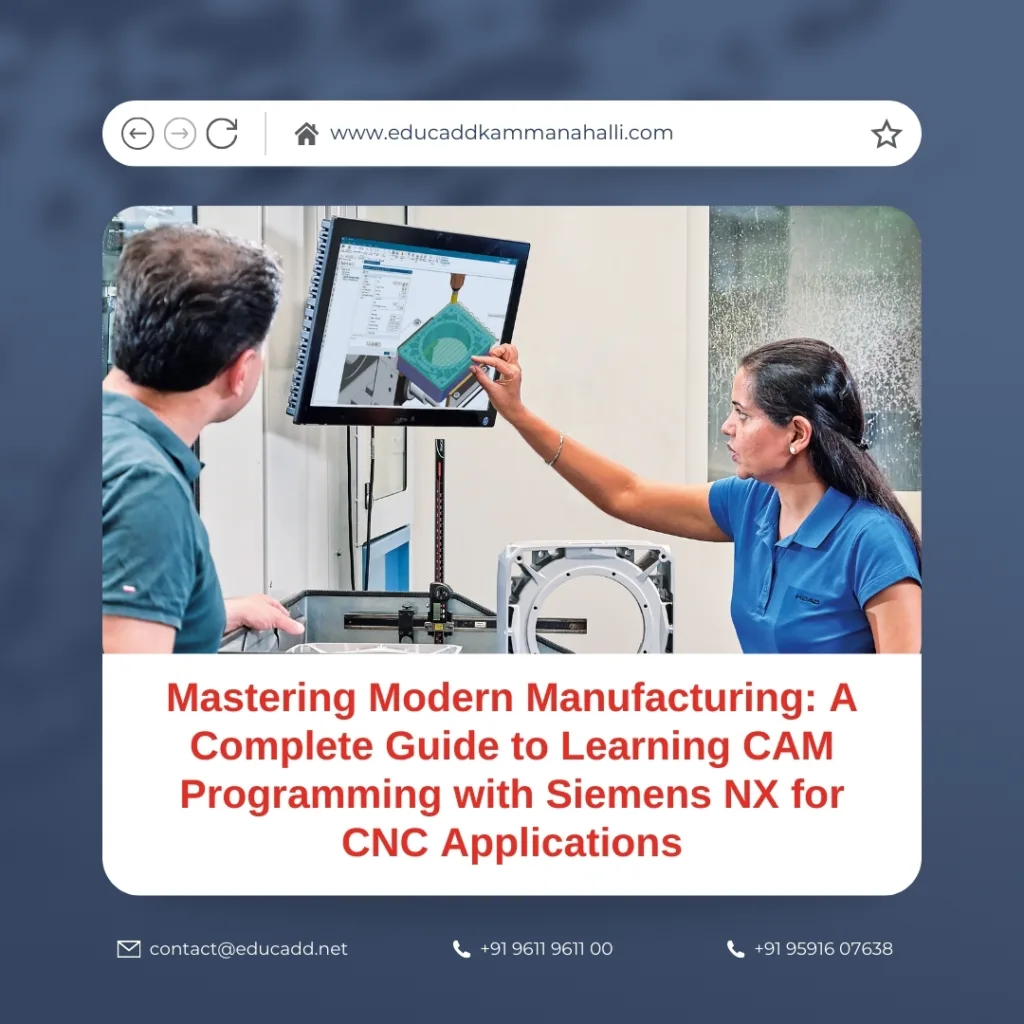
Siemens NX CAM Training
Digital manufacturing continues to evolve at high speed, and companies now depend on integrated design and machining systems to deliver accurate components on time. Skilled professionals who bridge the gap between engineering design and practical machining stand out in today’s competitive environment. Among the many tools available, Siemens NX CAM has emerged as one of the most advanced and trusted platforms for modern CNC programming.
1. Understanding the Digital Shift in Modern Manufacturing
Digital manufacturing is now at the center of global production. Companies rely on automation, connected workflows, and real-time data to stay competitive. This shift has increased the need for advanced software platforms that support efficient machining operations and team collaboration.
The Rise of Integrated Digital Systems
Manufacturers used to rely on manual drawings and separate tools to manage design and machining. Today, smart factories run on unified systems that connect CAD, CAM, and data management. Engineers now create designs digitally and share information instantly with machinists. The result is faster communication, fewer errors, and shorter production cycles.
This digital ecosystem works best when supported by strong CAM platforms. Siemens NX CAM stands out because it links the design, machining, simulation, and validation stages without data loss. As industries push toward automation, the Siemens NX CAM Training grows rapidly. Companies want professionals who can adapt to digital workflows and maintain high productivity.
Why Digital Manufacturing Improves Efficiency
Digital tools provide a clear view of the entire manufacturing process. Engineers can assess tolerances, machinists can review toolpaths, and managers can track performance metrics. By integrating these tasks into one platform, manufacturers reduce mistakes and improve output quality.
Engineers also gain better control over machining strategies. They can use simulation to test operations before cutting material. This reduces scrap, protects tools, and provides safer machine conditions. The shift toward digital operations gives manufacturers the power to optimize productivity without increasing cost.
Industry Demand for CAM-Ready Professionals
Manufacturing companies now require professionals who understand design systems and machine behavior. Skilled CAM programmers help reduce production delays, improve part accuracy, and optimize machine performance.
Companies value experts who can learn CAM programming with Siemens NX for CNC applications, because they bring flexibility, problem-solving ability, and digital machining insights. With this skill, engineers can create precise toolpaths, troubleshoot machining issues, and improve part quality. As a result, CAM professionals enjoy strong career opportunities in aerospace, automotive, medical device manufacturing, and precision machining industries.
2. Why Siemens NX CAM Leads in CNC Programming
With many CAM systems available, Siemens NX continues to dominate because of its advanced features, stable performance, and strong integration with CAD and CAE tools. It gives professionals a complete environment for modeling, manufacturing, and simulation.
A Unified CAD-CAM-CAE Ecosystem
One of Siemens NX’s biggest strengths is that it combines design and manufacturing into one seamless platform. A change in design updates manufacturing operations instantly. This eliminates rework and helps teams maintain consistent results.
By working in a unified environment, engineers avoid data translation issues, geometry errors, and time-consuming file conversions. This gives Siemens NX a clear advantage over standalone CAM tools.
Advanced Toolpath Strategies for Every Industry
Siemens NX offers machining solutions for simple 2-axis tasks as well as complex 5-axis operations. The software supports roughing, semi-finishing, finishing, high-speed machining, adaptive clearing, and specialized strategies for molds, dies, aerospace components, and precision parts.
These advanced options benefit every programmer who wants to learn CAM programming with Siemens NX for CNC applications. The software helps programmers create efficient paths that reduce cycle time, limit tool wear, and improve surface finish.
Strong Simulation and Error Prevention Features
A major advantage of Siemens NX is its full machine simulation. Users can model machine kinematics, tool movements, fixtures, and workpiece interactions. This allows programmers to catch collisions, over-travel errors, and motion conflicts before machining begins.
Simulation increases safety and prevents expensive machine damage. It also boosts confidence, especially when dealing with advanced machines or tight tolerances.
Support for Complex CNC Machines
Siemens NX supports 3-axis, 4-axis, 5-axis, and multi-function machines. This makes it suitable for advanced industries that require tight tolerance and efficiency.
Professionals who use multi-axis machining appreciate NX’s flexibility and control. They can create smooth, accurate paths that work well even on complex shapes and freeform surfaces.
3. Essential Skills You Develop When Learning Siemens NX CAM
To become a strong CAM programmer, you need a structured roadmap. Siemens NX gives learners the tools and interface to develop skills that apply directly to real-world CNC machining.
Mastering Geometry and Manufacturing Models
Before toolpath creation, understanding geometry is essential. Siemens NX recognizes surfaces, solids, edges, and boundaries. The software reads model topology and converts it into machinable features.
When you learn CAM programming with Siemens NX for CNC applications, you begin to understand how design geometry affects machining strategy. You learn to prepare models, clean geometry, define machining regions, and manage visibility for better workflow.
Understanding Tools, Holders, and Cutting Parameters
Siemens NX provides full control over tool geometry, holder design, feed rates, spindle speeds, and cutting parameters. Programmers can build custom tool libraries and match them to materials and operations.
You learn:
-
How tool radius affects corner cleanup
-
How flute length influences step-down values
-
How feed rates change based on material
-
How holders affect reach and clearance
These skills help you create efficient strategies and protect cutting tools from early wear.
Toolpath Creation and Motion Optimization
Creating toolpaths is one of the core skills of CAM programming. Siemens NX offers intuitive controls that guide users through roughing, rest machining, contouring, drilling, and multi-axis programming.
Programmers also learn optimization techniques that reduce air cuts, adjust stepover values, and improve engagement angles. This leads to smoother motion, lower cycle times, and better surface quality.
Simulation, Verification, and Post-Processing
Verification ensures that toolpaths behave correctly on the actual machine. Siemens NX simulates machine movement, checks spindle behavior, and evaluates clearance.
Post-processing converts the toolpath into G-code that CNC machines can understand. With the right post-processor, you produce clean code that fits your machine’s requirements.
Building Confidence Through Repeated Practice
Learning CAM is a hands-on process. Every toolpath teaches something new. When learners practice on real projects, they gain experience in evaluating machining problems and choosing the right strategies for each geometry.
4. Real-World Advantages of Learning Siemens NX CAM for CNC Machining
Siemens NX is not only a useful learning tool—it delivers measurable results on actual production floors. Companies trust NX because of its reliability and strong machining logic.
Faster Programming with Better Productivity
Siemens NX automates many tasks that once required manual effort. Its powerful algorithms generate toolpaths quickly and predict how material will be removed. This advanced logic lets programmers handle complex parts without slowing down production.
When teams work faster, companies reduce lead time and deliver parts sooner.
Consistent Quality Across Every Machined Part
Consistency is essential in modern manufacturing. Siemens NX supports predefined templates, tooling libraries, and standardized machining strategies. Teams can store their best methods and apply them to similar jobs.
Professionals who Siemens NX CAM Training produce repeatable results that maintain tight quality control.
Improved Collaboration Between Design and Manufacturing Teams
Designers and machinists often work in different environments, which can lead to miscommunication. Siemens NX solves this by allowing both teams to work with the same digital models.
A design update flows through the CAM module instantly. This prevents delays and protects production schedules.
Support for High-Performance Machining
Many industries need advanced machining capabilities. Siemens NX supports high-speed cutting, multi-axis machining, toolpath smoothing, and high-precision finishing.
This makes it ideal for sectors that handle complex geometries, such as:
-
Aerospace blade machining
-
Automotive powertrain components
-
Medical implants
-
Mold and die production
With these capabilities, programmers deliver reliable results even for demanding applications.
5. The Best Way to Learn Siemens NX CAM Effectively
A structured learning plan helps newcomers and professionals build strong confidence. Siemens NX offers tools that make learning smooth and practical.
Start With the Interface and Manufacturing Workflow
Beginners should explore the interface to understand where tools, dialogs, and settings are located. The manufacturing environment includes operation browsers, geometry selectors, and toolpath options.
This foundation helps learners move more quickly through advanced operations.
Work on Step-by-Step Tutorials and Practical Projects
Hands-on learning is the most effective approach. Start with simple parts, generate toolpaths, and verify results. Each project adds new skills and strengthens understanding.
Practicing on various shapes helps learners recognize different machining patterns.
Study CNC Machine Behavior Alongside CAM Concepts
CAM programming becomes easier when you understand CNC fundamentals. Learn how machine axes move, how spindle speed affects cutting, and how G-code works.
When you learn CAM programming with Siemens NX for CNC applications, you also learn how machine limits influence toolpath decisions.
Use Simulation to Build Safe, Predictable Programs
Simulation helps learners see how the cutter interacts with material. This visual feedback improves their decision-making and reduces errors.
Testing each path before production ensures safety and builds a professional workflow.
Advance Into Multi-Axis Machining for Greater Career Growth
Once you understand 3-axis programming, you can grow into 4-axis and 5-axis machining. These operations require deeper understanding but offer major career advantages.
Industries prefer programmers who can handle advanced motion control and create reliable strategies for complex geometries.
Conclusion
The future of manufacturing depends on professionals who understand digital workflows and advanced machining strategies. Siemens NX CAM Training, you gain a powerful skill that improves engineering accuracy, production speed, and overall efficiency. Siemens NX supports every stage of manufacturing—from design to toolpath optimization—and gives programmers strong control over real machining outcomes.
With consistent practice, real-world projects, and a structured learning path, you can master Siemens NX CAM and unlock strong career opportunities in modern manufacturing. This skill strengthens your ability to solve machining challenges, produce high-quality components, and contribute to digital transformation across industries.

