
From Mesh to Masterpiece: Advanced STL to Solid Model Conversion Techniques for Modern Engineering
In the world of product design, reverse engineering, additive manufacturing, and digital prototyping, converting mesh files into editable CAD models has become an essential process. Among various file formats, STL files are the most widely used for 3D printing and scanning applications. However, STL models consist of thousands or even millions of triangular facets, making them difficult to modify in conventional CAD software. This is where STL to Solid Conversion play a critical role. Engineers, designers, and manufacturing professionals rely on these techniques to transform mesh-based geometry into accurate solid models that support editing, analysis, simulation, and production workflows.
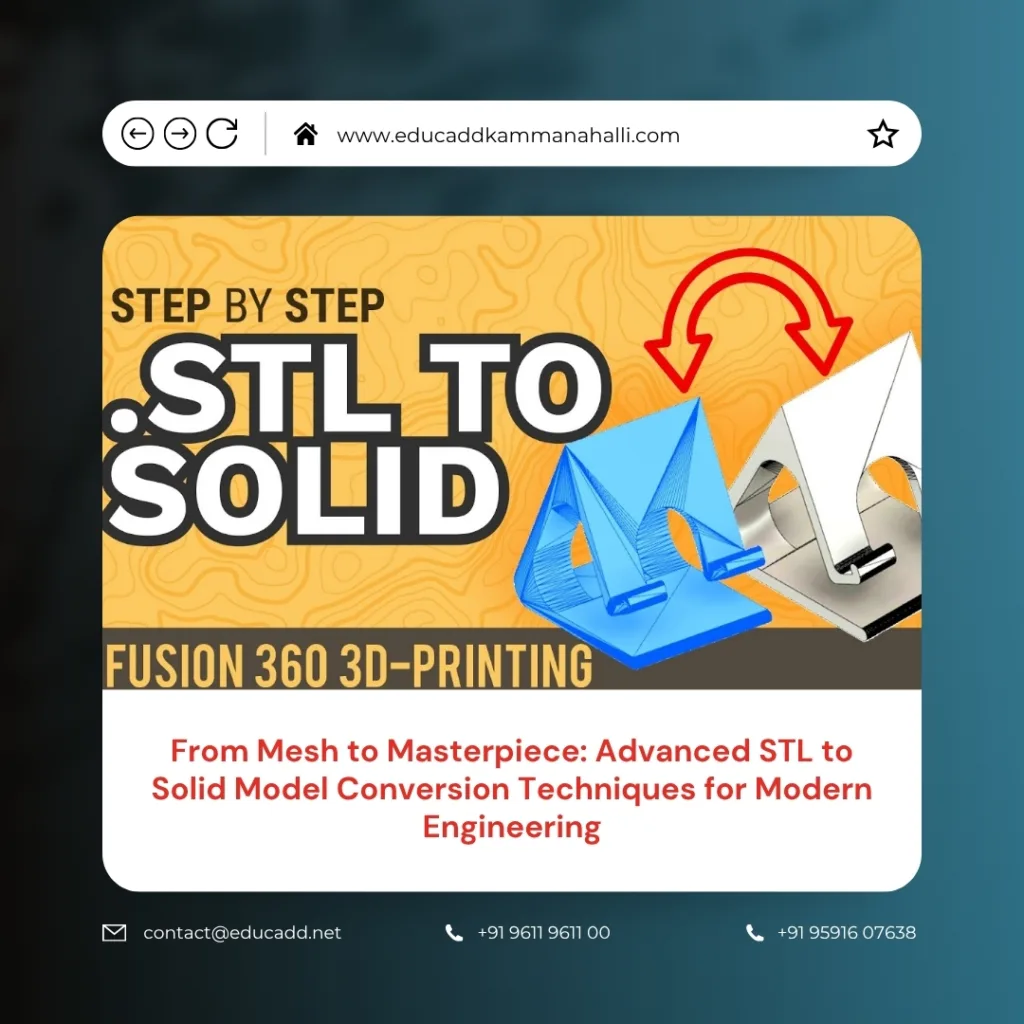
STL to Solid Conversion
As industries increasingly adopt digital manufacturing and reverse engineering practices, the demand for efficient conversion methods continues to grow. A properly converted solid model allows users to make design modifications, create technical drawings, perform finite element analysis, and integrate scanned data into product development cycles. Understanding modern conversion approaches helps professionals improve productivity while maintaining geometric accuracy and design intent.
Understanding STL Files and Their Limitations
An STL file represents a three-dimensional object through a collection of connected triangular facets. Each triangle contains information about its vertices and surface orientation. While this format works exceptionally well for 3D printing, it lacks intelligent design features such as dimensions, parametric relationships, constraints, and feature history. Consequently, editing an STL file directly within CAD software becomes challenging.
Most engineering applications require solid models because they contain mathematically defined surfaces and volumes. Engineers can modify dimensions, add features, and perform simulations using solid geometry. Since STL files only represent surface approximations, they cannot provide the flexibility needed for advanced design modifications. Therefore, organizations often invest significant effort into STL to Solid Model Conversion Techniques to bridge the gap between scanned or printed data and engineering-ready CAD models.
Why STL to Solid Conversion Is Important in Modern Engineering
The importance of converting STL files into solid models extends across multiple industries. Reverse engineering projects often begin with a scanned object represented as an STL mesh. Manufacturers may need to redesign legacy components for which original CAD data no longer exists. Similarly, quality control teams compare scanned products against design specifications using converted solid models.
The benefits of conversion include:
- Improved design flexibility and editability.
- Better compatibility with CAD, CAM, and CAE software platforms.
Moreover, engineering teams can optimize product designs, conduct structural analysis, and generate manufacturing documentation once a solid model becomes available. These advantages make STL conversion a valuable skill in aerospace, automotive, medical device, consumer product, and industrial equipment sectors.
Preparing STL Files Before Conversion
Before beginning the conversion process, engineers should evaluate and prepare the STL file carefully. Mesh quality significantly affects the accuracy and success of the final solid model. Many scanned or downloaded STL files contain defects such as holes, overlapping triangles, non-manifold edges, and distorted surfaces.
Mesh repair software helps identify and correct these issues. Engineers often remove unnecessary triangles, fill gaps, smooth rough surfaces, and eliminate duplicate facets before conversion. Proper preparation reduces computational complexity and improves conversion accuracy. Additionally, cleaning the mesh allows CAD software to interpret geometric relationships more effectively, resulting in a higher-quality solid model.
A well-prepared mesh forms the foundation for successful STL to Solid Conversion Techniques, ensuring smoother workflows and fewer downstream errors.
Direct Mesh-to-Solid Conversion Methods
One of the simplest approaches involves direct conversion of a mesh into a solid body. Many modern CAD platforms offer automated tools that attempt to transform closed mesh geometry into solid models. These tools analyze the triangulated structure and create a volumetric representation based on the mesh boundaries.
Direct conversion works best when the STL file contains a manageable number of triangles and represents relatively simple geometry. Engineers can quickly generate a solid body without extensive remodeling. However, highly detailed meshes may produce excessively complex solids that become difficult to edit. Despite this limitation, direct conversion remains a practical solution for straightforward applications where rapid results are more important than feature-based editing.
As CAD software continues to evolve, automated direct conversion capabilities are becoming more sophisticated and accurate.
Surface Reconstruction Techniques
Surface reconstruction represents one of the most effective STL to Solid Conversion Techniques used in professional engineering environments. Instead of converting individual triangles directly, this method creates smooth mathematical surfaces that approximate the original mesh geometry.
Engineers first segment the mesh into recognizable regions such as planes, cylinders, cones, and freeform surfaces. The software then generates NURBS surfaces that fit these regions accurately. After creating the necessary surfaces, users stitch them together to form a watertight solid model.
Surface reconstruction offers several advantages. The resulting model remains lightweight, editable, and suitable for advanced engineering operations. This technique is particularly valuable when working with complex organic shapes, automotive components, medical implants, and consumer products where smooth surface quality is essential.
Feature-Based Reverse Engineering Approaches
Feature recognition technology has transformed modern reverse engineering workflows. Rather than recreating every triangle, advanced software identifies engineering features such as holes, slots, fillets, bosses, and extrusions within the mesh data.
The software analyzes geometric patterns and automatically generates corresponding CAD features. Engineers can then modify these features using traditional parametric modeling tools. This approach dramatically reduces modeling time while preserving design intent.
Feature-based methods are especially beneficial for mechanical components with well-defined geometric characteristics. By combining automated recognition with manual adjustments, engineers can create highly accurate solid models that support future modifications and manufacturing activities.
Using Hybrid Modeling Strategies
Many engineering projects involve a combination of simple and complex geometry. In such cases, hybrid modeling strategies provide the most efficient solution. Engineers use automatic conversion for standard geometric regions while manually reconstructing intricate surfaces that require greater precision.
This balanced approach combines speed with accuracy. For example, planar surfaces and cylindrical features may be converted automatically, while freeform curves and sculpted surfaces receive specialized reconstruction treatment. Hybrid workflows allow professionals to optimize resources while achieving superior model quality.
Organizations dealing with complex reverse engineering projects frequently adopt hybrid methodologies because they offer flexibility and adaptability across diverse product categories.
Role of NURBS in STL Conversion
Non-Uniform Rational B-Splines, commonly known as NURBS, play a central role in advanced conversion processes. NURBS surfaces provide mathematical descriptions of curves and shapes that are both accurate and computationally efficient.
Unlike STL meshes, which rely on thousands of discrete triangles, NURBS surfaces define geometry using control points and mathematical equations. This structure enables smooth editing, precise dimensioning, and seamless integration with CAD systems.
Several benefits make NURBS-based conversion attractive:
- Excellent surface smoothness and geometric continuity.
- Superior compatibility with engineering design and simulation software.
As a result, many professional-grade STL to Solid Model Conversion Techniques incorporate NURBS reconstruction as a fundamental step in the workflow.
Popular Software Tools for STL to Solid Conversion
Numerous software platforms support STL conversion processes. Each solution offers unique capabilities depending on project requirements and complexity levels. Popular engineering tools include CAD systems, reverse engineering software, and specialized mesh-processing applications.
Well-known platforms provide automated mesh repair, surface reconstruction, feature recognition, and solid modeling functions within a unified environment. Some software packages focus primarily on reverse engineering, while others integrate conversion tools into broader design ecosystems.
Selecting the right software depends on factors such as model complexity, required accuracy, workflow integration, budget constraints, and user expertise. Organizations should evaluate these criteria carefully to maximize conversion efficiency and project outcomes.
Challenges Faced During Conversion Projects
Despite significant technological advancements, STL conversion still presents several challenges. Large mesh files often contain millions of triangles, increasing computational demands and processing times. Furthermore, scanned data may include noise, missing regions, or measurement inaccuracies that complicate reconstruction efforts.
Another challenge involves preserving design intent. While geometric accuracy remains important, engineers must also understand the functional purpose of specific features. Failure to capture design intent can lead to models that appear correct but perform poorly during manufacturing or operation.
Complex freeform surfaces create additional difficulties because they require sophisticated reconstruction algorithms and extensive manual intervention. Consequently, successful conversion projects demand both technical expertise and a systematic workflow.
Best Practices for Accurate Conversion Results
Achieving high-quality results requires adherence to proven engineering practices. Professionals should begin by evaluating project objectives and determining the desired level of model accuracy. Understanding whether the final model will support manufacturing, inspection, simulation, or visualization helps guide the conversion strategy.
Engineers should also maintain a balance between accuracy and efficiency. Excessive detail can create unnecessarily large CAD models, while oversimplification may compromise functionality. Regular validation against original scan data ensures dimensional consistency throughout the process.
Additionally, maintaining organized workflows, documenting reconstruction decisions, and verifying critical dimensions help minimize errors and improve project success rates. These practices enhance the effectiveness of STL to Solid Model Conversion Techniques across various engineering applications.
Applications Across Industries
The adoption of STL conversion technologies continues to expand across multiple industries. Aerospace companies use reverse engineering to reproduce obsolete components and improve maintenance operations. Automotive manufacturers analyze physical prototypes and optimize vehicle designs through digital reconstruction.
Medical professionals convert patient-specific scans into solid models for implant design and surgical planning. Consumer product companies leverage conversion workflows to accelerate product development and market introduction. Industrial equipment manufacturers utilize these techniques to modernize legacy systems and improve operational efficiency.
As digital transformation advances, solid model conversion will remain a critical capability supporting innovation, customization, and advanced manufacturing initiatives worldwide.
Future Trends in STL to Solid Model Conversion
Emerging technologies are reshaping conversion workflows. Artificial intelligence and machine learning algorithms now assist in feature recognition, surface reconstruction, and automated geometry classification. These innovations reduce manual effort while improving accuracy and consistency.
Cloud-based processing platforms enable organizations to handle larger datasets without investing heavily in local computing infrastructure. Meanwhile, advancements in 3D scanning technology continue to produce higher-quality mesh data that simplifies downstream conversion activities.
Future developments will likely focus on greater automation, faster processing speeds, and improved integration between scanning, modeling, simulation, and manufacturing environments. These advancements will further enhance the effectiveness of STL to Solid Conversion Techniques and support increasingly sophisticated engineering applications.
Conclusion
The ability to transform mesh-based STL files into fully editable CAD models has become an indispensable skill in modern engineering. Through advanced STL to Solid Conversion Techniques, professionals can unlock the value of scanned data, reverse engineer legacy components, improve product designs, and streamline manufacturing workflows. Whether using direct conversion, surface reconstruction, feature recognition, hybrid modeling, or NURBS-based approaches, selecting the appropriate technique is essential for achieving accurate and usable results.
As industries continue embracing digital engineering and additive manufacturing, the demand for reliable STL conversion methods will only increase. Organizations that master these techniques gain a competitive advantage through improved design flexibility, faster product development cycles, enhanced quality control, and more efficient innovation processes. By understanding the principles, challenges, and emerging trends of STL conversion, engineers can confidently navigate the evolving landscape of modern product development and manufacturing.

