
Mastering SDLC: A Strategic Blueprint for Efficient and Scalable Software Development
Software powers almost every modern business process, from small startups managing customer data to global enterprises running complex digital ecosystems. Yet successful software does not emerge from random coding efforts or scattered ideas. It evolves through a structured, disciplined, and strategic approach known as the Software Development Life Cycle. Strategic Software Development Lifecycle for efficient software development helps organizations reduce risk, control costs, enhance quality, and deliver value consistently.
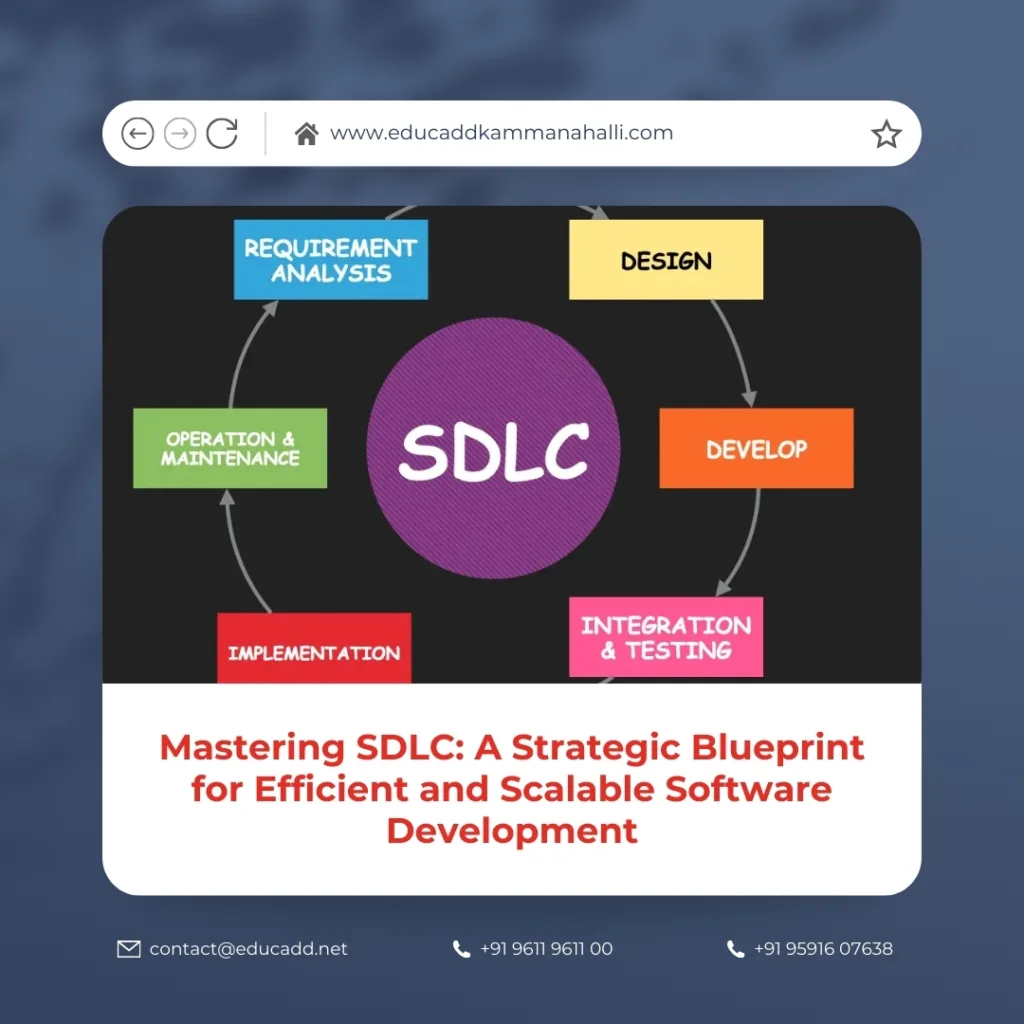
Strategic Software Development Lifecycle
When teams follow a clear life cycle, they move from concept to deployment with clarity and confidence. Moreover, they avoid confusion, reduce rework, and maintain alignment with business objectives. This blog explores every stage of the Software Development Life Cycle in depth. It explains how each phase contributes to efficiency, scalability, and long-term sustainability. By the end, you will gain a practical and strategic understanding of SDLC that can elevate your development process.
1. What Is SDLC and Why It Matters
The Strategic Software Development Lifecycle a structured framework that guides software projects from initial planning to final maintenance. It defines specific phases, responsibilities, and deliverables that ensure consistency and clarity throughout the project. When organizations understand SDLC for efficient software development, they transform software creation from a chaotic process into a systematic operation.
Instead of rushing into development, teams first analyze requirements, define scope, and design architecture. This structured flow reduces misunderstandings and prevents costly mistakes. Furthermore, it creates accountability because each phase has measurable outcomes.
Efficiency improves significantly when teams follow a life cycle model. Deadlines become realistic, communication improves, and resources are utilized effectively. As a result, businesses experience fewer delays and lower operational risks. SDLC does not restrict creativity; rather, it provides a framework that channels innovation productively.
2. The Core Phases of the Software Development Life Cycle
To truly understand SDLC for efficient software development, one must explore its core phases. Although models vary slightly, most follow six major stages: planning, requirement analysis, design, development, testing, deployment, and maintenance.
Each phase builds upon the previous one. Planning defines objectives and feasibility. Requirement analysis gathers user expectations. Design structures the solution. Development transforms designs into functional code. Testing ensures reliability. Deployment delivers the product to users. Maintenance supports ongoing improvements.
When teams respect this sequence, they minimize confusion and maximize productivity. Moreover, structured transitions between phases help maintain quality standards. Efficiency emerges not from speed alone but from disciplined execution.
3. Planning: Building a Strong Foundation
Planning forms the backbone of the Software Development Life Cycle. Without careful planning, even the most talented developers struggle to deliver consistent results. During this phase, stakeholders define project goals, timelines, budgets, and risk assessments.
Project managers analyze feasibility from technical, operational, and financial perspectives. They evaluate available resources and estimate costs. Additionally, they identify potential risks and create mitigation strategies.
Effective planning ensures alignment between business needs and technical capabilities. It prevents scope creep and clarifies expectations. Consequently, teams avoid unnecessary delays. When organizations understand SDLC for efficient software development, they treat planning as a strategic investment rather than a mere formality.
4. Requirement Analysis: Defining What Truly Matters
Requirement analysis bridges the gap between business vision and technical execution. In this stage, analysts gather detailed functional and non-functional requirements from stakeholders. They conduct interviews, workshops, and surveys to capture user needs accurately.
Clear documentation plays a vital role here. Well-defined requirements reduce ambiguity and prevent misinterpretation. Furthermore, they provide a reference point for developers and testers.
Inefficient requirement gathering often leads to rework and budget overruns. However, when teams focus on clarity and collaboration, they eliminate confusion early. Understanding SDLC for efficient software development emphasizes the importance of precise requirement analysis as a cornerstone of project success.
5. System Design: Turning Vision into Architecture
System design transforms requirements into a technical blueprint. Architects define system structure, database models, user interfaces, and integration strategies. They choose suitable technologies, frameworks, and tools.
Design decisions influence scalability, performance, and security. Therefore, architects must evaluate long-term implications carefully. A well-designed system adapts easily to future enhancements.
Good design also improves collaboration. Developers receive clear guidelines, which reduces uncertainty. Additionally, testers understand expected behaviors more effectively. When organizations prioritize design within the Software Development Life Cycle, they reduce technical debt and enhance overall efficiency.
6. Development Phase: Bringing Ideas to Life
The development phase converts design specifications into working software. Developers write code, create modules, and integrate components according to the defined architecture.
Collaboration remains essential during this phase. Developers communicate regularly with designers and analysts to clarify doubts. Moreover, they follow coding standards and documentation practices to maintain quality.
Modern teams often use version control systems and continuous integration tools. These technologies improve transparency and reduce integration conflicts. By Strategic Software Development Lifecycle, teams recognize that disciplined coding practices directly impact project stability and scalability.
7. Testing: Ensuring Quality and Reliability
Testing verifies whether the developed software meets requirements and functions as expected. Quality assurance teams conduct unit testing, integration testing, system testing, and user acceptance testing.
Effective testing identifies defects early. Consequently, developers fix issues before deployment. This proactive approach reduces costs and enhances user satisfaction.
Automation tools accelerate testing processes. They increase coverage while maintaining accuracy. Understanding SDLC for efficient software development highlights that quality cannot be inspected into a product at the end; it must be built and verified continuously.
8. Deployment: Delivering Value to Users
Deployment marks the transition from development to real-world usage. Teams release the software to production environments, ensuring compatibility and performance.
Before deployment, they often conduct staging tests to verify readiness. Clear communication with stakeholders ensures a smooth launch.
A well-managed deployment reduces downtime and user disruption. Furthermore, monitoring systems track performance metrics immediately after release. Organizations that master SDLC for efficient software development treat deployment as a strategic milestone rather than a simple technical step.
9. Maintenance: Sustaining Long-Term Performance
Software requires ongoing support after deployment. Maintenance includes bug fixes, performance enhancements, security updates, and feature upgrades.
User feedback plays a critical role during this stage. Teams analyze insights and implement improvements. Continuous monitoring ensures system stability.
Maintenance extends the product lifecycle and protects investments. Therefore, understanding SDLC for efficient software development involves recognizing that software evolution never truly stops. Instead, it adapts continuously to changing market demands.
10. Popular SDLC Models and Their Impact
Various models exist within the Software Development Life Cycle framework. Each model offers unique advantages depending on project complexity and requirements.
The Waterfall model follows a linear approach. Agile promotes iterative development and flexibility. Spiral emphasizes risk management. DevOps integrates development and operations for faster delivery.
Selecting the right model enhances efficiency significantly. For instance, Agile suits dynamic environments, while Waterfall works well for clearly defined projects. Understanding SDLC for efficient software development enables organizations to choose models strategically rather than randomly.
11. Risk Management and Quality Control in SDLC
Risk management remains integral to every stage of the Software Development Life Cycle. Teams identify potential challenges, assess impact, and implement preventive strategies.
Quality control measures ensure compliance with standards and best practices. Code reviews, audits, and automated testing strengthen reliability.
When organizations embed risk management into SDLC, they reduce uncertainties and enhance stakeholder confidence. Consequently, projects achieve greater predictability and success rates.
12. Enhancing Collaboration Through Structured Processes
Efficient software development depends heavily on teamwork. SDLC fosters collaboration by defining roles and responsibilities clearly. Analysts, developers, testers, and project managers work cohesively within structured boundaries.
Regular communication ensures alignment. Meetings, progress reports, and collaborative tools streamline workflows. Additionally, transparency builds trust among stakeholders.
By understanding SDLC for efficient software development, teams create an environment where accountability and innovation coexist harmoniously.
13. Cost Efficiency and Resource Optimization
Cost control represents a major benefit of the Software Development Life Cycle. Structured planning and phased execution prevent budget overruns.
Resource allocation becomes more strategic when tasks are clearly defined. Teams avoid duplication of effort and minimize waste.
Furthermore, early detection of issues reduces expensive corrections later. Understanding SDLC for efficient software development enables organizations to maximize return on investment while maintaining high standards.
14. The Future of SDLC in a Rapidly Evolving World
Technology evolves rapidly, and so does the Software Development Life Cycle. Artificial intelligence, automation, and cloud computing reshape traditional workflows.
Modern SDLC approaches emphasize continuous integration, continuous delivery, and real-time monitoring. Teams adopt flexible methodologies to adapt quickly to market changes.
Nevertheless, the core principles remain consistent: planning, clarity, collaboration, and quality. Understanding SDLC for efficient software development prepares organizations to navigate technological shifts confidently while maintaining operational stability.
Conclusion
Software success rarely occurs by accident. It results from disciplined processes, strategic planning, and collaborative execution. The Software Development Life Cycle provides a proven framework that transforms complex projects into manageable, structured journeys.
By Strategic Software Development Lifecycle, organizations enhance productivity, reduce risks, and deliver reliable solutions consistently. Each phase plays a critical role, from planning and analysis to deployment and maintenance. When teams embrace this structured approach, they create software that not only meets current requirements but also adapts to future challenges.
Ultimately, SDLC empowers businesses to innovate responsibly and sustainably. It balances creativity with discipline and speed with quality. As digital transformation accelerates across industries, mastering SDLC becomes not just beneficial but essential for long-term success.

