
Stress Analysis to Prevent Product Failures: The Key to Building Stronger, Safer, and More Reliable Products
In today’s highly competitive manufacturing environment, companies must deliver products that perform flawlessly under different working conditions. Customers expect durability, safety, and long-lasting performance from every product they purchase. Even a small structural weakness can lead to severe product failures, customer dissatisfaction, financial losses, and damage to a company’s reputation. Therefore, manufacturers across industries now rely heavily on Stress Analysis Product Failures to ensure products remain strong and reliable throughout their lifecycle. Stress Analysis Product Failures plays a critical role in identifying weak points in a design before production begins.
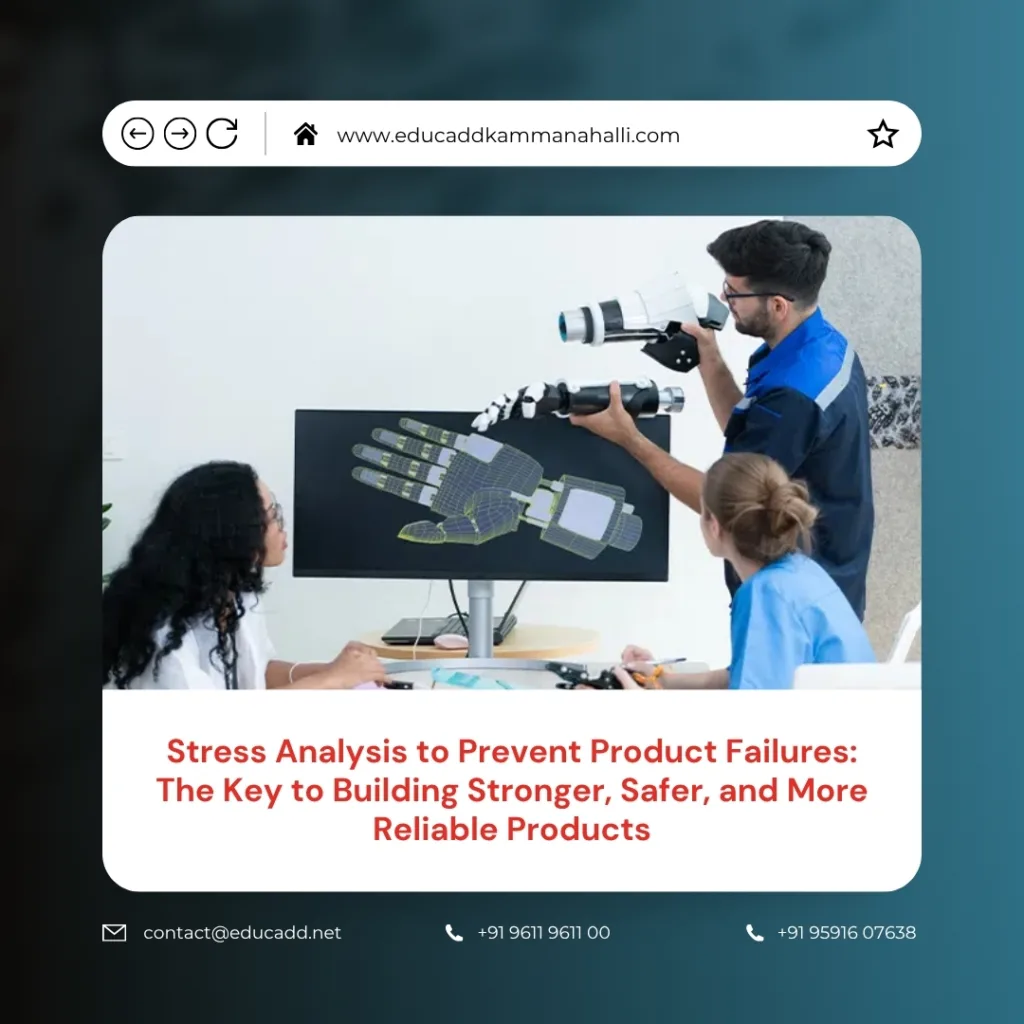
Stress Analysis Product Failures
Engineers use advanced simulation tools and engineering techniques to evaluate how products react to forces, pressure, vibration, heat, and environmental conditions. This process helps companies improve product quality, reduce manufacturing costs, minimize risks, and speed up product development. From automotive parts and aerospace components to medical devices and consumer electronics, stress analysis has become an essential part of modern engineering design.
Understanding the Importance of Stress Analysis Product Failures Development
Stress Analysis Product Failures is a systematic engineering process used to determine how materials and structures respond to external forces. It helps engineers predict whether a product can withstand operational conditions without cracking, deforming, or failing. Without proper analysis, products may experience unexpected breakdowns that can create safety hazards and costly recalls.
Manufacturers use stress analysis during the design phase to identify potential structural problems early. This proactive approach allows engineers to make necessary modifications before physical prototypes are produced. As a result, companies save both time and money while improving product reliability.
Modern engineering industries face increasing pressure to create lightweight yet durable products. Stress analysis makes this possible by helping engineers optimize material usage without compromising structural strength. Consequently, businesses achieve better performance while reducing manufacturing expenses.
How Product Failures Affect Businesses and Customers
Product failures can create devastating consequences for both businesses and consumers. When products fail unexpectedly, companies often face financial losses, legal complications, and reputation damage. Customers lose trust in brands that deliver unsafe or unreliable products.
In industries such as aerospace, automotive, and healthcare, product failures can even lead to life-threatening situations. Therefore, companies must prioritize structural safety and reliability during product development. Stress analysis provides the technical foundation required to prevent these dangerous failures.
Several common issues can result from poor structural design:
- Material cracking and deformation
- Sudden component breakdown under load
These problems often arise because products were not properly tested for real-world operating conditions. Stress analysis helps engineers detect such risks early and develop safer designs.
The Role of Stress Analysis in Modern Engineering
Modern engineering relies heavily on digital simulation technologies to improve product performance. Stress analysis allows engineers to evaluate different loading conditions without manufacturing multiple physical prototypes. This process significantly accelerates product development.
Finite Element Analysis (FEA) has become one of the most widely used methods for stress analysis. Engineers divide complex structures into smaller elements and analyze how each section behaves under stress. This detailed approach helps identify weak areas with remarkable accuracy.
Additionally, stress analysis enables engineers to compare different design options efficiently. Instead of relying on trial-and-error methods, teams can optimize designs through simulation-based decision-making. Consequently, manufacturers achieve higher productivity and better engineering precision.
Types of Stress That Can Cause Product Failures
Products encounter different forms of stress during operation. Each type of stress affects materials differently, and understanding these effects is essential for developing reliable products. Engineers analyze multiple stress conditions to ensure structural stability.
Tensile stress occurs when forces pull materials apart, while compressive stress pushes materials together. Shear stress develops when forces act parallel to a surface, causing layers to slide against each other. Meanwhile, thermal stress results from temperature changes that cause expansion or contraction.
Fatigue stress is particularly dangerous because repeated loading over time can gradually weaken materials. Even when loads remain below the material’s strength limit, continuous cycles may eventually cause cracks and failure. Therefore, fatigue analysis is crucial for products exposed to repetitive motion or vibration.
Why Finite Element Analysis Is Essential for Stress Evaluation
Finite Element Analysis has transformed the way engineers perform stress analysis. Traditional testing methods required expensive prototypes and time-consuming experiments. However, FEA enables engineers to simulate product behavior digitally before production begins.
Through advanced computer modeling, engineers can apply forces, temperature conditions, and motion to virtual designs. The software then calculates stress distribution, deformation, and strain throughout the structure. This process provides accurate insights into product performance under real-world conditions.
FEA offers several important advantages:
- Reduces prototype development costs
- Improves design accuracy and reliability
Because of these benefits, industries worldwide use FEA to improve product quality and accelerate innovation. It has become an indispensable tool for modern mechanical engineering and product development.
Material Selection and Its Impact on Product Strength
Material selection plays a major role in preventing product failures. Even the best design can fail if engineers choose unsuitable materials for the application. Stress analysis helps engineers evaluate material performance under different operating conditions.
Different materials exhibit unique mechanical properties such as strength, ductility, hardness, and elasticity. Engineers must consider these characteristics carefully during product development. For example, aerospace industries prefer lightweight materials with high strength-to-weight ratios, while construction industries prioritize durability and load-bearing capacity.
Stress analysis allows engineers to compare material behavior under various stress conditions. This data helps companies select materials that offer the best balance between performance, cost, and safety. As a result, products become more efficient and reliable.
The Connection Between Stress Analysis and Product Safety
Product safety remains one of the most critical priorities in engineering design. Unsafe products can cause injuries, operational failures, and major legal liabilities. Therefore, stress analysis serves as an essential safety evaluation tool.
Engineers use stress analysis to ensure components remain within allowable stress limits during operation. By identifying structural weaknesses early, companies can eliminate risks before products reach the market. This process significantly improves consumer safety and product reliability.
Industries such as automotive and aerospace follow strict safety regulations that require comprehensive stress testing. Manufacturers must demonstrate that products can withstand extreme conditions without catastrophic failure. Stress analysis helps companies meet these regulatory requirements efficiently.
Reducing Manufacturing Costs Through Early Stress Detection
One of the biggest advantages of stress analysis is cost reduction. Detecting structural issues during the early design stage prevents expensive modifications later in production. Consequently, companies avoid unnecessary manufacturing delays and material waste.
When engineers identify weak points early, they can redesign products before tooling and production begin. This proactive strategy minimizes rework, reduces prototype expenses, and shortens development cycles. Businesses therefore achieve faster product launches and improved profitability.
Additionally, optimized designs often require less material while maintaining structural integrity. Reduced material usage lowers production costs and supports sustainable manufacturing practices. Stress analysis thus contributes to both economic and environmental benefits.
The Importance of Fatigue Analysis in Long-Term Performance
Many products fail not because of sudden overloads but because of repeated stress cycles over time. Fatigue failure occurs gradually, making it difficult to detect without proper analysis. Therefore, fatigue analysis is essential for ensuring long-term product durability.
Components such as engine parts, bridges, turbines, and industrial machinery experience continuous cyclic loading during operation. Small cracks may develop and grow slowly until complete failure occurs. Stress analysis helps engineers predict fatigue life and improve component durability.
Engineers use fatigue testing and simulation tools to evaluate how products behave over extended periods. By understanding fatigue behavior, companies can design products that last longer and require less maintenance. This approach enhances customer satisfaction and reduces operational risks.
Thermal Stress Analysis for High-Temperature Applications
Temperature variations can significantly affect product performance and structural stability. Many industries operate equipment under extreme thermal conditions, making thermal stress analysis highly important. Engineers must understand how heat impacts materials and structures.
When materials expand or contract unevenly due to temperature changes, thermal stress develops. Excessive thermal stress can cause warping, cracking, or complete structural failure. Therefore, products used in aerospace, power generation, and electronics require detailed thermal analysis.
Stress analysis software allows engineers to simulate heat distribution and thermal expansion accurately. This information helps optimize cooling systems, material selection, and structural design. As a result, products perform reliably even in demanding thermal environments.
How Simulation Technology Improves Engineering Accuracy
Engineering simulation technology has advanced rapidly in recent years. Modern stress analysis software provides highly accurate predictions that help engineers make informed design decisions. Simulation-driven engineering reduces uncertainty and improves product quality.
Advanced tools allow engineers to visualize stress concentrations, deformation patterns, and potential failure zones in three-dimensional models. These visual insights improve understanding and enable faster problem-solving. Engineers can also test multiple design variations efficiently.
Moreover, simulation technology supports innovation by allowing companies to experiment with complex geometries and lightweight structures. Businesses can therefore develop high-performance products while maintaining safety and reliability standards.
Industries That Depend Heavily on Stress Analysis
Stress analysis plays a vital role across numerous industries. Every sector that designs mechanical or structural components relies on stress evaluation to ensure product safety and durability. The demand for reliable engineering solutions continues to grow worldwide.
The automotive industry uses stress analysis to improve vehicle safety, fuel efficiency, and crash performance. Aerospace companies depend on it to develop lightweight aircraft structures capable of handling extreme forces. Similarly, construction industries apply stress analysis to ensure building stability and infrastructure safety.
Medical device manufacturers also use stress analysis extensively. Implants, surgical instruments, and healthcare equipment must perform reliably under complex loading conditions. Therefore, engineering simulation remains essential across diverse industrial applications.
Challenges Engineers Face During Stress Analysis
Although stress analysis offers significant benefits, engineers still face several technical challenges during implementation. Accurate results depend on proper modeling techniques, material data, and loading conditions. Small errors can lead to incorrect conclusions.
Complex geometries often require advanced meshing strategies and high computational power. Additionally, some materials exhibit nonlinear behavior that is difficult to simulate accurately. Engineers must therefore possess strong technical expertise to perform reliable analysis.
Another major challenge involves replicating real-world operating conditions. Products may experience unpredictable loads, environmental factors, and manufacturing variations. Consequently, engineers must combine simulation results with practical testing for maximum accuracy.
Future Trends in Stress Analysis and Product Reliability
The future of stress analysis looks highly promising as technology continues to evolve. Artificial intelligence, machine learning, and cloud computing are transforming engineering simulation processes. These innovations enable faster calculations and more accurate predictions.
Digital twin technology is another major advancement in modern engineering. Engineers create virtual replicas of physical products and monitor real-time performance data. This approach helps companies predict failures before they occur and improve maintenance planning.
Additionally, automation and advanced simulation software are making stress analysis more accessible across industries. As technology improves, companies will develop safer, smarter, and more efficient products with greater confidence.
Conclusion
Stress Analysis Product Failures has become an essential engineering practice and improving structural reliability. By analyzing how products respond to different forces, temperatures, and operating conditions, engineers can identify weaknesses before manufacturing begins. This proactive approach reduces costs, enhances safety, and improves overall product quality.
Modern industries depend heavily on advanced simulation tools such as Finite Element Analysis to optimize designs and accelerate product development. From automotive and aerospace to healthcare and construction, stress analysis helps businesses deliver durable and high-performance products that meet customer expectations.
As engineering technology continues to evolve, stress analysis will play an even greater role in shaping the future of product innovation. Companies that invest in advanced analysis techniques will gain a competitive advantage by creating safer, stronger, and more reliable products for the global market.

