
Thermal Analysis in Mechanical Components: Enhancing Performance, Reliability, and Safety
In modern engineering design, understanding how heat behaves inside mechanical systems is critical for achieving optimal performance and reliability. Components in machines, vehicles, electronics, and industrial equipment constantly experience temperature changes due to friction, energy conversion, environmental conditions, and operational loads. When these thermal effects are not properly analyzed, mechanical components may suffer from deformation, reduced efficiency, premature wear, or even catastrophic failure. Thermal Analysis Mechanical Components allows engineers to evaluate how heat flows through materials, how temperature changes affect structural integrity, and how cooling systems can be optimized. Through this process, engineers can predict potential thermal issues before a product reaches the manufacturing stage. As a result, companies can reduce development costs, improve product quality, and extend the operational life of mechanical systems.
With advancements in simulation technologies and computational tools, thermal analysis has become an essential part of modern product development. Industries such as aerospace, automotive, energy, and manufacturing rely heavily on thermal simulations to improve design accuracy. By studying heat transfer, thermal stress, and temperature distribution, engineers can design systems that remain stable under demanding conditions.
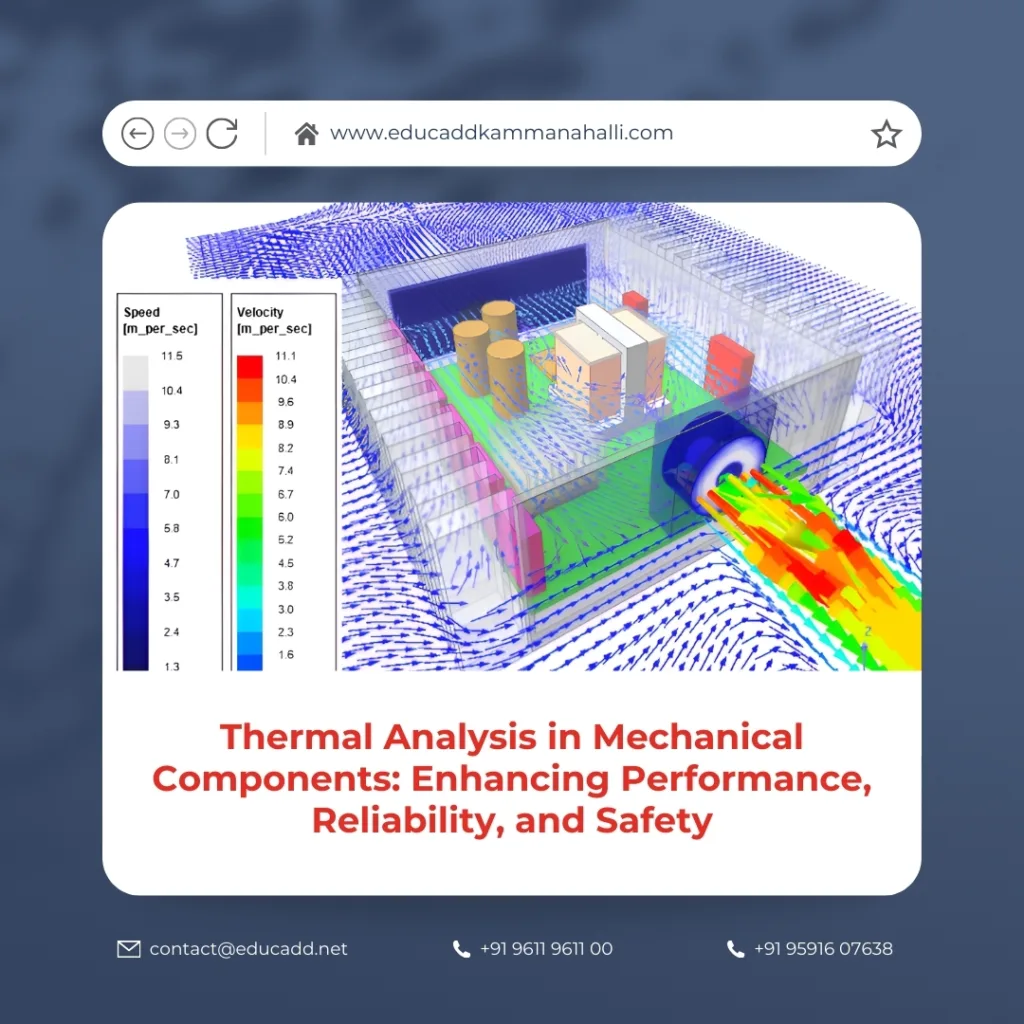
Thermal Analysis Mechanical Components
This article explores the importance, methods, applications, and benefits of thermal analysis in mechanical components. It also explains how engineers use thermal simulations to improve performance, safety, and efficiency in modern engineering systems.
Understanding Thermal Analysis in Mechanical Components
Thermal Analysis Mechanical Components refers to the process of studying temperature distribution and heat flow within mechanical parts. Engineers analyze how heat is generated, transferred, and dissipated within a component during operation. This process helps determine whether a design can withstand the expected thermal loads.
Mechanical systems often operate under high temperatures due to friction, electrical energy conversion, or external environmental factors. When components heat up, materials expand and change their physical properties. If engineers fail to predict these changes, components may lose dimensional accuracy or experience structural damage.
Thermal analysis helps engineers identify hot spots, heat accumulation areas, and inefficient cooling zones within a system. By identifying these areas early, engineers can redesign components to improve heat dissipation and maintain stable operating temperatures.
This process also helps engineers select appropriate materials for different thermal conditions. Some materials conduct heat efficiently, while others resist temperature changes. Choosing the right material improves thermal stability and enhances overall system performance.
Importance of Thermal Analysis in Mechanical Design
Thermal analysis plays a vital role in modern mechanical design because temperature directly influences material behavior, structural stability, and component performance. When engineers ignore thermal effects during design, mechanical systems often face unexpected operational failures.
One major advantage of thermal analysis is that it helps engineers detect design flaws before manufacturing begins. Through simulation tools, engineers can study how heat flows through a component and evaluate different design alternatives. This approach reduces the need for multiple physical prototypes and accelerates the product development process.
Thermal analysis also improves product safety. Excessive temperatures can cause overheating, material fatigue, or structural deformation. By predicting these risks early, engineers can implement better cooling strategies and improve component reliability.
Furthermore, thermal analysis contributes to energy efficiency. Many mechanical systems waste energy due to poor heat management. Engineers can redesign components to minimize energy losses and improve thermal performance.
Fundamental Principles of Heat Transfer
Thermal Analysis Mechanical Components is based on three primary heat transfer mechanisms: conduction, convection, and radiation. These mechanisms describe how heat moves within materials and across surfaces.
Conduction occurs when heat transfers through solid materials. This process depends on the thermal conductivity of the material. Metals, for example, conduct heat faster than plastics or composites. Engineers study conduction to understand how heat travels through mechanical parts.
Convection occurs when heat transfers through fluids such as air or liquids. Cooling systems in engines and electronic devices rely heavily on convection. Engineers analyze airflow patterns and fluid movement to design efficient cooling solutions.
Radiation involves heat transfer through electromagnetic waves. Even without direct contact or fluid movement, objects can exchange heat through radiation. High-temperature systems such as turbines and furnaces often involve significant radiant heat transfer.
Understanding these heat transfer mechanisms helps engineers create accurate thermal models and design systems that maintain stable temperatures during operation.
Thermal Stress and Material Behavior
Temperature changes can significantly affect the mechanical properties of materials. When materials heat up, they expand. When they cool down, they contract. This expansion and contraction can create thermal stress within mechanical components.
Thermal stress occurs when different parts of a component expand at different rates. If the expansion is restricted, internal stresses develop. Over time, these stresses may cause cracks, deformation, or structural failure.
Engineers perform thermal analysis to predict how materials respond to temperature changes. By studying thermal expansion and material properties, engineers can design components that tolerate thermal stress without losing strength or functionality.
Material selection also plays a key role in thermal stability. Engineers consider properties such as thermal conductivity, expansion coefficient, and heat resistance when selecting materials for mechanical components.
Proper thermal analysis ensures that materials remain stable under operating conditions and maintain their structural integrity throughout the product lifecycle.
Role of Thermal Simulation in Engineering
Thermal simulation tools have revolutionized the way engineers analyze heat behavior in mechanical systems. Instead of relying solely on physical experiments, engineers now use advanced simulation software to predict temperature distribution and heat transfer within components.
These simulations allow engineers to visualize temperature patterns and identify potential thermal issues early in the design process. Engineers can test different materials, geometries, and cooling methods without building expensive prototypes.
Thermal simulations also support faster design optimization. Engineers can modify parameters and immediately observe how changes affect temperature distribution and heat flow.
Modern simulation software integrates thermal analysis with structural analysis. This integration helps engineers understand how thermal loads influence mechanical stresses and structural deformation.
As a result, thermal simulation has become an essential tool in product development and engineering design.
Applications of Thermal Analysis in Mechanical Systems
Thermal analysis plays a crucial role in a wide range of industries where temperature affects system performance and reliability. Engineers rely on thermal analysis to design components that operate safely under extreme thermal conditions.
Some major applications include:
-
Automotive engines and braking systems, where heat generation affects performance and durability.
-
Aerospace turbine blades and propulsion systems, where extreme temperatures influence material stability.
In addition, thermal analysis supports the design of electronic cooling systems, manufacturing equipment, and power generation systems. By studying thermal behavior, engineers can improve efficiency and extend the lifespan of mechanical components.
Industries continue to adopt advanced thermal analysis techniques to meet increasing performance and safety requirements.
Thermal Management Techniques
Thermal Analysis Mechanical Components focuses on controlling and regulating temperature within mechanical systems. Effective thermal management prevents overheating and ensures stable operation.
Engineers use several strategies to improve thermal performance. These strategies include heat sinks, cooling channels, insulation materials, and airflow optimization. Each technique aims to remove excess heat or prevent heat accumulation within components.
Proper thermal management also improves energy efficiency. When heat flows efficiently through a system, less energy is wasted, and performance becomes more consistent.
In high-performance applications, such as electric vehicles and aerospace systems, thermal management plays a crucial role in maintaining safe operating conditions.
By combining thermal analysis with smart cooling strategies, engineers create systems that operate efficiently even under demanding conditions.
Finite Element Method in Thermal Analysis
The Finite Element Method (FEM) is widely used in thermal analysis to simulate heat transfer and temperature distribution in mechanical components. This method divides complex structures into smaller elements, allowing engineers to analyze thermal behavior with high accuracy.
FEM-based thermal analysis helps engineers evaluate how heat spreads through different regions of a component. By studying these patterns, engineers can identify thermal gradients and stress concentrations.
The Finite Element Method also supports coupled simulations that combine thermal and structural analysis. This approach allows engineers to study how temperature changes influence mechanical performance.
Modern engineering software uses FEM to perform highly detailed thermal simulations. Engineers rely on these simulations to improve product reliability and reduce design risks.
Through accurate modeling, the Finite Element Method provides valuable insights into thermal behavior and system performance.
Challenges in Thermal Analysis of Mechanical Components
Despite technological advancements, engineers still face several challenges when performing thermal analysis. Real-world systems often involve complex geometries, multiple materials, and varying environmental conditions.
Accurately predicting heat transfer in such systems requires detailed modeling and reliable input data. Even small errors in material properties or boundary conditions can affect simulation results.
Engineers must also consider transient thermal conditions. Many mechanical systems experience rapid temperature changes during operation. These dynamic conditions make thermal analysis more complex.
Another challenge involves balancing accuracy and computational efficiency. Highly detailed simulations require significant computing power and time. Engineers must carefully select modeling techniques that provide reliable results without excessive computational costs.
Addressing these challenges requires experience, advanced tools, and a strong understanding of thermal physics.
Benefits of Thermal Analysis in Product Development
Thermal Analysis Mechanical Components provides several advantages during product development and design optimization. By understanding how heat behaves within a system, engineers can improve performance and reliability.
Key benefits include:
-
Early detection of overheating problems, which prevents costly design failures.
-
Improved product lifespan, because components operate within safe temperature limits.
Thermal analysis also reduces development costs by minimizing the need for repeated physical testing. Engineers can evaluate multiple design options through simulation before finalizing a product.
In addition, companies gain a competitive advantage by delivering products that operate efficiently under demanding conditions.
These benefits highlight why thermal analysis has become a standard practice in modern mechanical engineering.
Thermal Analysis in Automotive Engineering
Automotive engineering relies heavily on thermal analysis to ensure safe and efficient vehicle operation. Engines, braking systems, batteries, and exhaust systems generate significant heat during operation.
Engineers analyze temperature distribution in engine components to prevent overheating and maintain fuel efficiency. Thermal analysis also helps optimize cooling systems such as radiators and airflow channels.
Electric vehicles present additional thermal challenges. Battery packs must operate within specific temperature ranges to maintain performance and safety. Engineers use thermal simulations to design battery cooling systems and prevent thermal runaway.
Brake systems also generate high temperatures due to friction. Engineers analyze thermal behavior to ensure braking components remain stable during heavy use.
Through thermal analysis, automotive engineers develop vehicles that perform reliably under diverse operating conditions.
Future Trends in Thermal Analysis Technology
Thermal analysis technology continues to evolve as engineering tools become more advanced and computational power increases. Emerging technologies are transforming how engineers study heat transfer and temperature behavior in mechanical systems.
Artificial intelligence and machine learning are beginning to assist engineers in predicting thermal performance. These technologies can analyze large datasets and identify patterns that improve simulation accuracy.
Digital twin technology is another promising development. Engineers create virtual replicas of physical systems and monitor their thermal behavior in real time. This approach enables predictive maintenance and performance optimization.
Advanced materials and cooling technologies are also influencing thermal design strategies. Engineers continue to explore new solutions that improve heat dissipation and thermal efficiency.
As industries demand higher performance and reliability, thermal analysis will remain a critical component of engineering innovation.
Conclusion
Thermal Analysis Mechanical Components plays a fundamental role in modern engineering design. By studying heat transfer, temperature distribution, and thermal stress, engineers can predict how components behave under real operating conditions. This knowledge helps prevent overheating, structural failure, and performance loss in mechanical systems.
Through advanced simulation tools and thermal management techniques, engineers can design components that operate safely and efficiently. Industries such as automotive, aerospace, electronics, and manufacturing rely on thermal analysis to improve product reliability and reduce development costs.
As technology advances, thermal analysis will continue to evolve with smarter simulations, artificial intelligence, and digital engineering solutions. These innovations will allow engineers to create more efficient and durable mechanical systems.
Ultimately, effective thermal analysis ensures that mechanical components maintain their strength, stability, and performance throughout their lifecycle. By integrating thermal considerations into the design process, engineers can build systems that meet modern demands for efficiency, safety, and reliability.

