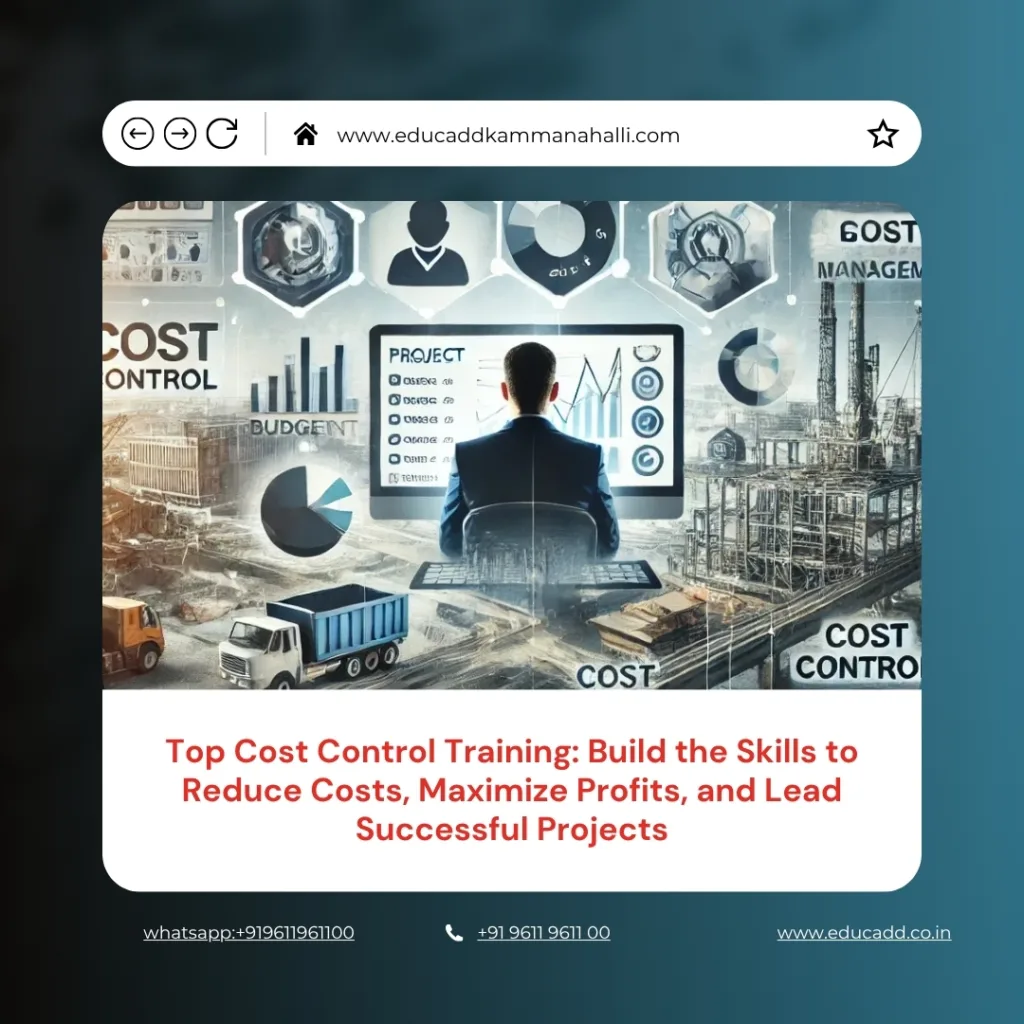
Top Cost Control Training: Build the Skills to Reduce Costs, Maximize Profits, and Lead Successful Projects
Every successful project depends on one essential factor: effective cost control. No matter the industry, organizations aim to complete projects within budget while maintaining quality and meeting deadlines. This goal requires professionals who understand how to plan, monitor, and optimize project expenses. That is why Top Cost Control Training has become one of the most valuable professional development programs for engineers, project managers, planners, quantity surveyors, construction professionals, and finance specialists.
Top Cost Control Training
Cost control is much more than tracking expenses. It involves forecasting budgets, identifying financial risks, managing resources efficiently, analyzing project performance, and making informed decisions that improve profitability. As industries become more competitive, companies actively seek professionals who possess strong cost management skills. Therefore, enrolling in a comprehensive cost control training program can significantly enhance career opportunities while helping organizations achieve financial success.
Why Top Cost Control Training Is Essential for Modern Professionals
Modern projects involve multiple stakeholders, complex schedules, changing material costs, and unexpected risks. Without proper financial planning, even technically successful projects can experience significant losses. Therefore, organizations prioritize professionals who understand cost management principles and can maintain financial discipline throughout every project phase.
Top Cost Control Training provides learners with practical knowledge that helps them monitor budgets effectively and identify cost deviations before they become major issues. Furthermore, participants develop analytical skills that improve financial decision-making. They also gain confidence in handling project budgets, preparing reports, and communicating financial performance to management teams. These capabilities make professionals more valuable in today’s competitive job market.
Understanding the Core Concepts of Cost Control
Before managing project expenses, professionals must understand the fundamental concepts of cost control. A structured training program introduces budgeting, cost estimation, forecasting, earned value management, variance analysis, and financial reporting. Each concept plays a vital role in maintaining project profitability.
Additionally, learners understand how planned costs differ from actual expenditures. They also discover methods to measure project performance accurately using internationally accepted standards. This knowledge enables professionals to detect budget overruns early and implement corrective actions before financial problems escalate. As a result, organizations can maintain greater control over project outcomes and improve long-term business performance.
Learning Accurate Cost Estimation Techniques
Accurate cost estimation forms the foundation of every successful project. Even the best execution strategy cannot compensate for unrealistic budget planning. Therefore, Top Cost Control Training teaches participants how to estimate costs using proven industry methodologies and historical project data.
Students learn to calculate labor expenses, material costs, equipment requirements, subcontractor charges, overhead expenses, and contingency budgets. Furthermore, they understand how market conditions influence project pricing. Through practical exercises, learners improve their estimation accuracy while minimizing financial uncertainty. Consequently, organizations experience fewer budget surprises and better project planning.
Mastering Budget Planning and Resource Allocation
Budget planning requires balancing project requirements with available financial resources. Effective planning ensures that every department receives adequate funding without exceeding organizational limitations. Consequently, project managers can maintain smooth operations while controlling unnecessary spending.
Top Cost Control Training explains how to prepare detailed project budgets that align with organizational objectives. Participants also learn resource allocation techniques that maximize productivity while reducing waste. Moreover, they understand how proper scheduling supports financial efficiency by preventing delays and minimizing idle resources. These planning skills contribute directly to improved project profitability.
Monitoring Project Costs Throughout Execution
Cost control does not end after budget approval. Continuous monitoring remains essential throughout project execution. Regular financial reviews help organizations identify spending patterns, detect deviations, and implement timely corrective actions before small issues become significant financial problems.
Training programs teach professionals how to compare planned budgets with actual expenditures using advanced monitoring techniques. Participants also learn to prepare financial dashboards, cost performance reports, and progress analyses. Furthermore, they gain practical experience using industry-standard software tools that simplify project tracking. This continuous monitoring improves transparency while strengthening financial accountability.
Managing Financial Risks with Confidence
Every project involves financial uncertainty. Material price fluctuations, labor shortages, schedule delays, design modifications, and unexpected site conditions can significantly increase project costs. Therefore, effective risk management becomes a critical component of successful cost control.
Top Cost Control Training introduces structured risk identification and assessment methods. Learners understand how to evaluate potential financial threats and develop practical mitigation strategies. Additionally, they learn contingency planning techniques that reduce the impact of unforeseen events. These proactive approaches help organizations maintain budget stability even under challenging circumstances.
Using Earned Value Management for Better Decision-Making
Earned Value Management, commonly known as EVM, combines scope, schedule, and cost into a single performance measurement system. Many organizations rely on EVM because it provides accurate insights into project health and financial performance.
During Top Cost Control Training, participants learn how to calculate Cost Performance Index, Schedule Performance Index, Budget at Completion, Estimate at Completion, and Estimate to Complete. They also interpret these performance indicators to support management decisions. Consequently, professionals gain valuable analytical skills that improve project forecasting and increase organizational confidence in financial reporting.
Improving Communication Through Cost Reporting
Clear communication supports effective financial management. Project managers, clients, contractors, and executives all rely on accurate reports to understand project performance and make informed decisions. Therefore, preparing professional financial reports becomes an essential skill.
Training programs teach participants how to organize financial information into easy-to-understand reports. They also learn data visualization techniques that simplify complex financial information for stakeholders. Moreover, learners understand how regular reporting promotes accountability, strengthens client confidence, and improves collaboration across project teams. Effective communication ultimately contributes to better project outcomes.
Practical Software Skills for Modern Cost Control
Today’s industries increasingly depend on digital tools to manage project finances. Manual calculations often consume valuable time and increase the likelihood of errors. Therefore, professionals benefit greatly from learning modern software applications that automate financial management processes.
Top Cost Control Training introduces popular cost management software and project planning tools used across construction, engineering, manufacturing, and infrastructure industries. Participants gain practical experience in budgeting, forecasting, cost tracking, scheduling, and financial reporting. Furthermore, these software skills increase employability because employers prefer professionals who can work efficiently with digital systems.
Career Opportunities After Completing Top Cost Control Training
The demand for cost control professionals continues to grow across numerous industries. Construction companies, infrastructure developers, manufacturing organizations, oil and gas firms, consulting agencies, and government departments actively recruit specialists who understand project financial management.
After completing Top Cost Control Training, professionals can pursue roles such as Cost Control Engineer, Project Cost Analyst, Planning Engineer, Project Controls Specialist, Quantity Surveyor, Budget Analyst, Cost Estimator, Commercial Engineer, Project Manager, and Financial Planning Consultant. Furthermore, experienced professionals often progress into senior management positions where they oversee large-scale projects and organizational financial strategies.
Industries That Benefit from Cost Control Expertise
Cost control skills extend beyond construction projects. Manufacturing companies require professionals who optimize production expenses. Information technology organizations monitor software development budgets. Healthcare institutions manage infrastructure investments carefully. Energy companies analyze project expenditures to improve profitability.
Similarly, transportation, real estate, telecommunications, aviation, and industrial engineering sectors rely on effective cost management. Therefore, Top Cost Control Training offers career flexibility across multiple industries. Professionals with strong financial management skills remain valuable regardless of economic conditions because organizations always seek greater operational efficiency.
Choosing the Right Top Cost Control Training Program
Selecting the right training institute significantly influences learning outcomes. A quality program combines theoretical knowledge with practical applications that reflect real industry challenges. Therefore, prospective learners should evaluate course content carefully before enrolling.
An excellent training program includes experienced instructors, practical case studies, software-based exercises, real project examples, certification preparation, career guidance, and industry-oriented assignments. Additionally, learners should consider placement assistance, flexible learning options, updated curriculum, and recognized certifications. These factors help maximize the return on educational investment while improving long-term career growth.
How Cost Control Skills Create Long-Term Professional Success
Technical expertise alone no longer guarantees career advancement. Organizations increasingly value professionals who understand both engineering principles and financial management. Cost control bridges this gap by combining analytical thinking with strategic decision-making.
Professionals who complete Top Cost Control Training develop stronger leadership capabilities because they understand how financial decisions influence project success. They become better at resource optimization, budget planning, stakeholder communication, and performance evaluation. As industries continue evolving, these versatile skills remain highly relevant and position professionals for leadership opportunities across global markets.
Conclusion
Top Cost Control Training provides far more than financial knowledge. It equips professionals with practical skills that improve budgeting accuracy, strengthen project planning, enhance decision-making, reduce financial risks, and maximize organizational profitability. As industries continue demanding greater efficiency and accountability, skilled cost control professionals remain essential for successful project delivery.
Whether you are an engineering graduate, project manager, planner, quantity surveyor, finance professional, or experienced industry expert, investing in Top Cost Control Training can accelerate your career growth and expand your professional opportunities. By mastering cost estimation, budgeting, forecasting, earned value management, financial reporting, and modern software tools, you become a valuable asset to any organization. In today’s competitive business environment, strong cost control expertise is not simply an advantage—it is a professional skill that drives long-term career success and sustainable business performance.

