
Zero-Downtime Success: DevOps Tools That Reduce Deployment Failures
Modern software teams release updates at an unprecedented pace. However, frequent releases often increase the risk of errors, downtime, and frustrated users. Even a minor configuration mistake can interrupt business operations and damage brand credibility. Therefore, organizations must adopt reliable practices and technologies that minimize risk during releases. This is where Zero Downtime DevOps Tools become critical.
DevOps combines development and operations into a unified workflow. It emphasizes collaboration, automation, continuous testing, and rapid feedback. When teams use the right DevOps tools that reduce deployment failures, they create predictable, repeatable, and stable deployment processes. These tools automate builds, enforce testing standards, manage infrastructure, and monitor production environments in real time. As a result, teams deliver features faster while maintaining stability.
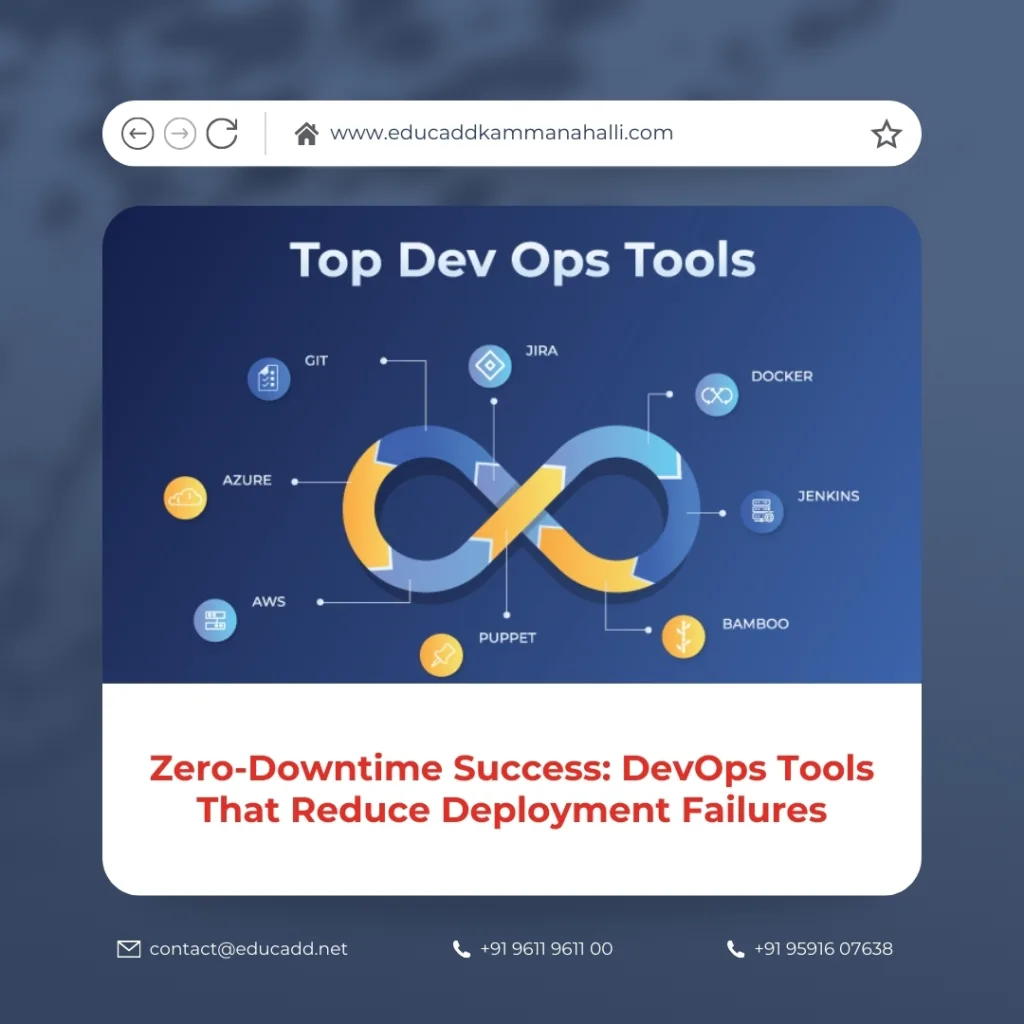
Zero Downtime DevOps Tools
In this comprehensive guide, you will explore the most Zero Downtime DevOps Tools that reduce deployment failures. You will also understand how each tool category strengthens your deployment pipeline. Moreover, you will learn practical strategies that ensure consistent release success. By the end, you will have a clear roadmap for building a failure-resistant DevOps ecosystem.
1. Understanding Deployment Failures in Modern Software Environments
Before selecting Zero Downtime DevOps Tools that reduce deployment failures, you must understand why failures occur. Deployment failures rarely happen because of a single mistake. Instead, they usually result from miscommunication, manual errors, configuration mismatches, or insufficient testing.
For example, a developer may test code in one environment while production runs on a different configuration. Even small differences can break the application. Similarly, manual deployment scripts increase human error. When engineers perform repetitive tasks, they often skip steps or misconfigure files.
Another common issue involves poor visibility. Without monitoring systems, teams cannot detect performance degradation early. Consequently, problems escalate into major outages. In addition, inconsistent rollback mechanisms prolong downtime and complicate recovery.
Therefore, organizations must implement DevOps tools that reduce deployment failures by eliminating manual processes, enforcing consistency, and providing real-time insights. Automation, configuration management, and observability work together to reduce risk. When these components integrate properly, deployments become predictable and controlled.
2. Continuous Integration Tools That Prevent Code Conflicts
Continuous Integration (CI) ensures that developers merge code changes frequently into a shared repository. This approach reduces integration conflicts and identifies errors early. CI tools automatically build and test applications whenever new code appears.
Without CI, developers merge large changes at the end of a project cycle. This process creates unpredictable errors. However, CI tools such as Jenkins, GitHub Actions, or GitLab CI execute automated builds instantly. They detect syntax errors, missing dependencies, and failed tests before deployment begins.
As a result, CI serves as the first line of defense among DevOps tools that reduce deployment failures. Automated testing ensures that broken code never reaches production. Furthermore, CI pipelines standardize workflows across teams. Every developer follows the same validation process.
Moreover, CI encourages smaller, incremental changes. Smaller changes reduce risk and simplify troubleshooting. When issues arise, teams quickly identify the exact commit responsible. Therefore, continuous integration dramatically lowers deployment uncertainty.
3. Continuous Delivery and Continuous Deployment Tools
While CI validates code, Continuous Delivery (CD) ensures that software remains deployable at any time. CD tools automate packaging, staging, and release workflows. They eliminate the guesswork involved in production releases.
Continuous Deployment goes one step further. It automatically pushes validated changes to production without manual approval. Although this approach requires mature testing practices, it significantly reduces deployment bottlenecks.
Tools like Spinnaker, Argo CD, and Azure DevOps streamline release orchestration. They manage approvals, environment promotion, and rollback strategies. Consequently, these DevOps tools that reduce deployment failures ensure consistency across staging and production.
Additionally, CD pipelines enable blue-green deployments and canary releases. Blue-green deployments run two identical environments. One handles live traffic while the other receives updates. If errors occur, traffic switches instantly. This strategy minimizes downtime.
Canary releases deploy changes to a small user segment first. Teams monitor performance metrics before full rollout. Therefore, CD tools dramatically reduce risk during live releases.
4. Version Control Systems That Improve Traceability
Version control systems (VCS) form the backbone of DevOps. They track code history, manage collaboration, and enable safe experimentation. Git remains the industry standard because it supports distributed workflows and branch management.
Without version control, teams cannot trace errors effectively. However, Git platforms such as GitHub, GitLab, and Bitbucket provide audit logs, pull request reviews, and merge conflict detection. These features improve accountability and transparency.
Code reviews, in particular, play a crucial role. When peers review changes before merging, they identify logical errors and security vulnerabilities early. This process reduces deployment failures significantly.
Moreover, branching strategies like Git Flow or trunk-based development maintain stable main branches. Developers test features in isolated branches before merging. Consequently, version control systems stand among the essential DevOps tools that reduce deployment failures.
5. Infrastructure as Code for Environment Consistency
Environment inconsistency causes many deployment failures. Developers test applications in one environment while production runs differently. Infrastructure as Code (IaC) solves this issue by defining infrastructure through configuration files.
Tools such as Terraform, AWS CloudFormation, and Pulumi allow teams to provision servers, networks, and databases programmatically. This method eliminates manual server setup errors.
Because IaC uses version-controlled templates, teams maintain identical environments across development, staging, and production. Moreover, automated provisioning ensures repeatability.
If an environment fails, teams rebuild it instantly using configuration files. Therefore, IaC stands out among DevOps tools that reduce deployment failures by removing configuration drift.
Additionally, IaC promotes scalability. Teams scale infrastructure dynamically without manual intervention. This capability prevents overload failures during high traffic.
6. Configuration Management Tools That Prevent Drift
While IaC provisions infrastructure, configuration management tools maintain server state. Tools like Ansible, Chef, and Puppet enforce consistent configurations across machines.
Configuration drift occurs when servers gradually diverge from intended settings. Over time, minor changes accumulate and cause unexpected failures. However, configuration management tools regularly validate and correct deviations.
For example, if a required package disappears from a server, the tool reinstalls it automatically. This automation reduces runtime errors during deployments.
Furthermore, these DevOps tools that reduce deployment failures ensure that security patches apply uniformly. Consistent patching reduces vulnerabilities and unexpected crashes.
Because configuration management works continuously, it prevents silent misconfigurations that often surface during deployments.
7. Containerization Tools for Portable Deployments
Containerization revolutionized software deployment. Containers package applications with all dependencies into isolated units. Docker remains the most popular container platform.
Containers eliminate environment mismatch problems. Developers build an image once and deploy it anywhere. Since the container includes libraries and runtime dependencies, production mirrors development exactly.
Moreover, container registries store versioned images. Teams deploy specific image tags, ensuring predictable behavior.
Therefore, containerization ranks among the most effective DevOps tools that reduce deployment failures. It guarantees portability and consistency.
Additionally, containers start quickly and scale efficiently. Teams replicate services rapidly during peak demand. This flexibility reduces service interruptions.
8. Container Orchestration Tools for Stability
While containers simplify packaging, orchestration tools manage them at scale. Kubernetes leads in container orchestration. It automates scaling, load balancing, and self-healing.
Kubernetes restarts failed containers automatically. If a node crashes, the system redistributes workloads. This resilience prevents prolonged outages.
Furthermore, Kubernetes supports rolling updates. It replaces containers gradually without downtime. If errors appear, it rolls back to the previous stable version.
Thus, orchestration platforms serve as advanced DevOps tools that reduce deployment failures. They ensure application reliability even during infrastructure disruptions.
Because orchestration systems monitor container health continuously, they detect issues early and respond instantly.
9. Automated Testing Tools That Safeguard Quality
Testing remains one of the strongest defenses against deployment failures. Automated testing tools validate functionality, performance, and security before release.
Unit testing frameworks like JUnit and pytest verify individual components. Integration tests evaluate interactions between services. End-to-end tests simulate user behavior.
Additionally, performance testing tools such as JMeter assess scalability under load. Security scanners detect vulnerabilities proactively.
When teams integrate automated testing into CI pipelines, they catch defects early. Consequently, these DevOps tools that reduce deployment failures prevent unstable releases.
Moreover, test automation accelerates feedback loops. Developers fix issues immediately instead of discovering them in production.
10. Monitoring and Observability Tools for Real-Time Insights
Even with strong testing, issues may arise after deployment. Monitoring tools provide visibility into system health. Tools like Prometheus, Grafana, and Datadog track metrics continuously.
Observability extends beyond metrics. It includes logs, traces, and events. Centralized logging systems such as ELK Stack analyze errors quickly.
When performance degrades, alerts notify teams immediately. Fast detection reduces downtime dramatically.
Therefore, monitoring platforms belong among DevOps tools that reduce deployment failures because they shorten recovery time.
Moreover, historical data helps teams identify recurring patterns. Continuous improvement becomes easier when metrics guide decisions.
11. Feature Flag Management for Controlled Releases
Feature flags allow teams to enable or disable features without redeploying code. This strategy separates deployment from release.
For example, teams deploy new functionality but keep it hidden until ready. If issues appear, they disable the feature instantly.
Tools like LaunchDarkly and Split.io simplify feature flag management. These DevOps tools that reduce deployment failures lower risk during experimentation.
Additionally, feature flags support A/B testing. Teams evaluate user responses before full rollout.
Because flags provide control and flexibility, they minimize production disruptions.
12. Security and Compliance Automation Tools
Security vulnerabilities often cause deployment delays. DevSecOps integrates security into the pipeline.
Static Application Security Testing (SAST) tools scan code during development. Dynamic testing tools evaluate running applications.
Dependency scanners identify outdated libraries. Container security tools inspect images for vulnerabilities.
By automating security checks, teams eliminate last-minute surprises. Consequently, these DevOps tools that reduce deployment failures protect systems without slowing delivery.
Moreover, compliance automation ensures adherence to regulatory standards. Automated audits reduce human oversight errors.
13. Incident Management and Rollback Tools
Despite best efforts, failures may still occur. Incident management tools coordinate responses efficiently. Platforms like PagerDuty and Opsgenie notify the right teams instantly.
Clear communication accelerates recovery. Incident timelines help teams analyze root causes afterward.
Additionally, automated rollback mechanisms restore previous versions quickly. CD pipelines often support one-click rollbacks.
Because rapid recovery limits damage, rollback tools qualify as critical DevOps tools that reduce deployment failures.
Post-incident reviews further improve future deployments. Continuous learning strengthens resilience.
14. Building an Integrated DevOps Ecosystem
Individual tools provide value, yet integration creates true resilience. Successful organizations design cohesive pipelines where tools communicate seamlessly.
For instance, CI triggers automated tests. Successful builds move to CD pipelines. Infrastructure as Code provisions environments. Containers deploy through orchestration. Monitoring tools observe performance. Incident systems manage alerts.
When each component integrates smoothly, the system becomes self-reinforcing. Automation eliminates manual intervention. Standardization enforces consistency.
Therefore, the most effective Zero Downtime DevOps Tools deployment failures operate within a unified strategy. Tool selection alone does not guarantee success. Teams must adopt a culture of collaboration, accountability, and continuous improvement.
Moreover, regular audits and pipeline reviews identify inefficiencies. Organizations should refine workflows continuously to stay competitive.
Conclusion
Deployment failures can disrupt operations, erode customer trust, and increase operational costs. However, organizations can significantly reduce risk by implementing Zero Downtime DevOps Tools failures across their development lifecycle. Continuous integration validates code early. Continuous delivery ensures safe releases. Infrastructure as Code maintains environment consistency. Containers and orchestration enhance reliability. Automated testing protects quality. Monitoring provides real-time visibility. Security automation prevents vulnerabilities. Incident management accelerates recovery.
When teams integrate these tools thoughtfully, they transform deployments from risky events into routine processes. Furthermore, automation fosters confidence and scalability. As businesses demand faster innovation, resilient deployment pipelines become essential.
Ultimately, DevOps tools that reduce deployment failures empower teams to deliver high-quality software consistently. By combining technology, automation, and culture, organizations achieve stability without sacrificing speed.

