Launch Your Tech Career Fast: Software Development Course with Placement
The demand for skilled developers continues to rise as businesses shift toward digital transformation. Companies across industries are actively searching for professionals who can build, maintain, and scale software solutions. However, many aspiring learners struggle with one key challenge—bridging the gap between learning and employment. This is where a Software Development Course Placement becomes a game-changer.
Such programs are designed not only to teach coding but also to prepare candidates for real-world job roles. They combine technical knowledge, practical experience, and career support into a structured learning path. As a result, students are not left wondering what to do next after completing the course. Instead, they are guided step by step toward employment opportunities.
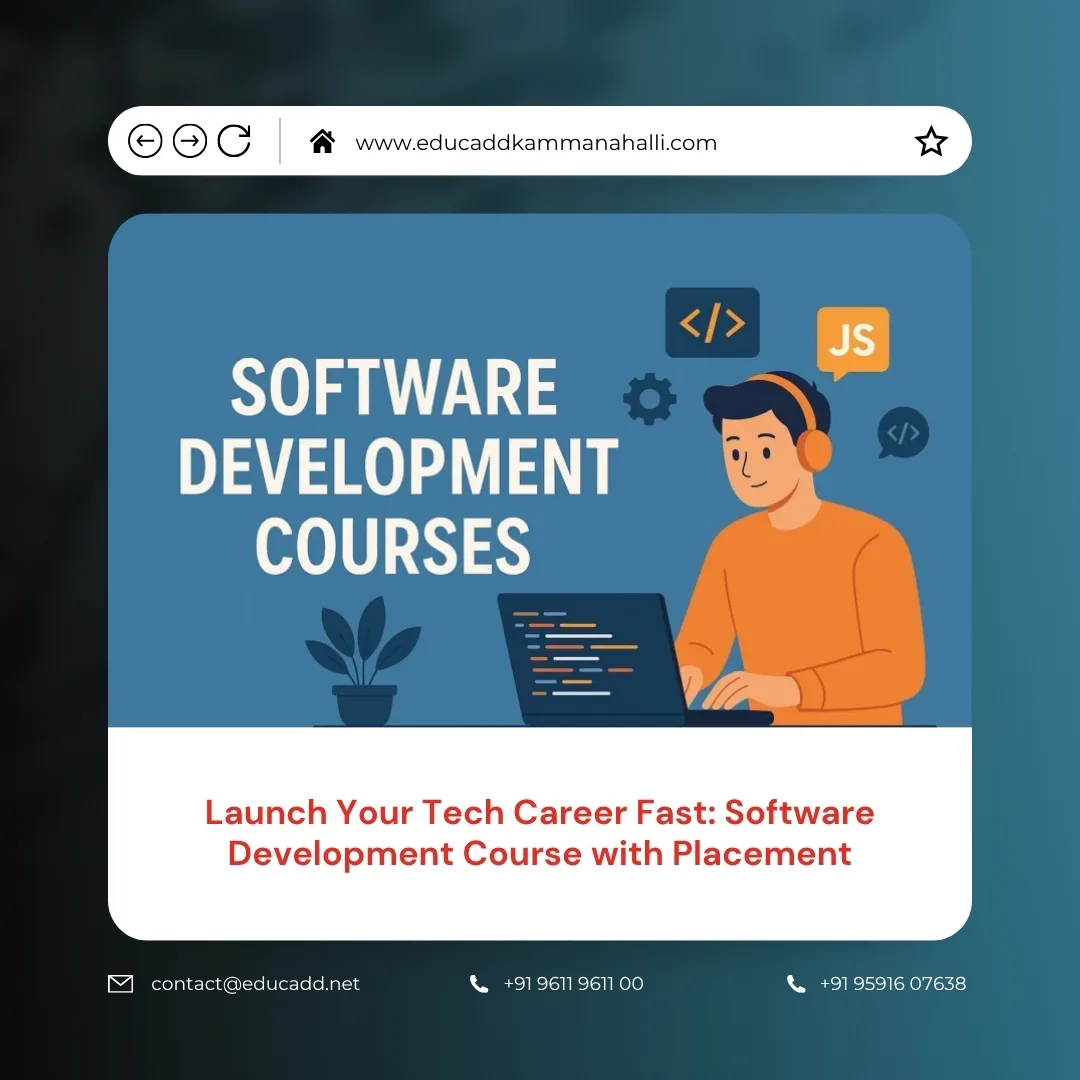
Software Development Course Placement
In this blog, you will explore how these courses work, why they are valuable, and how they can accelerate your career growth. Each section will give you clarity on important aspects so that you can make an informed decision.
Why Software Development Skills Are in High Demand
Technology has become the backbone of modern businesses. From startups to multinational companies, every organization depends on software solutions to operate efficiently. As a result, developers are needed to create applications, websites, and enterprise systems.
Moreover, the rise of artificial intelligence, cloud computing, and mobile applications has expanded the demand even further. Businesses are constantly innovating, and skilled developers play a crucial role in this transformation. Therefore, learning software development today is not just a career choice—it is a future-proof decision.
Additionally, the flexibility offered by tech careers makes them even more attractive. Many professionals work remotely or freelance, which provides better work-life balance and global exposure.
What Is a Software Development Course Placement
A software development course with placement is a structured training program that focuses on both technical learning and job readiness. Unlike traditional courses, these programs emphasize practical skills and real-world applications.
Students are trained in programming languages, frameworks, and tools that are widely used in the industry. At the same time, placement support ensures that learners get opportunities to attend interviews and secure jobs.
These courses often include:
- Hands-on projects and real-time assignments
- Resume building and interview preparation
As a result, learners gain confidence and become industry-ready by the end of the program.
Core Programming Languages You Will Learn
Every software development course starts with foundational programming languages. These languages help you understand logic, problem-solving, and coding structure.
Popular languages taught include Python, Java, JavaScript, and C++. Each language serves a different purpose. For instance, Python is widely used in data science, while JavaScript is essential for web development.
Furthermore, learning multiple languages increases your versatility. It allows you to explore different career paths and adapt to changing industry trends.
Importance of Hands-On Project Experience
Practical experience plays a vital role in mastering software development. Simply learning theory is not enough to succeed in this field. Employers look for candidates who can apply their knowledge to real-world scenarios.
Therefore, most placement-oriented courses include project-based learning. Students work on live projects, which simulate real industry environments. This approach helps them understand how software is developed, tested, and deployed.
In addition, projects act as proof of your skills. They can be showcased in your portfolio, making you more attractive to potential employers.
Understanding Front-End and Back-End Development
Software development is broadly divided into front-end and back-end development. Both areas are essential for building complete applications.
Front-end development focuses on the user interface and user experience. It involves technologies like HTML, CSS, and JavaScript. On the other hand, back-end development deals with server-side logic, databases, and application functionality.
A comprehensive course covers both aspects, giving you full-stack development skills. This makes you more valuable in the job market.
Role of Industry-Relevant Tools and Technologies
Modern software development relies on various tools and frameworks. Learning these tools is essential to stay competitive in the job market.
Some commonly used technologies include:
- Version control systems like Git
- Frameworks such as React and Angular
These tools improve productivity and help developers collaborate effectively. Therefore, courses with placement focus heavily on teaching these technologies.
How Placement Support Makes a Difference
Placement support is one of the most valuable aspects of these courses. It bridges the gap between learning and employment.
Institutes collaborate with companies to provide job opportunities for students. They also conduct mock interviews, aptitude tests, and soft skills training.
As a result, students are better prepared to face real interview scenarios. This significantly increases their chances of getting hired.
Resume Building and Interview Preparation
A strong resume can make a significant difference in your job search. Placement-oriented courses provide guidance on creating professional resumes that highlight your skills and achievements.
Additionally, interview preparation sessions help you understand common questions and improve your communication skills. These sessions often include technical interviews, HR interviews, and group discussions.
Consequently, students gain confidence and perform better during actual interviews.
Career Opportunities After Completing the Course
Completing a software development course opens the door to various career opportunities. You can choose roles based on your interests and skills.
Some popular job roles include:
- Software Developer
- Web Developer
Other roles include mobile app developer, full-stack developer, and software tester. The demand for these roles continues to grow, offering excellent career prospects.
Benefits of Choosing a Placement-Oriented Course
A placement-oriented course offers several advantages over traditional learning methods. It provides a clear career path and reduces uncertainty.
Firstly, students receive structured guidance throughout their learning journey. Secondly, placement assistance ensures that they get job opportunities after completing the course.
Moreover, these courses often include mentorship from industry experts. This helps students gain valuable insights and stay updated with the latest trends.
How to Choose the Right Course for You
Selecting the right course is crucial for your success. You should consider factors such as curriculum, faculty, placement record, and industry connections.
Additionally, check whether the course includes hands-on training and real-world projects. These elements are essential for building practical skills.
It is also important to evaluate the support provided for job placement. A strong placement network can significantly impact your career growth.
Common Challenges and How to Overcome Them
Learning software development can be challenging, especially for beginners. However, these challenges can be overcome with the right approach.
One common difficulty is understanding complex concepts. This can be addressed by practicing regularly and seeking guidance from mentors.
Another challenge is staying consistent. Setting daily learning goals and following a structured plan can help you stay on track.
Future Trends in Software Development Careers
The future of software development looks promising. Emerging technologies such as artificial intelligence, blockchain, and cloud computing are creating new opportunities.
Developers who stay updated with these trends will have a competitive advantage. Therefore, continuous learning is essential in this field.
Moreover, the demand for skilled professionals is expected to increase in the coming years. This makes software development a stable and rewarding career choice.
Conclusion
A Software Development Course Placement offers a complete pathway from learning to employment. It equips you with technical skills, practical experience, and career support. As a result, you are not only trained but also prepared to enter the job market with confidence.
In today’s competitive world, choosing the right course can make all the difference. By investing in a placement-oriented program, you increase your chances of securing a rewarding job in the tech industry. With dedication, consistency, and the right guidance, a successful career in software development is well within your reach.

