
BIM LOD 100 to 500 Training Program: Mastering the Complete Building Information Modeling Lifecycle
The construction industry is rapidly embracing digital transformation, and Building Information Modeling (BIM) has become the foundation of modern project planning, design, construction, and facility management. As organizations increasingly adopt BIM workflows, professionals must develop a clear understanding of BIM Levels of Development (LOD) to remain competitive in the industry. A comprehensive BIM LOD Training Program equips engineers, architects, project managers, BIM coordinators, and construction professionals with the knowledge required to manage building information throughout the entire project lifecycle.
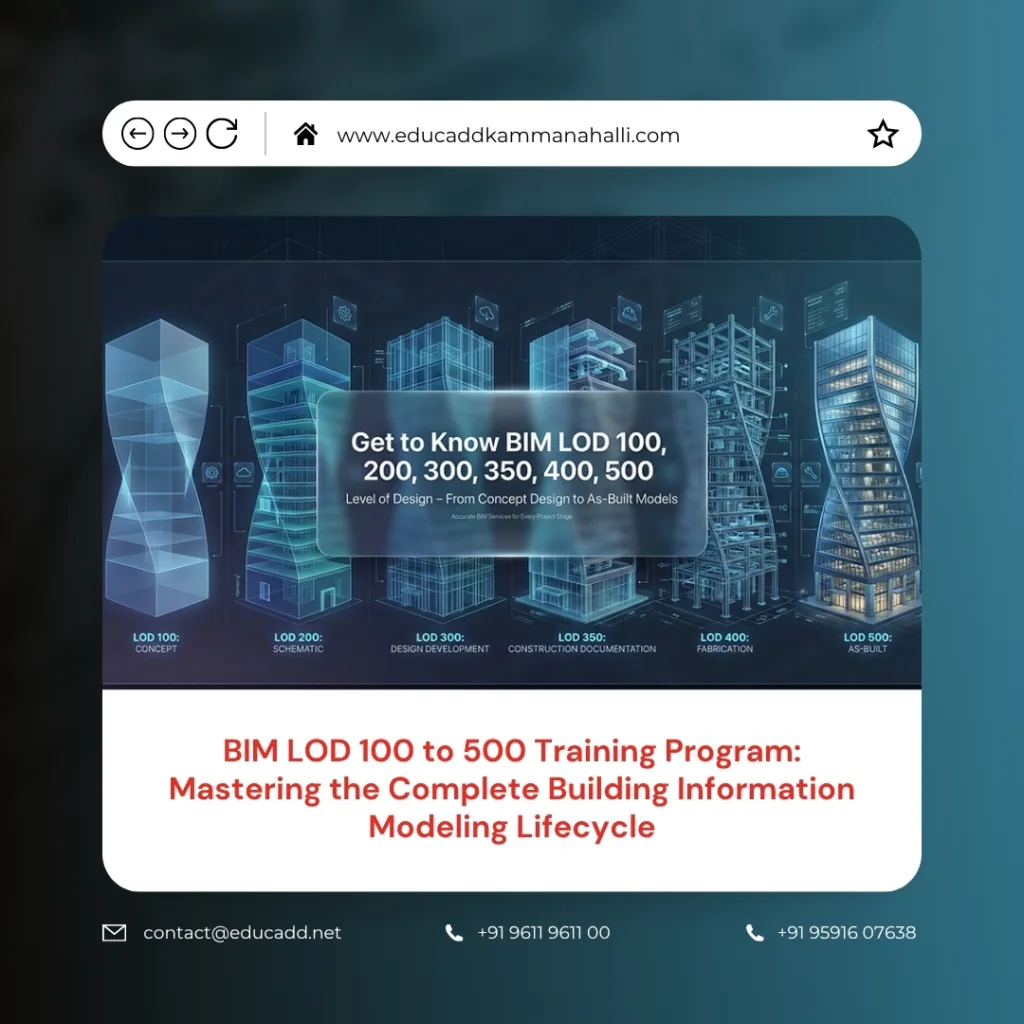
BIM LOD standards provide a structured framework that defines the level of detail, geometry, and information included within a BIM model at different stages of a project. From conceptual planning to facility operations, each LOD stage serves a specific purpose and helps stakeholders make informed decisions. Understanding how a model evolves from LOD 100 to LOD 500 enables professionals to improve project coordination, reduce rework, minimize risks, and enhance collaboration among multidisciplinary teams.
BIM LOD Training Program
This BIM LOD Training Program is designed to provide practical and theoretical expertise in creating, managing, and utilizing BIM models across every phase of project delivery. Participants gain hands-on experience with industry-standard workflows, model development strategies, clash detection processes, documentation techniques, and asset management principles. As a result, they become capable of delivering highly accurate and information-rich BIM models that support successful project outcomes.
Understanding the Importance of BIM LOD Training Program
Before diving into the individual levels, it is essential to understand why BIM Levels of Development play such a critical role in project execution. LOD standards establish clear expectations regarding model accuracy, information reliability, and intended use. Without these standards, stakeholders may interpret model content differently, leading to misunderstandings and costly errors.
The BIM LOD 100 to 500 Training Program teaches professionals how each level contributes to project success. Participants learn how to define model requirements, establish project deliverables, and communicate model expectations effectively. Furthermore, they understand how different project teams utilize BIM data at various stages of design and construction. This knowledge creates consistency and improves collaboration across the entire project team.
BIM LOD 100: Conceptual Design and Project Visualization
LOD 100 represents the earliest stage of BIM development. At this level, model elements are conceptual and provide basic information about building size, shape, orientation, and overall project intent. Designers use LOD 100 models to evaluate feasibility, perform preliminary analysis, and communicate design concepts to stakeholders.
Within the BIM LOD 100 to 500 Training Program, participants learn how to create conceptual models that support early decision-making. They explore massing studies, site evaluations, and high-level project visualization techniques. Additionally, they gain an understanding of how conceptual BIM models assist in estimating project scope, assessing sustainability goals, and presenting design ideas to clients. Although the information remains limited at this stage, LOD 100 establishes the foundation for all future model development.
BIM LOD 200: Preliminary Design Development
As projects progress into the design development phase, BIM models advance to LOD 200. At this stage, model elements include approximate geometry, quantities, sizes, locations, and orientations. Designers begin refining the building layout while maintaining flexibility for future modifications.
The BIM LOD 100 to 500 Training Program emphasizes the transition from conceptual modeling to preliminary design development. Participants learn how to create accurate architectural, structural, and MEP components while maintaining coordination among disciplines. Furthermore, they understand how LOD 200 supports early quantity takeoffs, cost planning, and design validation.
Key learning areas include:
- Preliminary architectural, structural, and MEP modeling techniques.
- Early-stage quantity extraction and project estimation workflows.
By mastering LOD 200 processes, professionals can provide stakeholders with more reliable project information while preserving design flexibility.
BIM LOD 300: Detailed Design and Coordination
LOD 300 represents a significant milestone in BIM implementation. At this level, model elements contain precise geometry, dimensions, locations, and quantities. The model accurately reflects the intended design and supports detailed documentation, coordination, and construction planning activities.
During the BIM LOD 100 to 500 Training Program, participants learn how to create highly detailed BIM models suitable for multidisciplinary coordination. They develop expertise in producing construction documents, conducting design reviews, and identifying potential conflicts between building systems.
The training also covers advanced coordination practices that improve communication among architects, engineers, and contractors. By utilizing accurate LOD 300 models, project teams can reduce design discrepancies, minimize rework, and improve overall project efficiency.
BIM LOD 350: Enhancing Interdisciplinary Collaboration
LOD 350 expands upon LOD 300 by introducing interfaces and connections between building systems. While LOD 300 focuses on individual components, LOD 350 addresses how these components interact with one another. This level plays a crucial role in coordination and clash detection activities.
The BIM LOD 100 to 500 Training Program provides extensive training on model coordination workflows. Participants learn how to analyze relationships between structural, architectural, and MEP systems. They also gain practical experience using clash detection tools to identify and resolve conflicts before construction begins.
This level significantly improves project coordination because stakeholders can visualize system interactions and address potential issues early. Consequently, project delays and construction costs decrease substantially.
BIM LOD 400: Construction-Level Modeling and Fabrication
LOD 400 introduces fabrication-level detail into the BIM model. Components include precise geometry, assembly information, fabrication specifications, and installation details. Contractors and fabricators rely on LOD 400 models to support manufacturing, procurement, and construction activities.
The BIM LOD 100 to 500 Training Program teaches participants how to develop highly detailed construction models that align with real-world fabrication requirements. Students learn how to create constructible models that support prefabrication, modular construction, and advanced manufacturing processes.
Additionally, they explore the integration of BIM with construction scheduling and procurement workflows. This practical knowledge enables professionals to improve construction accuracy and optimize project delivery timelines.
BIM LOD 500: As-Built Modeling and Facility Management
LOD 500 represents the final stage of BIM development. At this level, the model reflects actual field conditions and serves as a reliable source of information for facility management and operations. Building owners use LOD 500 models to support maintenance planning, asset tracking, and lifecycle management.
Within the BIM LOD 100 to 500 Training Program, participants learn how to validate model accuracy, incorporate field verification data, and create comprehensive as-built documentation. They also explore facility management applications that extend BIM value beyond project completion.
As organizations increasingly prioritize asset management and operational efficiency, LOD 500 expertise has become highly valuable in the construction industry.
Model Progression from LOD 100 to LOD 500
One of the most important concepts covered in the BIM LOD 100 to 500 Training Program is model progression. BIM development is not a series of isolated stages but rather a continuous process in which information gradually evolves throughout the project lifecycle.
Participants learn how to manage model transitions effectively while maintaining data consistency and accuracy. They understand how each level builds upon previous work and contributes to future project requirements. This knowledge ensures that BIM models remain useful, reliable, and aligned with stakeholder expectations at every stage of development.
BIM Software and Tools Covered in the Training Program
Modern BIM workflows depend on advanced software platforms that support design, coordination, and project management activities. Therefore, the BIM LOD 100 to 500 Training Program introduces participants to industry-leading BIM tools used worldwide.
Training often includes:
- BIM authoring software for architectural, structural, and MEP modeling.
- Coordination and clash detection platforms for multidisciplinary collaboration.
Participants gain practical experience creating models, generating documentation, conducting coordination reviews, and managing project information. These software skills significantly enhance employability and career growth opportunities within the BIM industry.
Clash Detection and Coordination Workflows
Clash detection remains one of the most valuable applications of BIM technology. Identifying conflicts before construction begins saves both time and money while improving project quality. The BIM LOD 100 to 500 Training Program dedicates significant attention to coordination workflows and clash management strategies.
Participants learn how to establish coordination standards, perform clash detection analyses, prioritize issues, and facilitate resolution meetings. They also understand how different LOD levels influence clash detection effectiveness. As a result, they develop the ability to create coordinated models that support smooth project execution and minimize field conflicts.
BIM Documentation and Information Management
A BIM model contains much more than geometry. It also serves as a repository for project information, documentation, specifications, and operational data. Effective information management is therefore essential for successful BIM implementation.
The BIM LOD 100 to 500 Training Program teaches best practices for organizing model data, managing parameters, maintaining naming conventions, and ensuring information consistency. Participants learn how to generate drawings, schedules, quantity takeoffs, and reports directly from BIM models. These skills improve productivity while enhancing project documentation accuracy.
Career Opportunities After Completing BIM LOD Training Program
Demand for BIM professionals continues to grow across architecture, engineering, construction, infrastructure, and facility management sectors. Organizations seek individuals who understand BIM standards and can manage projects across multiple LOD stages.
Completing a BIM LOD 100 to 500 Training Program can open doors to numerous career opportunities, including BIM Modeler, BIM Coordinator, BIM Engineer, BIM Manager, Digital Construction Specialist, Design Coordinator, Project Information Manager, and Facility Management Consultant. Furthermore, professionals with comprehensive LOD knowledge often enjoy higher earning potential and greater career advancement opportunities.
As governments and private organizations increasingly mandate BIM adoption, skilled BIM professionals remain in high demand worldwide.
Industry Benefits of BIM LOD Expertise
Organizations that employ BIM-trained professionals gain significant competitive advantages. Accurate BIM models improve project planning, enhance collaboration, reduce construction errors, and support informed decision-making. The BIM LOD 100 to 500 Training Program prepares participants to contribute directly to these organizational goals.
By understanding how information evolves across different LOD stages, professionals can align project deliverables with stakeholder expectations. This capability improves project quality, increases client satisfaction, and enhances overall business performance. Moreover, BIM expertise supports digital transformation initiatives that drive long-term industry innovation.
Future Trends in BIM and Digital Construction
The future of BIM extends far beyond traditional 3D modeling. Emerging technologies such as digital twins, artificial intelligence, cloud collaboration, augmented reality, virtual reality, and smart facility management systems are reshaping the industry. BIM models developed according to LOD standards provide the foundation for these advanced technologies.
The BIM LOD 100 to 500 Training Program introduces participants to evolving industry trends and prepares them for future digital construction environments. As technology continues to advance, professionals who possess strong BIM fundamentals will remain well-positioned to adapt and succeed. Understanding the complete LOD framework ensures long-term relevance in an increasingly digital construction ecosystem.
Conclusion
The BIM LOD Training Program provides a comprehensive pathway for mastering Building Information Modeling across the entire project lifecycle. From conceptual design at LOD 100 to facility management at LOD 500, each level contributes unique value that supports project planning, coordination, construction, and operations. Professionals who understand these levels can create accurate models, improve collaboration, reduce project risks, and deliver greater value to stakeholders.
As BIM adoption continues to accelerate worldwide, expertise in LOD standards has become a critical skill for modern construction professionals. Through structured training, practical experience, and a deep understanding of BIM workflows, participants gain the knowledge needed to excel in architecture, engineering, construction, and facility management careers. Ultimately, mastering BIM LOD 100 to 500 empowers professionals to lead digital transformation initiatives and contribute to more efficient, sustainable, and successful project outcomes.

