
Creating CAD Models from 3D Scan Data: Transforming Real-World Objects into Precision Digital Designs
Modern engineering, manufacturing, architecture, and product development depend heavily on accurate digital models. As industries move toward faster design cycles and improved precision, 3D scanning technology has become an essential tool for capturing real-world objects and converting them into digital assets. However, raw scan data alone cannot support advanced design modifications, simulations, or manufacturing processes. This is where creating CAD Models from 3D Scans data becomes extremely valuable.
The process combines advanced scanning technology with computer-aided design techniques to transform physical objects into editable and intelligent digital models. Companies use this approach for reverse engineering, quality inspection, product redesign, heritage preservation, and custom manufacturing. Furthermore, businesses can significantly reduce development time while maintaining exceptional accuracy. As digital transformation continues to reshape industries, the ability to convert scan data into CAD models has become a critical skill for engineers, designers, and manufacturers. Understanding this process can help organizations improve productivity, reduce errors, and create innovative products more efficiently.
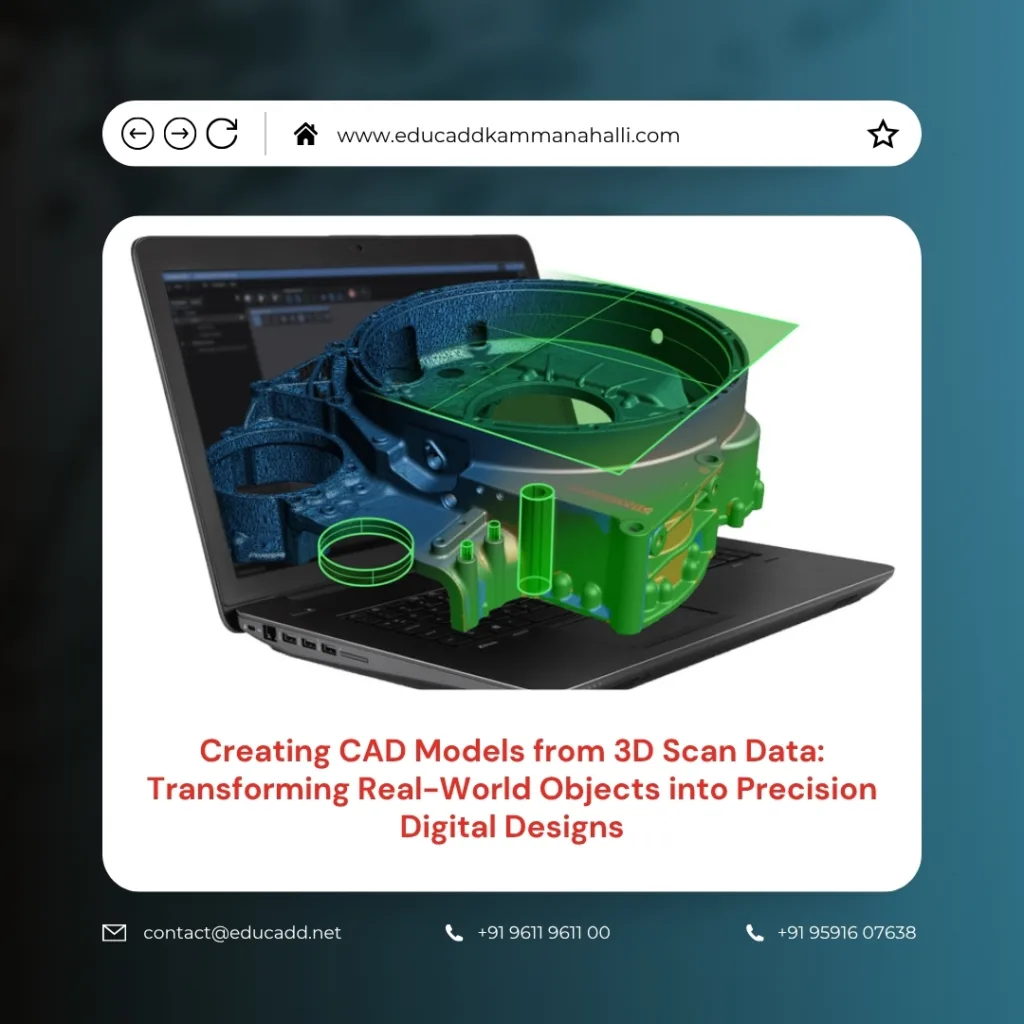
CAD Models from 3D Scans
Understanding the Relationship Between 3D Scanning and CAD Modeling
Creating CAD Models from 3D Scans data begins with understanding the difference between scanning and modeling. A 3D scanner captures the physical geometry of an object and generates a dense collection of points known as a point cloud. This point cloud represents the object’s surface in three-dimensional space.
While scan data accurately reflects the object’s shape, it lacks the intelligence and parametric features required for engineering applications. CAD software, on the other hand, creates structured models that allow designers to edit dimensions, modify features, and generate manufacturing drawings. Therefore, the conversion process bridges the gap between raw physical measurements and intelligent digital design. This connection enables organizations to transform existing products into editable engineering models without starting from scratch. As a result, companies gain a faster and more reliable path toward product development and innovation.
Why Industries Are Adopting CAD Models from 3D Scans Conversion
Many industries now rely on scan-to-CAD workflows because they offer remarkable advantages over traditional measurement methods. Conventional techniques often require extensive manual measurements, which consume time and increase the risk of errors. In contrast, modern scanners capture millions of data points within minutes.
Manufacturers use scan-to-CAD conversion to reproduce legacy components, improve product designs, and create accurate digital twins. Automotive companies leverage this technology to redesign vehicle parts and validate prototypes. Similarly, aerospace organizations depend on precise CAD models for maintenance and performance improvements. Consequently, businesses can achieve faster turnaround times while maintaining exceptional accuracy. The growing demand for customization and rapid product development continues to drive adoption across multiple sectors.
Capturing Accurate Scan Data for Successful CAD Modeling
The quality of the final CAD model depends heavily on the quality of the scan data. Therefore, the scanning process requires careful planning and execution. Engineers must select the appropriate scanning technology based on object size, complexity, material properties, and required accuracy.
Laser scanners, structured-light scanners, and photogrammetry systems each offer unique advantages. During scanning, operators must ensure complete surface coverage while minimizing noise and distortion. Proper lighting conditions and scanner positioning also contribute to better results. When high-quality scan data is collected, the CAD modeling process becomes smoother and more efficient. Consequently, organizations can reduce rework and achieve more accurate digital representations of physical objects.
Processing Point Cloud Data Before CAD Conversion
Raw scan data often contains unwanted information that must be cleaned before modeling begins. This preprocessing stage plays a critical role in ensuring a successful conversion process. Engineers use specialized software to remove noise, eliminate duplicate points, and align multiple scans into a single coordinate system.
The cleaned point cloud provides a more accurate foundation for creating CAD geometry. Additionally, technicians may reduce excessive data density to improve software performance without compromising accuracy. Through careful processing, the scan data becomes easier to interpret and convert into meaningful design features. This stage lays the groundwork for efficient and reliable CAD model development.
Converting Point Clouds into Polygon Meshes
After point cloud processing, the next step involves generating a polygon mesh. A mesh consists of interconnected triangles that form a continuous surface representation of the scanned object. This conversion helps visualize the object more clearly and serves as an intermediate step toward CAD modeling.
Mesh generation software analyzes neighboring points and creates a surface that accurately reflects the object’s geometry. Engineers then inspect the mesh for holes, irregularities, and artifacts. Necessary repairs improve surface quality and ensure better modeling outcomes. Once the mesh accurately represents the object, designers can begin extracting geometric features for CAD creation. Therefore, mesh development serves as a crucial bridge between scanning and engineering design.
Reverse Engineering Through CAD Reconstruction
Reverse engineering is one of the most common applications of creating CAD Models from 3D Scans data. Organizations frequently encounter situations where original design documentation is unavailable. In such cases, scan-to-CAD technology enables engineers to recreate digital models from existing physical components.
This approach proves particularly useful for obsolete machinery parts, custom components, and legacy equipment. Engineers analyze scanned geometry, identify critical features, and rebuild them within CAD software. The resulting model supports manufacturing, analysis, and future modifications. As a result, businesses can extend equipment lifespans and reduce costly downtime. Reverse engineering also encourages innovation by allowing companies to improve existing products while preserving their essential functionality.
Parametric Modeling for Intelligent Design Control
One significant advantage of CAD modeling lies in the creation of parametric features. Unlike static scan data, parametric CAD models contain editable dimensions, constraints, and relationships. These features provide greater control over the design process.
Key benefits of parametric modeling include:
- Easy modification of dimensions and design features.
- Faster generation of manufacturing drawings and documentation.
Engineers can adjust design parameters without rebuilding the entire model. Furthermore, parametric models support simulations, tolerance analysis, and optimization studies. This flexibility makes CAD models more valuable than simple geometric representations. Consequently, organizations can respond more effectively to changing design requirements and customer demands.
Software Tools Used for Scan-to-CAD Conversion
The growing popularity of scan-to-CAD workflows has led to the development of powerful software solutions. These platforms help engineers process scan data, reconstruct surfaces, and create accurate CAD models. Commonly used software includes Geomagic Design X, SolidWorks, CATIA, Siemens NX, Autodesk Inventor, and Fusion 360.
Each platform offers unique capabilities tailored to specific industries and applications. Advanced tools incorporate automated feature recognition, which accelerates the modeling process. Additionally, artificial intelligence is increasingly improving feature extraction and geometry reconstruction. As software capabilities continue to evolve, engineers can achieve greater efficiency and accuracy throughout the conversion process.
Maintaining Accuracy Throughout the Modeling Process
Accuracy remains a primary concern when creating CAD Models from 3D Scans data. Even small deviations can impact product performance, manufacturing quality, and assembly fit. Therefore, engineers must validate the CAD model against the original scan data throughout the project.
Deviation analysis tools compare the CAD geometry with the scanned surface and highlight dimensional differences. This verification process ensures that the reconstructed model accurately represents the physical object. Moreover, regular validation helps identify errors before they become costly production issues. Through continuous quality checks, organizations can maintain confidence in their digital models and manufacturing outcomes.
Applications in Manufacturing and Product Development
Manufacturing organizations benefit significantly from scan-to-CAD technology. Engineers use digital models to redesign products, improve manufacturing processes, and accelerate prototype development. Accurate CAD models also support CNC machining, additive manufacturing, and quality control activities.
Common manufacturing applications include:
- Product redesign and optimization.
- Tooling, mold, and fixture development.
By leveraging precise digital representations, companies can shorten development cycles and improve product quality. Furthermore, scan-based modeling enables faster adaptation to market demands. This capability provides a valuable competitive advantage in today’s rapidly changing business environment.
The Role of Scan-to-CAD in Quality Inspection
Quality inspection has become another major application of creating CAD models from 3D scan data. Manufacturers use scanning systems to compare finished products against their original CAD designs. This comparison reveals deviations that may affect performance or compliance requirements.
Inspection teams can quickly identify dimensional inaccuracies, assembly issues, and manufacturing defects. Additionally, detailed reports provide valuable insights for process improvement initiatives. As quality standards become increasingly stringent, scan-based inspection methods offer greater speed and reliability than traditional measurement techniques. Consequently, organizations can maintain consistent product quality while reducing inspection time.
Supporting Digital Twin Development and Industry 4.0
Industry 4.0 initiatives have increased demand for digital twins and smart manufacturing solutions. A digital twin serves as a virtual representation of a physical asset, enabling real-time monitoring and analysis. Creating CAD models from 3D scan data provides the foundation for many digital twin projects.
Engineers use accurate digital models to simulate performance, predict maintenance needs, and optimize operations. Furthermore, digital twins improve collaboration between design, manufacturing, and maintenance teams. As organizations continue investing in connected technologies, scan-to-CAD workflows will play an increasingly important role in supporting data-driven decision-making and operational excellence.
Challenges Associated with Scan-to-CAD Workflows
Despite its advantages, the scan-to-CAD process presents several challenges. Complex geometries, reflective surfaces, and hidden features can complicate data capture. Large datasets may also require substantial computing resources for processing and analysis.
Additionally, converting freeform surfaces into editable CAD features often demands significant expertise. Engineers must balance accuracy, modeling efficiency, and project requirements throughout the workflow. However, advances in software automation and artificial intelligence continue to address many of these challenges. As technology evolves, scan-to-CAD processes are becoming more accessible and efficient for organizations of all sizes.
Future Trends in Creating CAD Models from 3D Scans Data
The future of creating CAD models from 3D scan data looks exceptionally promising. Emerging technologies are transforming how engineers capture, process, and model physical objects. Artificial intelligence and machine learning algorithms are improving automatic feature recognition and surface reconstruction capabilities.
Cloud-based platforms are also enabling collaborative modeling and faster data sharing across global teams. Meanwhile, advancements in scanning hardware continue to deliver higher accuracy and faster acquisition speeds. These innovations will further streamline the conversion process and expand its applications across industries. As a result, organizations will gain even greater opportunities to improve productivity, reduce costs, and accelerate innovation.
Conclusion
Creating CAD Models from 3D Scans data has become a cornerstone of modern engineering, manufacturing, and product development. By transforming physical objects into intelligent digital models, organizations can streamline design processes, improve accuracy, and reduce development time. The workflow begins with precise scanning and progresses through point cloud processing, mesh generation, feature extraction, and CAD reconstruction. Each stage contributes to building a reliable and editable model that supports manufacturing, inspection, simulation, and innovation.
Moreover, the growing adoption of Industry 4.0 technologies, digital twins, and advanced manufacturing methods continues to increase the importance of scan-to-CAD conversion. Although challenges remain, ongoing advancements in software, automation, and artificial intelligence are making the process faster and more efficient than ever before. Businesses that embrace this technology can gain a significant competitive advantage through improved productivity, enhanced product quality, and faster time-to-market. As industries continue their digital transformation journey, creating CAD models from 3D scan data will remain a powerful tool for turning real-world objects into highly accurate and valuable digital assets.

