
Master Advanced Mechanical CADD Training and Build a Successful Engineering Career with Placement Support
The manufacturing and engineering industries are changing at an incredible pace. Companies now expect mechanical engineers and diploma holders to possess practical software expertise alongside strong technical knowledge. Traditional engineering concepts remain essential, but industries increasingly rely on digital product design, simulation, drafting, and manufacturing technologies to improve efficiency and reduce production costs. As a result, professionals who understand modern Advanced Mechanical CADD Training tools enjoy better career opportunities and faster professional growth than those with only theoretical knowledge.
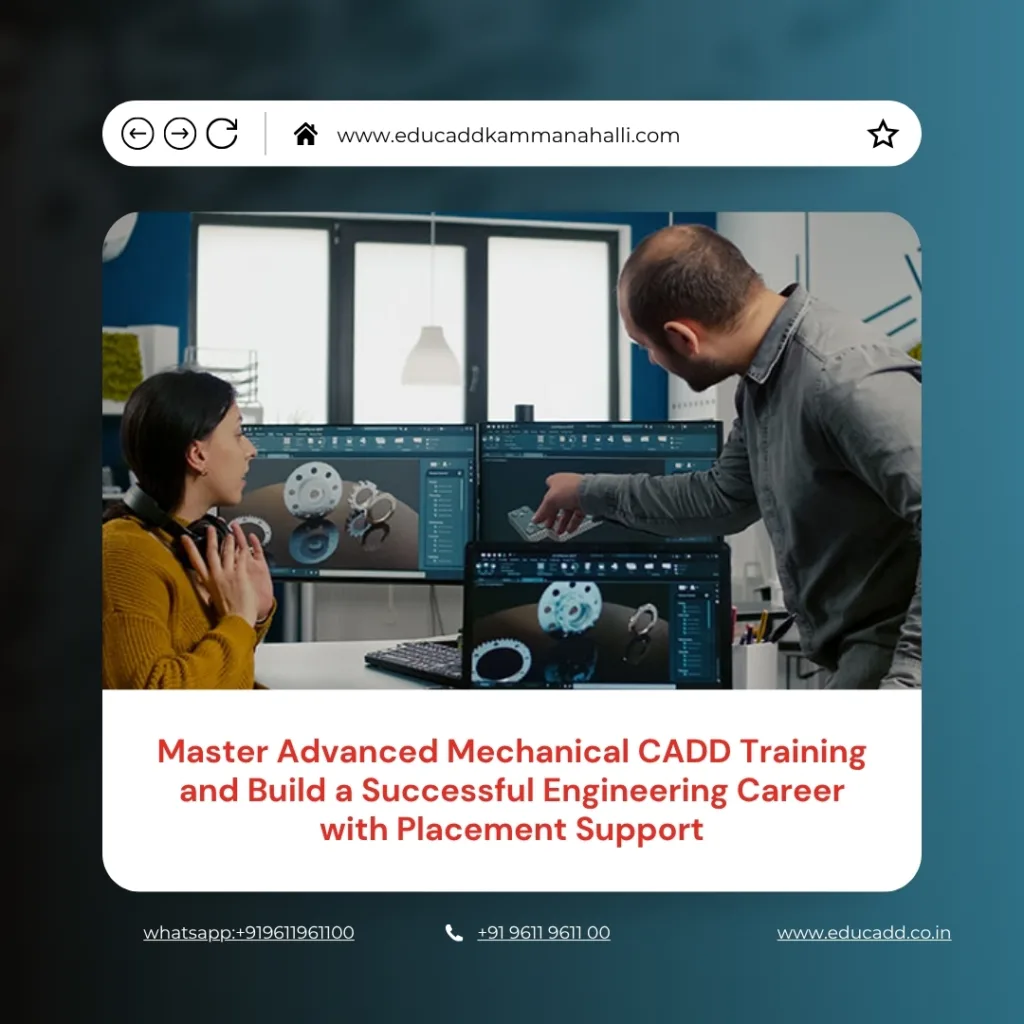
Advanced Mechanical CADD Training
Advanced Mechanical CADD Training with Placement Support provides the ideal pathway for aspiring engineers to gain industry-ready skills. This comprehensive training combines classroom learning, practical projects, software expertise, and career guidance to prepare students for real-world engineering roles. Whether you are a fresh graduate, diploma holder, working professional, or career changer, this program helps you build confidence, improve technical capabilities, and secure rewarding employment in leading engineering companies. With structured learning, experienced trainers, and dedicated placement assistance, students become well-prepared to meet the growing demands of today’s competitive engineering industry.
Why Advanced Mechanical CADD Skills Are Essential in Today’s Engineering Industry
Mechanical engineering has transformed significantly because industries now depend on digital engineering solutions throughout product development. Every stage, from conceptual design to manufacturing and quality inspection, requires advanced design software. Consequently, organizations actively seek professionals who can create accurate engineering drawings, detailed assemblies, and manufacturing-ready documentation using industry-standard CADD applications.
Advanced Mechanical CADD Training equips students with these practical skills through extensive hands-on practice. Instead of learning only software commands, students understand design principles, engineering standards, tolerancing methods, material selection, and production workflows. Moreover, they become familiar with industrial practices followed by automotive, aerospace, heavy engineering, manufacturing, oil and gas, and industrial equipment companies.
As industries continue adopting automation, digital manufacturing, and smart engineering solutions, Mechanical CADD professionals remain in high demand. Therefore, acquiring advanced software expertise significantly improves employability while opening opportunities in both domestic and international markets.
Comprehensive Software Training Builds Complete Engineering Expertise
A quality Advanced Mechanical CADD Training program covers multiple engineering software applications rather than focusing on just one platform. This approach prepares students to work confidently across different industries and engineering environments.
Students typically begin with AutoCAD Mechanical to master technical drafting, engineering drawings, dimensioning, and industry standards. After establishing strong drafting fundamentals, they move to powerful 3D modeling software such as SolidWorks, CATIA, Creo, Siemens NX, or Autodesk Inventor. These applications enable engineers to develop complex parts, assemblies, exploded views, production drawings, and product prototypes.
Additionally, students learn sheet metal design, weldment modeling, surfacing techniques, plastic component design, assembly management, and parametric modeling. As their expertise grows, they also gain exposure to finite element analysis, motion simulation, rendering, and manufacturing documentation. Consequently, graduates become versatile professionals capable of handling diverse engineering projects with confidence.
Practical Learning Through Real-Time Industry Projects
Practical experience plays a major role in professional success. While theoretical knowledge provides a foundation, industries expect candidates to solve real engineering problems efficiently. Therefore, Advanced Mechanical CADD Training emphasizes project-based learning throughout the course.
Students work on industrial components, machine assemblies, production equipment, automotive parts, piping systems, fixtures, and customized engineering models. Each project helps learners understand design methodology, engineering calculations, tolerance management, and manufacturing feasibility. Furthermore, project work develops analytical thinking, creativity, and technical decision-making abilities.
Working on real-time assignments also teaches students how engineering teams collaborate throughout product development. They learn documentation practices, design revisions, drawing approvals, and engineering change management. These experiences prepare students for professional responsibilities even before they enter the workforce.
Industry-Oriented Curriculum Designed for Career Success
An effective training curriculum aligns closely with current industrial requirements instead of outdated academic syllabi. As technology evolves rapidly, training institutes continuously update their course content to match changing engineering trends.
Advanced Mechanical CADD Training introduces students to Geometric Dimensioning and Tolerancing (GD&T), product lifecycle management, design validation, manufacturing processes, engineering standards, reverse engineering concepts, and documentation procedures. Furthermore, learners understand design optimization, material behavior, production constraints, and quality assurance principles.
Because industries require engineers who can contribute immediately after recruitment, this industry-focused curriculum significantly enhances job readiness. Students graduate with practical knowledge that employers value, making them stronger candidates during technical interviews.
Experienced Trainers Enhance Technical Confidence
Learning from experienced professionals makes a significant difference in technical education. Qualified instructors share practical knowledge gained through years of industrial experience, helping students understand not only software functions but also engineering applications.
During Advanced Mechanical CADD Training, trainers explain real production scenarios, common design mistakes, manufacturing challenges, and practical engineering solutions. They encourage students to ask questions, solve complex design problems, and explore multiple approaches to engineering tasks.
Moreover, personalized mentoring allows students to improve weak areas while strengthening technical confidence. Regular assessments, design reviews, and constructive feedback ensure continuous improvement throughout the learning journey. Consequently, students develop both technical competence and professional confidence.
Placement Support Accelerates Professional Growth
Placement support remains one of the most valuable benefits of Advanced Mechanical CADD Training. Technical skills alone may not guarantee employment unless candidates also understand recruitment processes and interview expectations.
Professional placement assistance includes resume preparation, portfolio development, aptitude training, mock interviews, technical interview practice, communication skill enhancement, and personality development sessions. These activities help students present themselves professionally before recruiters.
Furthermore, many training institutes maintain strong relationships with engineering companies, manufacturing organizations, automotive firms, consulting businesses, and design service providers. As a result, students receive regular interview opportunities that increase their chances of securing suitable employment soon after completing the course.
Career Opportunities After Advanced Mechanical CADD Training
Completing Advanced Mechanical CADD Training opens numerous career opportunities across multiple engineering sectors. Since almost every manufacturing organization requires design professionals, skilled candidates can explore diverse roles based on their interests and expertise.
Graduates often begin their careers as Mechanical Design Engineers, CAD Engineers, Product Design Engineers, Drafting Engineers, Production Design Engineers, Tool Design Engineers, Sheet Metal Design Engineers, Quality Documentation Engineers, or Design Validation Engineers. With experience, professionals can progress into senior engineering positions, project management, product development leadership, or engineering consultancy.
Additionally, industries such as automotive manufacturing, aerospace engineering, heavy machinery, industrial automation, renewable energy, consumer products, medical equipment, and industrial plant engineering actively recruit qualified Mechanical CADD professionals. Therefore, career growth remains strong across multiple sectors.
Building Strong Technical and Professional Skills
Technical software knowledge represents only one aspect of professional development. Employers also seek engineers who possess excellent communication, teamwork, analytical thinking, and problem-solving abilities.
Advanced Mechanical CADD Training helps students strengthen these essential workplace competencies through presentations, collaborative projects, engineering discussions, and technical documentation exercises. Furthermore, learners develop time management, project planning, quality awareness, and professional ethics throughout the training program.
These additional skills significantly improve workplace performance while helping professionals adapt to challenging engineering environments. Consequently, graduates become valuable contributors to organizational success from the beginning of their careers.
Staying Competitive with Emerging Engineering Technologies
Engineering technologies continue evolving rapidly through digital transformation, automation, artificial intelligence, and smart manufacturing solutions. Therefore, engineers must continuously upgrade their technical expertise to remain competitive.
Advanced Mechanical CADD Training introduces students to emerging engineering trends including Industry 4.0 concepts, digital manufacturing workflows, integrated product development, simulation-driven design, cloud collaboration, and engineering automation. Understanding these technologies enables professionals to work effectively within modern engineering environments.
Moreover, exposure to current industrial practices encourages continuous learning and professional development. Engineers who embrace technological advancements enjoy greater career stability, higher earning potential, and improved long-term employability.
Benefits for Fresh Graduates and Working Professionals
Advanced Mechanical CADD Training benefits learners at different career stages. Fresh graduates gain valuable practical skills that complement their academic education and improve job prospects immediately after graduation. They develop industrial confidence while building professional portfolios that impress recruiters.
Working professionals also benefit by upgrading existing skills, learning advanced design techniques, and qualifying for better career opportunities. Additionally, experienced engineers can transition into specialized design roles, product development positions, or leadership responsibilities after completing advanced training.
Even diploma holders and career changers find this training highly valuable because it bridges the gap between theoretical education and practical industry requirements. Therefore, learners from diverse educational backgrounds can successfully build rewarding engineering careers.
Hands-On Assessments Prepare Students for Real Engineering Challenges
Continuous evaluation ensures that students understand every concept thoroughly before progressing to advanced topics. Instead of relying solely on theoretical examinations, Advanced Mechanical CADD Training emphasizes practical assessments that closely resemble actual workplace assignments.
Students complete design challenges, drafting exercises, assembly modeling projects, simulation tasks, manufacturing documentation, and engineering presentations throughout the course. These activities strengthen technical accuracy while improving productivity under realistic project conditions.
Additionally, instructors provide detailed performance feedback after every assessment, allowing students to identify improvement areas and refine their engineering skills. Consequently, graduates enter professional environments with greater confidence and practical competence.
Long-Term Career Growth with Mechanical CADD Expertise
Mechanical CADD expertise creates opportunities for continuous professional advancement. As engineers gain experience, they can specialize in product design, automotive engineering, aerospace development, industrial machinery, plant engineering, robotics, or advanced manufacturing technologies.
Professional certifications, specialized software knowledge, and practical project experience further enhance career progression. Moreover, experienced Mechanical CADD professionals often transition into technical leadership, engineering management, product innovation, consulting, or entrepreneurship.
Because industries consistently invest in product development and manufacturing improvements, demand for skilled Mechanical CADD professionals continues growing. Therefore, investing in advanced training provides lasting career benefits that extend well beyond the first job.
Conclusion
Advanced Mechanical CADD Training with Placement Support offers much more than software education. It provides a complete learning experience that combines technical excellence, practical exposure, industry-oriented projects, professional mentoring, and dedicated career assistance. Through comprehensive software training, real-time engineering assignments, experienced faculty, and structured placement preparation, students develop the confidence required to excel in today’s competitive engineering industry.
Whether your goal is to secure your first engineering job, upgrade your technical expertise, or accelerate long-term career growth, Advanced Mechanical CADD Training equips you with the knowledge, practical skills, and professional readiness that employers actively seek. By investing in quality training today, you prepare yourself for a successful engineering career filled with exciting opportunities, continuous learning, and sustained professional achievement.

