
Build a Future-Ready Career with a Comprehensive BIM Career Development Program
The construction, architecture, and infrastructure industries are evolving rapidly, creating exciting opportunities for professionals who possess advanced digital skills. Building Information Modeling (BIM) has emerged as one of the most valuable technologies in modern construction because it improves collaboration, enhances project accuracy, and reduces costly errors. As organizations increasingly adopt BIM-based workflows, employers actively seek professionals who understand digital construction processes and project coordination. A well-structured BIM Career Development Program equips students and working professionals with practical knowledge, technical expertise, and industry-relevant skills that prepare them for successful careers.
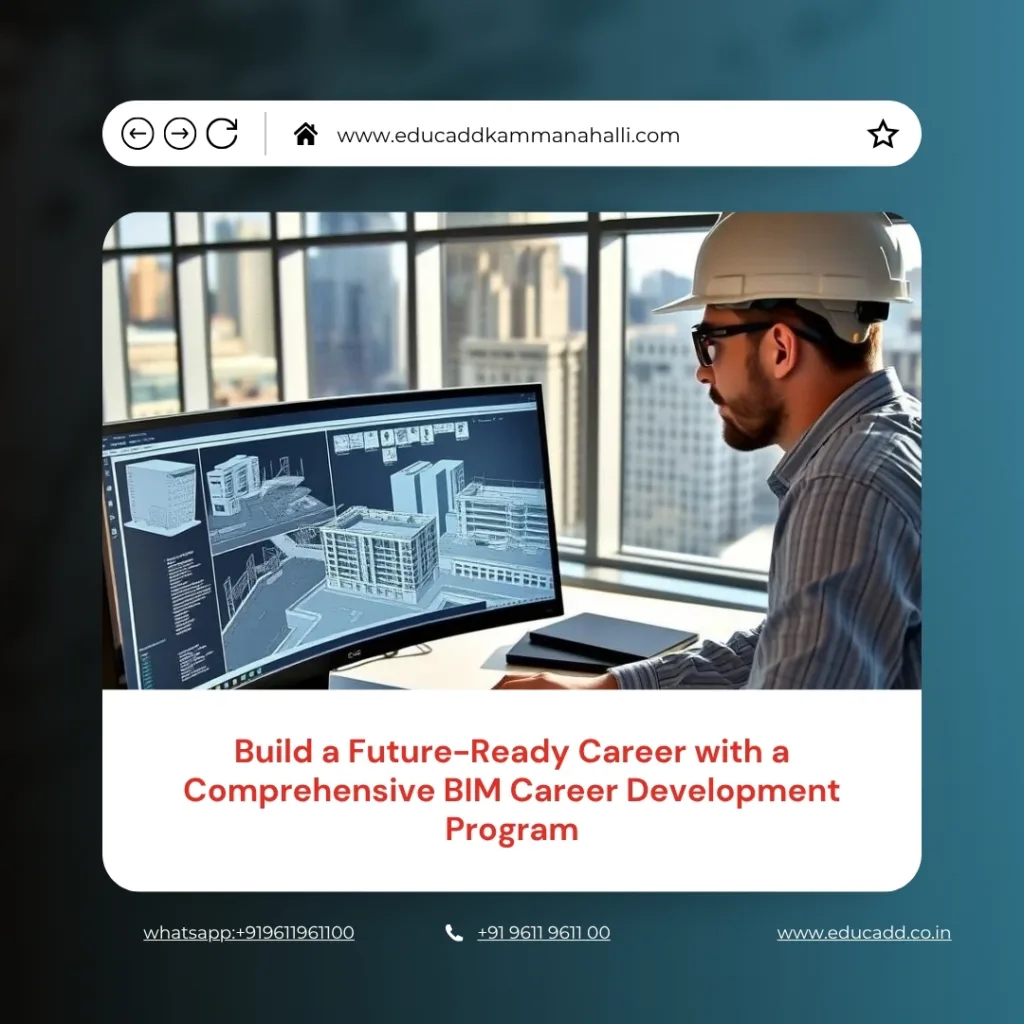
BIM Career Development Program
Whether you are a civil engineer, architect, mechanical engineer, electrical engineer, or interior designer, learning BIM can significantly improve your career prospects. This program combines technical learning with real-world project experience, enabling learners to confidently enter one of the fastest-growing sectors in the engineering and construction industry.
Why BIM Skills Are Transforming the Construction Industry
The global construction industry no longer depends solely on traditional drafting methods. Instead, organizations now rely on intelligent digital models to improve project planning, design, execution, and facility management. Building Information Modeling allows engineers, architects, and contractors to collaborate efficiently by working on a single integrated model. Consequently, project teams can detect clashes, reduce waste, optimize resources, and improve communication throughout every construction phase. Since governments and multinational companies increasingly mandate BIM adoption, professionals with BIM expertise enjoy greater employment opportunities. As a result, learning BIM has become an essential career investment for anyone seeking long-term growth in the AEC (Architecture, Engineering, and Construction) industry.
Understanding What a BIM Career Development Program Offers
A professional BIM Career Development Program goes beyond teaching software applications. Instead, it provides a complete learning journey that develops technical, analytical, and project management skills. Students gain hands-on experience with industry-leading BIM software while understanding international BIM standards, workflows, documentation practices, and project coordination techniques. The curriculum focuses on real construction scenarios that help learners understand how different disciplines work together throughout the project lifecycle. Furthermore, participants develop confidence in handling complex projects while improving their communication and teamwork abilities. This comprehensive approach ensures graduates are prepared for actual workplace responsibilities rather than just theoretical knowledge.
Mastering Industry-Leading BIM Software Applications
One of the strongest advantages of joining a BIM Career Development Program is learning multiple BIM software platforms used by leading construction companies worldwide. Students receive practical training in tools such as Autodesk Revit Architecture, Revit Structure, Revit MEP, Navisworks Manage, Autodesk Construction Cloud, BIM 360, AutoCAD, and Civil 3D depending on their specialization. Each software application plays an important role in creating intelligent 3D models, coordinating multidisciplinary projects, performing clash detection, generating construction documentation, and improving project visualization. Through regular assignments and practical exercises, learners become proficient in using these applications for real engineering projects.
Practical Project-Based Learning Enhances Professional Skills
Learning through live projects creates a significant difference between theoretical education and professional competency. A BIM Career Development Program emphasizes project-based learning that closely resembles actual industry practices. Students work on residential, commercial, industrial, and infrastructure projects while developing detailed BIM models from conceptual design through construction documentation. During these projects, learners understand how different engineering disciplines collaborate effectively to solve practical challenges. Additionally, instructors guide students through industry-standard workflows that improve technical accuracy and project efficiency. This practical exposure strengthens confidence while preparing students for workplace expectations immediately after completing the course.
Career Opportunities After Completing a BIM Career Development Program
The growing adoption of BIM technology has created a wide range of career opportunities across various engineering sectors. Graduates can pursue roles such as BIM Modeler, BIM Coordinator, BIM Engineer, BIM Technician, BIM Consultant, BIM Manager, Design Engineer, Project Coordinator, Quantity Surveyor, Digital Construction Specialist, and VDC Engineer. Construction companies, architectural firms, infrastructure developers, government agencies, and international engineering consultancies actively recruit BIM professionals because digital construction has become an industry standard. Moreover, professionals with strong BIM expertise often receive faster promotions and higher salary packages compared to those with only conventional CAD skills.
Developing Strong Coordination and Collaboration Skills
Technical knowledge alone cannot guarantee career success in the BIM industry. Therefore, a BIM Career Development Program also focuses on improving collaboration and communication skills. BIM projects require architects, structural engineers, mechanical engineers, electrical engineers, plumbing consultants, and contractors to work together efficiently. Students learn how to coordinate multidisciplinary models, identify design conflicts, resolve coordination issues, and maintain effective communication throughout project execution. These collaborative abilities enable professionals to contribute confidently within cross-functional project teams while minimizing errors and project delays.
Learning International BIM Standards and Best Practices
Global construction companies follow established BIM standards to maintain consistency, quality, and project efficiency. Therefore, a quality BIM Career Development Program introduces students to international BIM protocols, ISO standards, naming conventions, documentation procedures, model management strategies, and quality assurance practices. Understanding these standards helps learners work on international projects while maintaining professional consistency across different project environments. Furthermore, employers highly value candidates who already understand standardized BIM workflows because they require less training after recruitment. This knowledge significantly improves employability in both domestic and international markets.
Enhancing Visualization and Design Accuracy
One of the greatest strengths of BIM technology lies in its ability to produce highly detailed three-dimensional models. Unlike traditional two-dimensional drawings, BIM enables project stakeholders to visualize every component before construction begins. Students learn how to create intelligent 3D models, realistic visual presentations, walkthroughs, and construction simulations that improve design understanding. Better visualization allows project teams to identify potential issues earlier, reducing costly modifications during construction. Consequently, professionals who master BIM visualization techniques contribute significantly to improving overall project quality and client satisfaction.
Improving Construction Efficiency Through Clash Detection
Construction projects often face expensive delays because of conflicts between architectural, structural, and MEP systems. A BIM Career Development Program teaches students how to perform effective clash detection using advanced coordination software. By identifying design conflicts before construction starts, engineers can resolve problems early and minimize costly rework. Additionally, students learn how to prepare clash reports, coordinate multidisciplinary meetings, and update BIM models based on project revisions. These valuable skills help organizations save time, reduce material waste, and improve construction productivity while delivering higher-quality projects.
Building a Strong Professional Portfolio
Employers increasingly prefer candidates who can demonstrate practical experience rather than simply listing software knowledge on their resumes. Therefore, a BIM Career Development Program encourages students to develop an impressive professional portfolio showcasing their completed projects. Throughout the training, learners create residential buildings, commercial complexes, industrial facilities, and infrastructure models that reflect their technical capabilities. A well-organized portfolio demonstrates proficiency in BIM workflows, project coordination, documentation, and visualization. Consequently, job seekers gain a competitive advantage during interviews while increasing their chances of securing rewarding career opportunities.
Industry Mentorship and Career Guidance
Professional guidance plays an important role in career development. Many BIM Career Development Programs include mentorship sessions where experienced industry professionals share valuable insights into current market trends, project requirements, interview preparation, and career planning. Students receive personalized feedback on technical assignments while improving their problem-solving abilities through practical discussions. Career guidance also includes resume development, mock interviews, portfolio reviews, and placement assistance that prepare learners for successful employment. These mentoring opportunities bridge the gap between classroom learning and professional industry expectations.
Continuous Learning Keeps BIM Professionals Competitive
Technology continues to evolve rapidly, making continuous learning essential for long-term career success. A BIM Career Development Program encourages learners to stay updated with emerging software features, cloud collaboration platforms, automation tools, digital twins, artificial intelligence integration, and sustainable building technologies. Professionals who continuously upgrade their skills remain highly valuable to employers because they adapt quickly to changing industry demands. Furthermore, lifelong learning opens opportunities for leadership positions, international projects, specialized consulting roles, and advanced certifications that further accelerate career growth.
Why Choosing the Right BIM Training Institute Matters
Selecting a reputable training institute significantly influences your learning experience and career outcomes. A quality BIM Career Development Program provides experienced instructors, industry-focused curriculum, modern computer laboratories, practical assignments, live projects, placement support, and internationally recognized training methodologies. Students benefit from structured learning environments where theory and practical application receive equal importance. Moreover, institutes with strong industry connections often help learners secure internships and job placements through dedicated career support services. Therefore, choosing the right training provider becomes an important investment in building a successful professional future.
Conclusion
The construction industry is embracing digital transformation at an unprecedented pace, making BIM one of the most valuable professional skills for engineers, architects, designers, and construction specialists. A well-designed BIM Career Development Program provides comprehensive technical knowledge, practical project experience, industry-standard workflows, and career-focused training that prepare learners for high-demand roles across the global construction sector. Beyond software proficiency, the program develops collaboration, problem-solving, project coordination, and professional communication skills that employers actively seek. As BIM adoption continues to expand across infrastructure, commercial, residential, and industrial projects, professionals with specialized BIM expertise will enjoy stronger career growth, better salary opportunities, and long-term job stability. Investing in a BIM Career Development Program today is an investment in a future-ready career built on innovation, technology, and continuous professional success.

