
Build a Future-Ready Engineering Career with an Industry-Oriented Mechanical CADD Training Program
Mechanical engineering continues to evolve with modern manufacturing technologies, automation, and digital design tools. As industries increasingly rely on Computer-Aided Design and Drafting (CADD), skilled professionals are becoming more valuable than ever before. An Industry-Oriented Mechanical CADD Training Program bridges the gap between academic knowledge and real-world industrial expectations. It equips students and professionals with practical design skills, software expertise, and project experience that employers actively seek. Whether you are a student, a graduate, or a working professional, the right training program can help you develop technical confidence, improve productivity, and secure rewarding career opportunities across multiple engineering sectors.
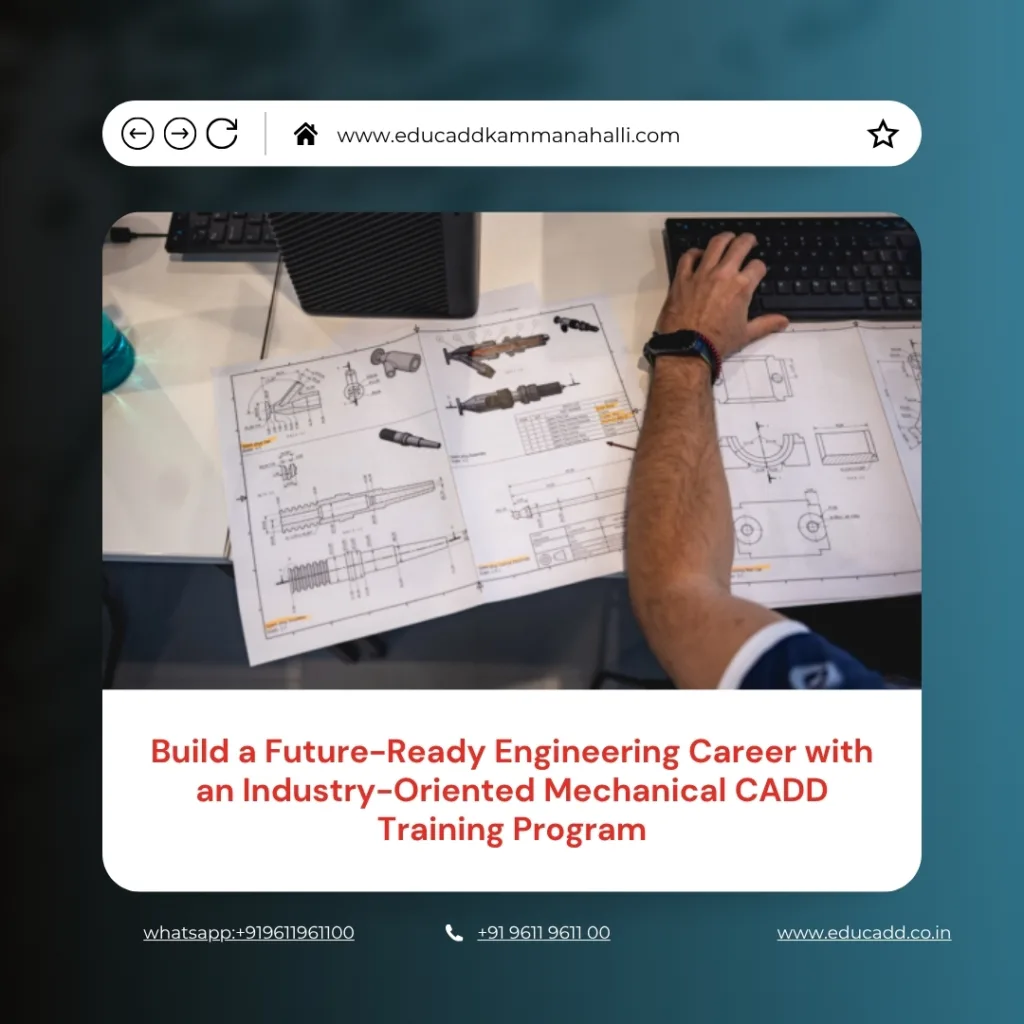
Mechanical CADD Training Program
Why Industry-Oriented Mechanical CADD Training Matters
Engineering industries no longer depend only on theoretical knowledge. Today, employers prefer candidates who understand real project workflows, industry standards, and modern design practices. An Industry-Oriented Mechanical CADD Training Program focuses on practical learning instead of traditional classroom methods. Students work on live projects, create production-ready drawings, and solve engineering design challenges using professional software.
Moreover, this practical approach helps learners understand how engineering companies operate. They become familiar with manufacturing processes, quality standards, documentation methods, and product development cycles. As a result, graduates become job-ready from the very beginning of their careers.
Learn the Most Demanded Mechanical CADD Software
One of the strongest advantages of an industry-oriented program is exposure to globally recognized Mechanical CADD software. Learning multiple design applications expands career opportunities and makes candidates more competitive in the job market.
Students usually receive hands-on training in software such as AutoCAD, SolidWorks, CATIA, Creo, Siemens NX, Autodesk Inventor, and ANSYS. Every application serves a different engineering purpose, ranging from drafting and 3D modeling to simulation and product design.
Instead of learning isolated commands, students complete practical assignments that strengthen their understanding of real engineering applications. Consequently, they gain both technical expertise and confidence while working on industrial projects.
Build Strong Foundations in Mechanical Design
Before creating advanced engineering models, students must understand the core principles of mechanical engineering. Therefore, a quality training program begins with strong design fundamentals.
Learners study engineering drawing standards, orthographic projections, geometric dimensioning and tolerancing (GD&T), material properties, manufacturing processes, machine components, and design calculations. These concepts allow them to create accurate models that satisfy industrial requirements.
Furthermore, mastering these fundamentals helps students avoid design errors and improves their ability to communicate effectively with production teams and design engineers.
Gain Practical Experience Through Real-Time Projects
Practical exposure transforms theoretical knowledge into professional skills. Instead of simply completing software exercises, students work on industry-based projects that closely resemble actual engineering assignments.
They design machine components, create assembly models, prepare production drawings, develop sheet metal parts, and generate bill of materials (BOM). Each project strengthens their technical thinking while improving their design accuracy.
Additionally, project-based learning encourages creativity, problem-solving, and analytical thinking. Employers highly value these abilities because they directly contribute to workplace productivity.
Understand Industry Standards and Engineering Practices
Engineering organizations follow strict international standards while designing mechanical products. Therefore, students must become familiar with these standards during training.
An Industry-Oriented Mechanical CADD Training Program introduces ISO standards, ASME drawing practices, GD&T principles, tolerance analysis, drafting conventions, and manufacturing documentation. Students also learn revision management and engineering documentation techniques.
As they continue practicing these standards, they develop professional habits that prepare them for industrial environments. Consequently, they can contribute effectively from the first day of employment.
Develop Skills Beyond Software Knowledge
Although software proficiency is important, successful engineers require several additional technical and professional skills. Industry-oriented training focuses on complete career development rather than software education alone.
Students improve their communication abilities, presentation skills, teamwork, project planning, and technical documentation. They also learn time management, design validation, engineering ethics, and workplace discipline.
Furthermore, these professional skills improve collaboration across departments and increase confidence during interviews, client meetings, and project discussions.
Learn Manufacturing and Product Development Workflows
Mechanical design does not end after creating a 3D model. Every product follows a structured development process before reaching production. Therefore, understanding manufacturing workflows becomes equally important.
Students explore concept development, prototype creation, design optimization, machining processes, fabrication techniques, quality inspection, assembly planning, and product testing. This complete understanding helps them visualize how every design decision affects manufacturing efficiency.
Moreover, employers appreciate candidates who understand the relationship between design, production, and quality control because they contribute to faster product development.
Prepare for High-Demand Mechanical Engineering Careers
Industries across manufacturing, automotive, aerospace, energy, construction, heavy equipment, consumer products, and industrial automation require Mechanical CADD professionals. Consequently, trained candidates enjoy a wide variety of career options.
Popular job roles include Mechanical Design Engineer, CAD Engineer, Product Design Engineer, Tool Design Engineer, Production Engineer, Design Analyst, HVAC Design Engineer, Piping Designer, Sheet Metal Designer, Maintenance Engineer, and Quality Engineer.
As industries continue adopting digital engineering technologies, the demand for skilled Mechanical CADD professionals continues to grow steadily across both domestic and international markets.
Enhance Employability with Portfolio Development
Employers often evaluate practical work before making hiring decisions. Therefore, building a professional design portfolio significantly improves job prospects.
Throughout the training program, students compile engineering drawings, assembly models, simulation reports, sheet metal designs, machine components, and complete industrial projects into a professional portfolio. This portfolio demonstrates technical competence far better than certificates alone.
Additionally, presenting project work during interviews allows candidates to explain their design approach, software skills, and engineering knowledge with greater confidence.
Learn from Experienced Industry Professionals
Experienced trainers play a major role in shaping successful careers. Industry-oriented institutes employ professionals who possess extensive experience in mechanical design, manufacturing, product development, and industrial engineering.
Their practical knowledge helps students understand current market expectations, common workplace challenges, and effective engineering solutions. Instead of focusing only on textbook concepts, trainers share real industrial case studies that improve practical understanding.
Furthermore, regular interaction with industry experts motivates students to adopt professional engineering practices throughout their careers.
Improve Career Opportunities Across Multiple Industries
Mechanical CADD skills are transferable across numerous engineering sectors. Unlike specialized programs that limit career options, an industry-oriented curriculum opens doors to multiple industries.
Graduates can work in automotive manufacturing, industrial machinery, robotics, HVAC systems, aerospace engineering, oil and gas, renewable energy, medical equipment, construction equipment, consumer electronics, and heavy engineering companies.
Because every manufacturing organization requires accurate engineering designs, skilled Mechanical CADD professionals remain valuable across diverse industrial domains.
Stay Updated with Modern Engineering Technologies
Technology changes rapidly, and engineering professionals must continuously update their knowledge. An effective Mechanical CADD training program introduces students to emerging technologies that influence modern product development.
Learners become familiar with product lifecycle management (PLM), digital manufacturing, finite element analysis (FEA), computer-aided manufacturing (CAM), automation concepts, industrial simulation, additive manufacturing, and digital engineering workflows.
Consequently, students remain competitive in an evolving engineering landscape while preparing themselves for future technological advancements.
Placement Support and Career Guidance
Career support adds significant value to professional training. Many industry-oriented institutes assist students beyond classroom learning by providing placement preparation and interview guidance.
Students receive resume-building assistance, aptitude training, mock interviews, technical interview preparation, personality development sessions, and career counseling. These activities improve confidence while preparing candidates for competitive recruitment processes.
Additionally, placement partnerships with engineering companies increase employment opportunities for deserving candidates. As a result, students transition smoothly from training to professional careers.
Continuous Learning Creates Long-Term Success
Engineering is a lifelong learning profession. Even after completing training, professionals should continue improving their technical knowledge and software expertise.
Successful Mechanical CADD professionals regularly upgrade their skills by learning advanced modeling techniques, simulation software, automation tools, and new manufacturing technologies. They also participate in workshops, certification programs, webinars, and industrial seminars to stay ahead of industry trends.
Therefore, adopting a mindset of continuous improvement ensures long-term career growth, better salary prospects, and greater professional satisfaction in the engineering field.
Conclusion
An Industry-Oriented Mechanical CADD Training Program provides far more than software education. It combines engineering fundamentals, practical project experience, industrial standards, manufacturing knowledge, professional skills, and career preparation into one comprehensive learning journey. Students develop the confidence to design, analyze, and communicate like industry professionals while building a strong portfolio that attracts employers. As engineering industries continue embracing digital transformation, professionals with practical Mechanical CADD expertise will remain in high demand. Choosing an industry-focused training program is not just an educational decision—it is a strategic investment in a successful, future-ready engineering career.

