
Mastering Fluid Flow: A Practical Guide to CFD Basics for Mechanical Engineers
CFD Basics for Engineers has become an essential tool for mechanical engineers who aim to analyze, predict, and optimize fluid flow and heat transfer in complex systems. From aerospace and automotive industries to HVAC and energy sectors, CFD plays a critical role in enhancing design efficiency and reducing development costs. By simulating real-world conditions in a virtual environment, engineers can evaluate multiple scenarios without the need for extensive physical testing.
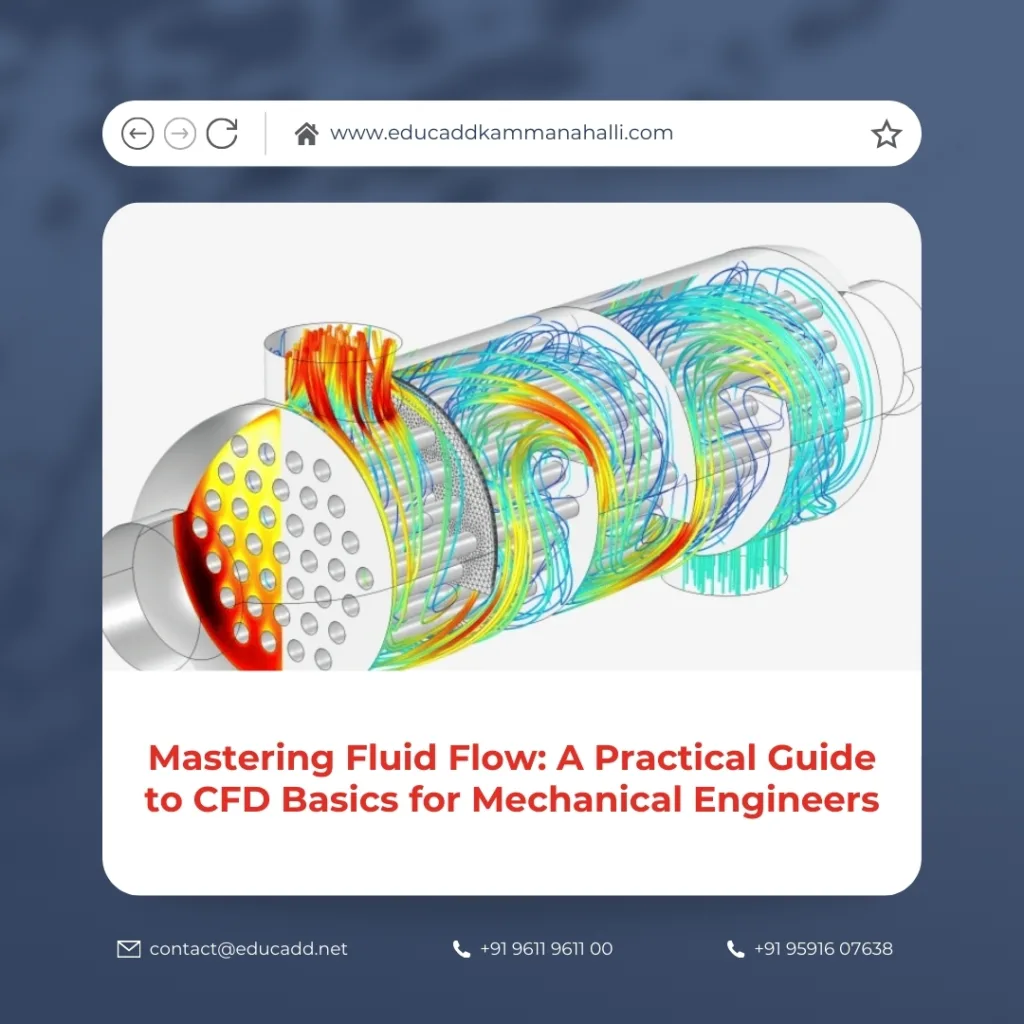
CFD Basics for Engineers
Understanding the fundamentals of CFD is crucial for anyone entering this field or looking to strengthen their analytical capabilities. This guide provides a structured and comprehensive overview of CFD basics, tailored specifically for mechanical engineers. It focuses on key principles, methodologies, and practical applications, ensuring clarity while maintaining technical depth.
1. Understanding the Concept of CFD
CFD Basics for Engineers is a branch of fluid mechanics that uses numerical methods and algorithms to analyze fluid flow behavior. Instead of solving equations manually, CFD relies on computer simulations to predict how fluids move and interact with surfaces.
Engineers use CFD to model complex phenomena such as turbulence, heat transfer, and multiphase flows. The process involves dividing a physical domain into smaller elements and solving governing equations at each point. As a result, engineers gain insights into pressure distribution, velocity profiles, and temperature variations.
2. Importance of CFD in Mechanical Engineering
CFD has revolutionized mechanical engineering by enabling faster and more cost-effective design processes. Traditional experimental methods often require expensive prototypes and long testing cycles, whereas CFD provides rapid insights with high accuracy.
Moreover, CFD enhances innovation by allowing engineers to explore unconventional designs. It also improves product performance by identifying inefficiencies early in the design stage. Consequently, industries can achieve better reliability and reduced operational costs.
3. Governing Equations of Fluid Flow
At the core of CFD Basics for Engineers are the fundamental equations that describe fluid behavior. These include the continuity equation, momentum equations (Navier-Stokes), and energy equation. Together, they represent conservation of mass, momentum, and energy.
These equations are highly complex and often nonlinear. Therefore, they cannot be solved analytically for most real-world problems. CFD transforms these equations into algebraic forms that computers can solve numerically, making complex simulations feasible.
4. Discretization Methods in CFD
Discretization is the process of converting continuous equations into discrete forms. This step is essential because computers can only handle numerical data. Common discretization methods include finite difference, finite volume, and finite element methods.
Each method has its advantages and applications. For example, the finite volume method is widely used in CFD due to its conservation properties. Choosing the right method significantly impacts simulation accuracy and computational efficiency.
5. Meshing: The Foundation of Accurate Simulations
Meshing involves dividing the computational domain into smaller elements or cells. The quality of the mesh directly affects the accuracy and stability of the simulation. A finer mesh generally provides more accurate results but increases computational cost.
Engineers must strike a balance between accuracy and efficiency. Proper mesh refinement near boundaries and regions of high gradients is critical. Additionally, structured and unstructured meshes are selected based on geometry complexity.
6. Types of Flow in CFD Analysis
Understanding different types of flow is essential for selecting appropriate models. Flow can be categorized as laminar or turbulent, steady or unsteady, and compressible or incompressible.
-
Laminar flow is smooth and predictable, whereas turbulent flow is chaotic and complex.
-
Steady flow remains constant over time, while unsteady flow changes dynamically.
Recognizing these distinctions helps engineers apply suitable mathematical models and achieve accurate results.
7. Turbulence Modeling in CFD
Turbulence is one of the most challenging aspects of fluid flow simulation. Directly resolving all turbulent scales is computationally expensive, so engineers use turbulence models to approximate behavior.
Popular models include k-epsilon, k-omega, and Large Eddy Simulation (LES). Each model has specific applications depending on the complexity and required accuracy. Selecting the right turbulence model is crucial for reliable predictions.
8. Boundary Conditions and Their Role
Boundary conditions define how the fluid interacts with its surroundings. These include inlet velocity, outlet pressure, wall conditions, and symmetry boundaries.
Incorrect boundary conditions can lead to inaccurate or unstable simulations. Therefore, engineers must carefully define these parameters based on real-world scenarios. Proper boundary setup ensures that the simulation closely represents physical behavior.
9. Solver Types and Their Applications
CFD solvers are algorithms used to compute numerical solutions. They can be broadly classified into pressure-based and density-based solvers.
Pressure-based solvers are commonly used for incompressible flows, while density-based solvers are suitable for compressible flows such as supersonic aerodynamics. Choosing the appropriate solver ensures efficient convergence and accurate results.
10. Convergence and Solution Accuracy
Convergence refers to the process where the solution stabilizes as iterations progress. Engineers monitor residuals, which indicate the error in the solution. A lower residual value generally means better convergence.
-
Residuals should decrease consistently during simulation.
-
Physical quantities like velocity and pressure should stabilize.
Achieving convergence is essential for obtaining reliable results. However, engineers must also validate results to ensure accuracy.
11. Post-Processing and Result Interpretation
Once the simulation is complete, post-processing helps visualize and analyze results. Engineers use graphical tools to study velocity contours, pressure distribution, and temperature fields.
Effective interpretation of results is critical for decision-making. Engineers must identify patterns, detect anomalies, and derive meaningful conclusions. Proper visualization enhances understanding and communication of findings.
12. Applications of CFD in Industry
CFD Basics for Engineers is widely used across various industries due to its versatility. In the automotive sector, it helps optimize aerodynamics and reduce drag. In aerospace, CFD improves lift and fuel efficiency.
Additionally, CFD is used in HVAC design, energy systems, biomedical engineering, and marine applications. Its ability to simulate complex conditions makes it an indispensable tool for modern engineering challenges.
13. Advantages and Limitations of CFD
CFD offers numerous advantages, including reduced testing costs, faster design iterations, and detailed insights into fluid behavior. It allows engineers to test multiple scenarios without physical prototypes.
However, CFD also has limitations. Results depend heavily on assumptions, mesh quality, and model selection. High computational requirements can also be a challenge. Therefore, engineers must use CFD judiciously and validate results with experimental data when possible.
14. Future Trends in CFD Technology
The future of CFD is evolving rapidly with advancements in computing power and artificial intelligence. High-performance computing (HPC) enables faster simulations with greater accuracy.
Moreover, machine learning is being integrated into CFD to improve predictive capabilities. Cloud-based simulations and automation are also gaining popularity, making CFD more accessible to engineers worldwide. These advancements will continue to enhance the role of CFD in engineering design.
Conclusion
CFD Basics for Engineers has transformed the way mechanical engineers approach fluid flow and heat transfer problems. By combining mathematical modeling, numerical methods, and computational power, it enables detailed analysis of complex systems that would otherwise be difficult to study. Understanding the basics of CFD—from governing equations to post-processing—is essential for leveraging its full potential.
While CFD provides powerful insights, it must be used with a clear understanding of its assumptions and limitations. Engineers who master these fundamentals can significantly improve design efficiency, reduce costs, and drive innovation across industries. As technology continues to advance, CFD will remain a cornerstone of modern engineering, offering even greater possibilities for simulation and optimization.

