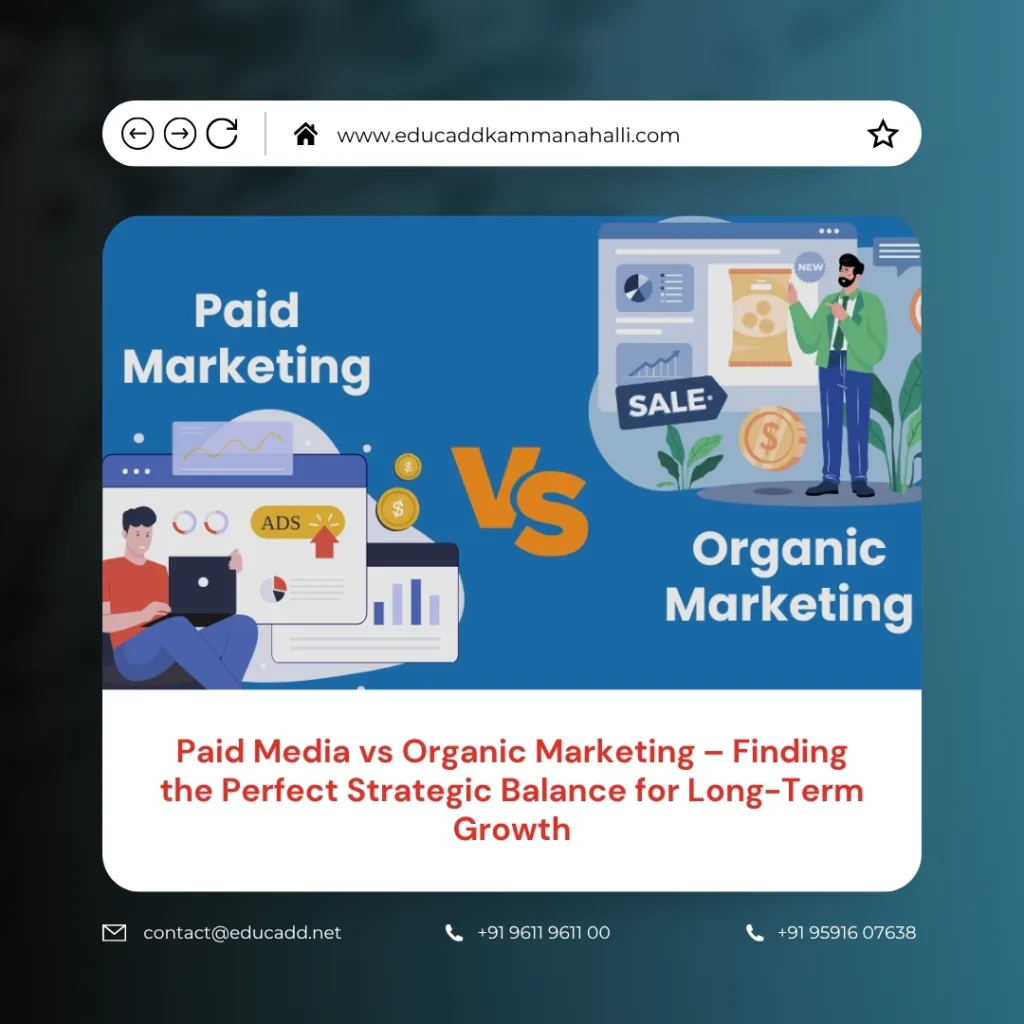
Paid Media vs Organic Marketing – Finding the Perfect Strategic Balance for Long-Term Growth
Modern businesses compete in a fast-moving digital world where visibility decides success. Every brand wants stronger engagement, qualified leads, and better conversions. However, many companies struggle with one important question: should they invest more in Paid Media Organic Marketing? While some brands depend heavily on advertisements, others believe organic reach creates stronger trust and sustainable growth. In reality, successful businesses rarely choose only one path. Instead, they create a strategic balance between both approaches.
Paid media delivers immediate traffic, fast visibility, and quick campaign results. On the other hand, organic marketing builds authority, customer trust, and long-term brand value. Businesses that understand how these two strategies complement each other often gain a competitive advantage. They attract customers faster while also creating sustainable growth channels that continue producing results over time.
Moreover, digital platforms continue to evolve rapidly. Search engine algorithms change frequently, social media competition increases daily, and customer behavior keeps shifting. Therefore, relying completely on a single marketing approach creates unnecessary risks. A balanced strategy allows businesses to remain adaptable, visible, and profitable in different market conditions.
Paid Media Organic Marketing
This blog explores the difference between Paid Media Organic Marketing, their advantages, challenges, and the smartest ways to combine both methods. By understanding the strategic balance between these two powerful marketing approaches, businesses can improve brand awareness, generate quality leads, and create long-term digital success.
Understanding the Core Concept of Paid Media
Paid media refers to any marketing activity where businesses spend money to promote products, services, or content. This includes search engine ads, display advertising, sponsored social media posts, influencer collaborations, video ads, and retargeting campaigns. Businesses use paid media because it offers immediate visibility to targeted audiences.
One of the biggest advantages of paid advertising is speed. A company can launch a campaign today and start generating website traffic within hours. Platforms like Google, Meta, and LinkedIn provide advanced targeting options that help brands reach specific audiences based on demographics, interests, online behavior, and location.
Additionally, paid media supports measurable marketing performance. Businesses can track clicks, impressions, conversions, and customer acquisition costs in real time. As a result, marketers can optimize campaigns quickly for better results. However, paid advertising requires continuous spending. Once the campaign budget stops, visibility usually disappears immediately.
Therefore, businesses should view paid media as a growth accelerator rather than a complete long-term solution. When used strategically, it creates momentum that supports larger marketing objectives.
The Real Power Behind Organic Marketing
Organic marketing focuses on attracting audiences naturally without direct advertising payments. This strategy includes search engine optimization, content marketing, blogging, social media engagement, email marketing, and community building. Unlike paid media, organic marketing aims to build trust and credibility over time.
Customers often trust organic content more because it feels informative rather than promotional. For example, when a business publishes helpful blogs, educational videos, or insightful social media content, audiences begin to see the brand as an industry authority. Consequently, stronger customer relationships develop naturally.
Organic marketing also improves long-term visibility in search engines. Businesses that consistently produce valuable content often rank higher on search engine results pages. This creates continuous traffic without paying for every visitor. Moreover, strong organic visibility reduces dependency on advertising budgets.
Key strengths of organic marketing include:
- Builds long-term customer trust and authority
- Generates sustainable website traffic over time
Although organic growth takes patience, the long-term rewards can be significant. Businesses that invest consistently in organic strategies often develop stronger customer loyalty and better brand recognition.
Why Businesses Depend on Paid Media for Quick Growth
Many businesses choose paid media because they need immediate results. Startups launching new products, companies entering competitive markets, and brands promoting seasonal offers often require fast visibility. Paid campaigns help them generate awareness quickly and reach customers before competitors do.
Furthermore, paid media provides exceptional targeting precision. Businesses can display advertisements to users based on age, interests, profession, browsing behavior, purchase intent, and even previous interactions with the brand. This level of targeting improves campaign efficiency and increases conversion potential.
Paid advertising also supports rapid testing. Marketers can test multiple headlines, creatives, audience segments, and offers simultaneously. As a result, businesses identify high-performing strategies faster. This flexibility helps brands optimize marketing budgets more effectively.
However, businesses should avoid overdependence on advertising alone. Rising advertising costs and increasing competition can reduce profitability over time. Therefore, combining paid campaigns with strong organic marketing creates better long-term stability.
Organic Marketing Creates Long-Term Brand Authority
While paid media delivers immediate visibility, organic marketing builds long-term brand authority. Customers often research brands before making purchase decisions. During this process, they look for blogs, reviews, social proof, educational videos, and informative content. Organic marketing supports all these touchpoints.
High-quality content also improves search engine rankings. When businesses consistently publish optimized and valuable content, search engines reward them with higher visibility. Over time, this generates recurring traffic without constant advertising costs.
Moreover, organic engagement strengthens customer relationships. Social media conversations, blog comments, and email newsletters encourage direct interaction with audiences. This creates trust, which strongly influences buying behavior.
Organic marketing also supports brand storytelling. Businesses can communicate their mission, expertise, and values more effectively through informative content rather than promotional advertisements. Consequently, customers feel more emotionally connected to the brand.
Companies that invest in organic strategies usually develop stronger market positioning because audiences remember educational value more than temporary advertisements.
The Cost Difference Between Paid Media Organic Marketing
Budget considerations strongly influence marketing decisions. Paid media often requires continuous investment because visibility depends on advertising spend. Larger budgets usually produce faster results, broader reach, and stronger campaign frequency. However, smaller businesses may struggle to sustain long-term advertising expenses.
Organic marketing requires investment too, but the spending structure differs significantly. Instead of paying directly for visibility, businesses invest in content creation, SEO optimization, website development, and audience engagement. Although organic strategies take more time, the long-term cost efficiency becomes highly attractive.
For example, a well-optimized blog can continue attracting visitors for several years after publication. In contrast, paid advertisements stop generating traffic once campaigns end. Therefore, organic marketing often produces stronger long-term returns on investment.
Still, businesses should not treat paid and organic strategies as competitors. Instead, they should view them as complementary investments that serve different business objectives at different stages of growth.
How Customer Trust Differs Between Both Approaches
Customer trust plays a major role in digital marketing success. Organic marketing generally creates stronger trust because audiences perceive educational content as more authentic. Informative blogs, tutorials, and social engagement help businesses appear knowledgeable and customer-focused.
In contrast, paid advertisements sometimes create skepticism because users know businesses are paying for visibility. However, this does not mean paid media lacks value. Well-designed advertising campaigns still create strong brand awareness and can influence purchasing decisions effectively.
The key difference lies in audience perception. Organic content nurtures relationships gradually, while paid media captures attention quickly. Businesses that combine both approaches successfully often use paid campaigns to attract audiences and organic content to build trust afterward.
Effective trust-building strategies include:
- Publishing educational and problem-solving content regularly
- Using paid campaigns to promote valuable content instead of direct sales only
This balanced approach creates stronger customer confidence and improves long-term conversion rates.
SEO and Paid Advertising Must Work Together
Many businesses mistakenly separate search engine optimization from paid advertising. However, these strategies perform best when integrated together. SEO helps businesses gain sustainable rankings, while paid search advertising provides immediate keyword visibility.
For example, businesses can use paid campaigns to identify high-converting keywords quickly. Later, they can optimize organic content around those same keywords for long-term rankings. This creates a highly efficient marketing ecosystem.
Additionally, paid ads can support content distribution. Businesses often promote blogs, guides, webinars, and case studies through paid campaigns to increase reach and engagement. Consequently, organic content gains more visibility and backlink opportunities.
SEO also improves paid campaign performance indirectly. Strong landing pages, quality content, and optimized user experiences contribute to better ad quality scores, which can reduce advertising costs.
Therefore, businesses should align their SEO and paid media teams instead of treating them as separate departments.
Social Media Strategy Requires Both Paid and Organic Reach
Social media platforms have become highly competitive. Organic reach alone often struggles to achieve large-scale visibility because platform algorithms prioritize engaging and sponsored content. Therefore, businesses increasingly combine organic posting with paid social campaigns.
Organic social media helps brands maintain relationships with followers. Businesses can share updates, educational content, testimonials, and behind-the-scenes insights. This keeps audiences engaged consistently.
Meanwhile, paid social media expands reach significantly. Businesses can promote content to targeted users who may never discover the brand organically. Platforms like Instagram, Facebook, and YouTube allow advanced audience targeting for better campaign effectiveness.
Moreover, combining both approaches improves brand consistency. Paid campaigns attract attention, while organic content nurtures relationships and maintains engagement over time.
Measuring Success Across Both Marketing Channels
Effective marketing requires accurate performance measurement. Paid media offers detailed metrics immediately. Businesses can track impressions, click-through rates, conversions, cost per click, and return on ad spend with precision.
Organic marketing measurement takes longer but remains equally important. Metrics such as organic traffic growth, keyword rankings, content engagement, backlinks, and audience retention help businesses evaluate long-term success.
However, marketers should avoid measuring both channels using identical expectations. Paid campaigns often generate quick conversions, while organic marketing builds gradual momentum. Therefore, businesses must establish separate performance goals for each strategy.
Additionally, attribution modeling becomes essential. Many customers interact with multiple marketing touchpoints before making decisions. For instance, a customer may first discover a business through a paid ad but later convert after reading organic blog content.
Understanding this customer journey helps businesses allocate marketing budgets more intelligently.
Small Businesses Need a Balanced Marketing Strategy
Small businesses often face limited budgets, making marketing decisions more challenging. Some invest entirely in paid advertising expecting immediate sales, while others depend only on organic marketing to save money. Unfortunately, both extremes create limitations.
A balanced strategy usually works best for smaller companies. Businesses can use paid media selectively for product launches, promotions, and lead generation campaigns. Simultaneously, they should build strong organic foundations through content marketing and SEO.
This combination supports both short-term and long-term growth objectives. Paid campaigns create visibility quickly, while organic marketing reduces future customer acquisition costs.
Furthermore, small businesses can compete effectively by focusing on niche expertise. Educational content, local SEO, and community engagement often help smaller brands outperform larger competitors in specific markets.
Strategic consistency matters more than massive budgets in digital marketing success.
Content Marketing Connects Paid and Organic Efforts
Content marketing acts as a bridge between paid media and organic marketing. Businesses create valuable content not only for SEO but also for advertising campaigns, social engagement, and lead nurturing.
For example, a company may publish a detailed industry guide organically while simultaneously promoting it through paid campaigns. This increases traffic, engagement, and authority simultaneously.
Additionally, strong content improves advertising performance. Valuable content keeps users engaged longer, reduces bounce rates, and increases trust. Consequently, conversion rates often improve.
Video marketing also supports both strategies effectively. Educational videos perform well organically on search engines and social media while also serving as powerful advertising assets.
Therefore, businesses should prioritize high-quality content creation because it strengthens every digital marketing channel simultaneously.
The Importance of Audience Retargeting
Retargeting represents one of the most effective ways to combine paid and organic marketing. Many users visit websites organically but leave without converting. Retargeting campaigns help businesses reconnect with those visitors later through personalized advertisements.
This strategy improves conversion rates because audiences already recognize the brand. Instead of targeting cold audiences repeatedly, businesses focus on users who already showed interest.
Retargeting also supports customer journey progression. Businesses can display different messages depending on user behavior. For instance, a visitor who reads a blog may later see a product-focused advertisement.
Moreover, retargeting maximizes the value of organic traffic. Businesses invest significant time creating SEO content and social engagement. Retargeting ensures that traffic receives additional conversion opportunities.
As digital competition increases, retargeting continues becoming an essential part of integrated marketing strategies.
Common Mistakes Businesses Make
Many businesses fail because they misunderstand the relationship between paid and organic marketing. Some expect organic SEO to produce instant results, while others rely excessively on advertising without building long-term authority.
Another common mistake involves inconsistent branding. Businesses often create disconnected messaging between paid ads and organic content. This confuses audiences and weakens customer trust.
Additionally, companies sometimes focus only on vanity metrics such as likes, impressions, or followers. While these metrics matter, conversions and customer relationships remain more important.
Poor content quality also creates major problems. Businesses that publish low-value content rarely achieve strong organic rankings or successful advertising results.
To avoid these mistakes, businesses should focus on strategy alignment, audience understanding, and consistent value creation across all marketing channels.
Future Trends in Paid and Organic Marketing
Digital marketing continues evolving rapidly. Artificial intelligence, automation, voice search, and personalized experiences are shaping the future of both paid media and organic marketing.
Paid advertising platforms increasingly use AI-driven optimization for audience targeting and campaign management. Meanwhile, organic marketing emphasizes expertise, authenticity, and user-focused content more than ever before.
Video content continues growing rapidly across both channels. Short-form videos, live streaming, and interactive content increasingly influence customer engagement.
Additionally, privacy regulations and changing data policies are transforming digital advertising strategies. Businesses must adapt by building stronger first-party customer relationships through email marketing, communities, and valuable content experiences.
Brands that remain flexible and integrate paid and organic efforts strategically will likely achieve stronger long-term success in the evolving digital landscape.
Conclusion
The debate between Paid Media Organic Marketing should never focus on choosing one over the other. Both strategies offer unique advantages that support different stages of business growth. Paid media provides speed, targeted visibility, and rapid campaign scalability. Organic marketing builds trust, authority, and sustainable long-term traffic.
Businesses that depend entirely on paid advertising often struggle with rising acquisition costs. At the same time, brands relying only on organic growth may lose opportunities for faster expansion. Therefore, the smartest approach involves balancing both methods strategically.
A successful digital marketing strategy combines immediate visibility with long-term relationship building. Paid campaigns can attract new audiences quickly, while organic marketing nurtures trust and loyalty over time. Together, they create a stronger, more resilient marketing ecosystem.
Ultimately, businesses that align paid and organic strategies effectively position themselves for consistent growth, stronger customer engagement, and lasting digital success.

